


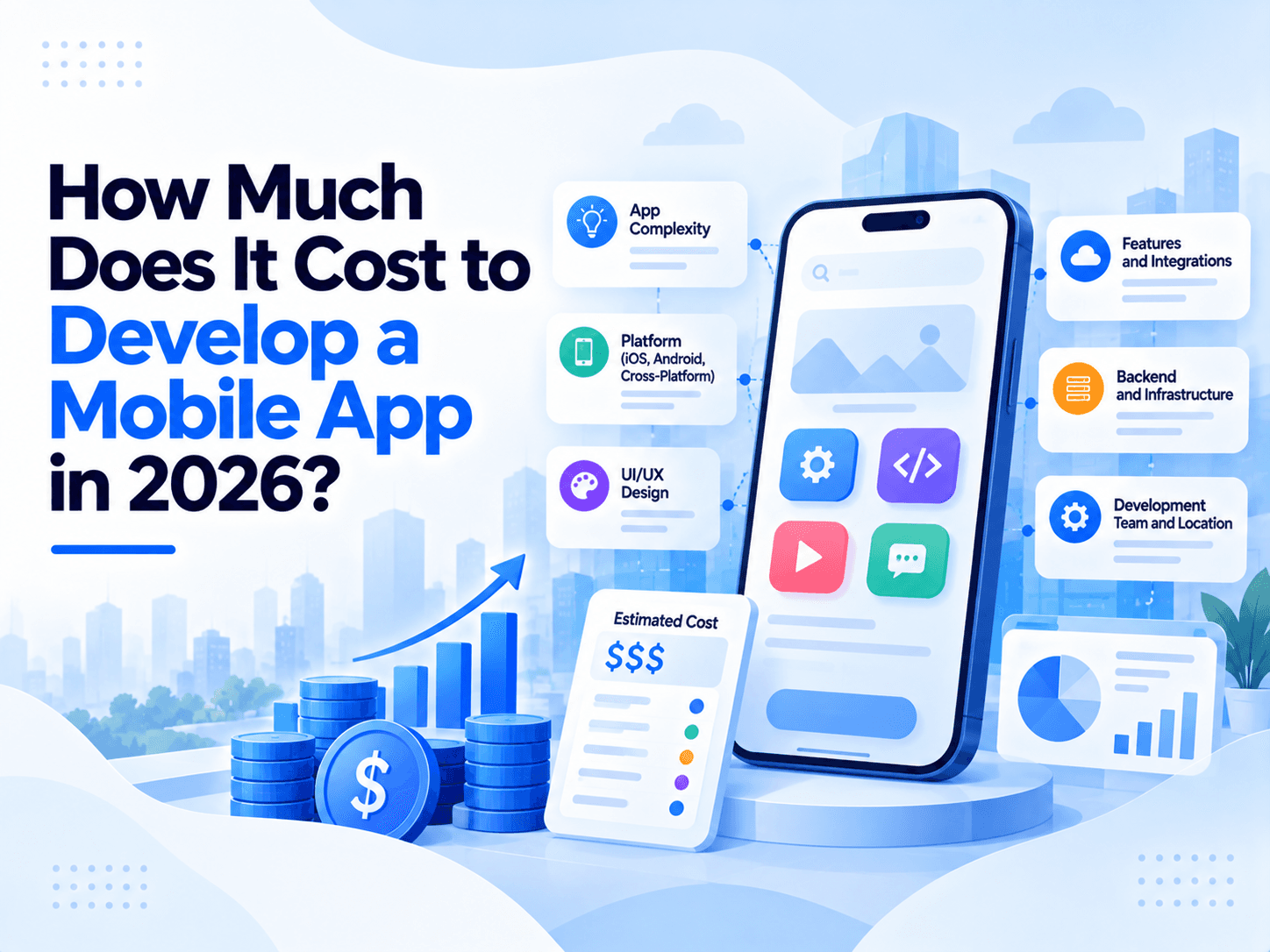
Quick Summary :- Mobile app development costs in 2026 vary according to app complexity, features, technology, and platform. In India, basic applications may cost a few lakh rupees, medium-complexity apps may require ₹8 lakh–₹25 lakh, and complex or enterprise platforms can cost significantly more. Understanding feature requirements, maintenance expenses, and technology choices helps businesses plan a realistic budget.
Developing a mobile app in 2026 can cost anywhere from a few lakh rupees to several crores, depending on the app's features, complexity, technology stack, security requirements, and development team. A simple application with basic functionality requires a much smaller investment than a sophisticated platform with real-time tracking, payment processing, artificial intelligence, and multiple user roles.
For businesses planning to invest in mobile technology, understanding the cost of mobile app development is an important first step. A realistic budget helps organizations choose the right features, select an appropriate development approach, and avoid unexpected expenses after launch.
According to Clutch's mobile app development pricing guide, updated in September 2026, most app development projects reviewed on its platform fall between $10,000 and $49,999, while its reported average project cost is approximately $90,780. These figures represent Clutch's global project data rather than a universal price for every mobile application.
In India, the budget can be considerably different depending on the development partner and project scope. Recent Indian app development cost estimates suggest that simple applications may cost approximately ₹3 lakh–₹8 lakh, medium-complexity applications ₹8 lakh–₹25 lakh, and complex applications ₹25 lakh or more.
This guide explains mobile app development costs in 2026, including pricing by complexity, features, platform, development approach, maintenance, and industry. It also explores practical ways to reduce expenses without compromising the quality or long-term value of your application.
Quick Summary: Mobile App Development Cost in 2026
The total investment depends on the functionality your business needs and the amount of engineering required to deliver it. The following ranges are indicative planning estimates for projects developed in India, not fixed market prices or guaranteed quotations.
App complexity | Estimated development cost | Typical functionality |
Basic app | ₹1.5 lakh–₹5 lakh | Informational screens, forms, simple navigation |
Small business app | ₹3 lakh–₹8 lakh | User accounts, service listings, basic backend |
Medium-complexity app | ₹8 lakh–₹25 lakh | Payments, admin dashboard, APIs, notifications |
Complex application | ₹25 lakh–₹50 lakh+ | Real-time features, multiple roles, advanced integrations |
Enterprise platform | ₹50 lakh–₹2 crore+ | Large-scale infrastructure, complex workflows, compliance |
These ranges are informed by published 2026 Indian app development estimates and Bright Infonet's pricing guide. Actual quotations vary with the team, deliverables, quality requirements, integrations, and commercial arrangements.
A useful starting point is to distinguish between the cost of building the initial product and the cost of operating it. Hosting, security updates, monitoring, third-party services, and ongoing maintenance can continue long after the development team has delivered the first release.
1. What Determines the Cost of Mobile App Development?
There is no single price for developing a mobile application because two products with a similar number of screens can require very different levels of engineering.
For example, a basic appointment-booking application may display available time slots and collect customer information. A more advanced booking platform may require real-time availability, payment processing, cancellations, automated reminders, staff scheduling, and integration with an existing business management system.
The second application requires more development, testing, and ongoing support.
App complexity and functionality
The number of features is an important cost factor, but the complexity of each feature matters just as much.
A simple profile screen is relatively straightforward. A secure profile system with role-based access, document uploads, verification, and account recovery requires considerably more work.
Before estimating costs, businesses should identify their essential features and separate them from optional enhancements.
User interface and user experience design
Design costs depend on the number of screens, the complexity of user journeys, branding requirements, animations, and accessibility needs.
A standard interface built from reusable components generally requires less effort than a highly customized interface with interactive dashboards, advanced visual effects, and extensive personalization.
Good design is not simply about appearance. Clear navigation and predictable interactions can make an application easier to use and maintain.
Backend development and APIs
The backend manages data, business rules, authentication, integrations, and communication between the application and its server.
An application that mainly displays static information may require limited backend functionality. A marketplace, healthcare platform, or delivery application may need several interconnected services, databases, permissions, and background processes.
These requirements can substantially increase development time and infrastructure costs.
Security and compliance
Applications that handle financial transactions, personal information, medical records, or confidential business data require additional safeguards.
Security-related work can include encryption, access controls, secure authentication, audit logs, vulnerability testing, and data retention policies. Applications operating in regulated industries may also require specialist compliance reviews.
Security should be included in the initial budget rather than treated as an optional feature to add after launch.
2. Mobile App Development Cost by Complexity
The following table provides a more detailed breakdown of typical project scope, cost, and development timelines in India.
Application type | Estimated cost | Indicative timeline |
Basic informational app | ₹1.5 lakh–₹4 lakh | 3–6 weeks |
Simple MVP | ₹3 lakh–₹8 lakh | 6–10 weeks |
Standard business app | ₹8 lakh–₹15 lakh | 2–4 months |
Advanced business app | ₹15 lakh–₹30 lakh | 3–6 months |
Complex marketplace or platform | ₹25 lakh–₹50 lakh+ | 5–9 months |
Enterprise-grade application | ₹50 lakh–₹2 crore+ | 6–12 months or longer |
Cost and timeline figures are illustrative planning ranges, not a published industry-wide dataset. They assume a defined scope and a development team with the appropriate skills. Some projects can take significantly longer.
Basic mobile applications
A basic application may contain informational pages, contact forms, simple navigation, and links to external services.
Typical examples include a small business catalogue, a restaurant information app, or a basic company application.
Costs increase when the project requires a custom content management system, user accounts, complex animations, or integrations with existing software.
Minimum viable products (MVPs)
An MVP is an initial product designed to test a business idea with a limited but useful set of features.
For example, a startup developing a food delivery platform might begin with customer registration, restaurant listings, order placement, and a simple administrative interface. Advanced loyalty programs and sophisticated recommendations can be introduced later.
An MVP allows businesses to validate important assumptions before committing to a much larger investment.
Medium-complexity applications
These applications typically include user authentication, database integration, payment processing, notifications, and an administrative dashboard.
Examples include fitness applications, appointment-booking systems, educational platforms, and small e-commerce businesses.
The cost depends on how these components interact and whether the business needs separate applications or interfaces for customers, staff, and administrators.
Complex and enterprise applications
Enterprise-grade applications may support large user populations, multiple departments, advanced reporting, custom integrations, and strict security requirements.
For example, a logistics platform may require live vehicle tracking, route optimization, driver management, delivery verification, and integration with enterprise resource planning software.
These applications need more extensive architecture planning, testing, deployment controls, and operational monitoring.
3. Visual Chart: Estimated App Development Costs
The following chart compares representative planning budgets for different application types. The figures are illustrative midpoints selected from the cost ranges above, not measured industry averages.
Estimated initial development budget in India (₹ lakh)
App category | Representative budget |
Basic app | ₹3 lakh |
MVP | ₹5.5 lakh |
Business app | ₹12 lakh |
Advanced app | ₹22 lakh |
Complex platform | ₹37.5 lakh |
Enterprise app | ₹75 lakh |
The enterprise example uses ₹75 lakh as an illustrative budget within the broader enterprise range. The chart compares selected budgets, not the minimum and maximum prices available in the market.
The comparison demonstrates why businesses should define the intended scope before requesting a quotation. A basic app and an enterprise platform should not be evaluated using the same assumptions.
4. Mobile App Development Cost by Feature
Features often have a greater effect on development cost than the visual design alone. Some features are relatively simple to implement, while others require complex business logic, external services, security controls, and additional testing.
The following estimates represent illustrative incremental costs for adding individual features to an existing application in India.
Feature | Estimated additional cost |
User registration and login | ₹20,000–₹80,000 |
User profile and account settings | ₹15,000–₹60,000 |
Push notifications | ₹15,000–₹50,000 |
Payment gateway integration | ₹30,000–₹1.5 lakh |
Search and filtering | ₹20,000–₹80,000 |
Maps and location services | ₹40,000–₹2 lakh |
Real-time chat | ₹75,000–₹3 lakh |
Appointment booking | ₹40,000–₹1.5 lakh |
Admin dashboard | ₹75,000–₹3 lakh |
AI-powered chatbot | ₹75,000–₹5 lakh+ |
Analytics and reporting | ₹30,000–₹1.5 lakh |
These figures are planning estimates rather than standardized market rates. Actual prices depend on feature complexity, third-party services, security needs, custom design, and the amount of backend development required.
For instance, integrating a basic payment provider into an existing backend may be relatively straightforward. Building a payment system with subscriptions, refunds, transaction reconciliation, fraud monitoring, and multiple payment methods requires more extensive work.
Similarly, a simple chatbot using an existing AI service is different from a custom AI assistant that searches internal documents, remembers user preferences, and connects to business systems.
Why feature costs can increase
A feature may look simple from the user's perspective while requiring significant engineering behind the scenes.
Consider a location-based delivery application. Displaying a map is only one part of the implementation. The complete workflow may require location permissions, GPS updates, routing services, driver status management, background processing, and mechanisms for handling network interruptions.
When requesting a quote, businesses should ask developers to describe the functionality included within each feature rather than evaluating estimates by feature names alone.
5. Native vs. Cross-Platform App Development Costs
One of the most important decisions is whether to build separate native applications for Android and iOS or use a cross-platform framework.
Native development typically uses Kotlin or Java for Android and Swift for iOS. Cross-platform development uses technologies such as Flutter or React Native to share a substantial portion of the application code across platforms.
Cost comparison
Development approach | Illustrative cost | Best suited for |
Native Android app | ₹3 lakh–₹15 lakh | Android-focused products |
Native iOS app | ₹4 lakh–₹18 lakh | iOS-focused products |
Separate native Android and iOS apps | ₹7 lakh–₹30 lakh+ | Products needing platform-specific implementations |
Flutter or React Native app | ₹4 lakh–₹20 lakh+ | Products targeting both platforms with shared code |
These ranges are illustrative and overlap because the scope of the application matters more than the framework name alone.
Native app development
Native development provides direct access to platform-specific capabilities and can be useful for applications involving advanced graphics, specialized hardware, or deep operating-system integration.
However, maintaining separate Android and iOS implementations can increase development and testing effort because platform-specific work must be performed for both applications.
Cross-platform development
Flutter and React Native allow teams to reuse a substantial amount of application code.
This can reduce duplicated effort when the same features are required on both platforms. However, cross-platform development does not eliminate all platform-specific work. Certain integrations, native modules, testing requirements, and operating-system features still require specialized implementation.
The best choice depends on performance requirements, team expertise, product complexity, and long-term maintenance plans.
6. Cost of Developing Different Types of Mobile Apps
Industry requirements also influence development budgets. Each application category has its own workflows, integrations, security considerations, and user expectations.
App category | Indicative development cost | Typical features |
E-commerce app | ₹5 lakh–₹25 lakh | Product catalogue, cart, checkout, payments |
Healthcare app | ₹8 lakh–₹40 lakh+ | Patient profiles, appointments, secure records |
Food delivery app | ₹8 lakh–₹30 lakh+ | Restaurant listings, orders, delivery tracking |
Fitness app | ₹4 lakh–₹20 lakh | Activity tracking, goals, subscriptions |
Education app | ₹5 lakh–₹25 lakh | Courses, video lessons, quizzes, progress |
Fintech app | ₹15 lakh–₹75 lakh+ | Authentication, financial integrations, risk controls |
Real estate app | ₹5 lakh–₹20 lakh | Listings, filters, maps, enquiries |
Logistics app | ₹10 lakh–₹40 lakh+ | Fleet tracking, dispatch, delivery management |
These are broad planning estimates, not fixed quotations or statistically measured industry averages. Regulated products and applications with substantial third-party integrations may cost considerably more.
E-commerce applications
An e-commerce app generally requires product listings, search, customer accounts, cart functionality, checkout, payment integration, and order management.
Additional costs may arise from inventory synchronization, personalized recommendations, loyalty programs, multiple sellers, and integration with warehouse systems.
Healthcare applications
Healthcare applications may need appointment scheduling, patient records, teleconsultation, prescription workflows, and secure communication.
The required security, privacy, and regulatory measures depend on the jurisdiction, data involved, and services offered. These requirements should be identified before the development budget is finalized.
Fintech applications
Financial applications can require identity verification, transaction monitoring, secure authentication, audit trails, and integration with financial institutions.
A basic budgeting application is not equivalent to a payment platform or digital banking product. Businesses should define the financial services being offered and obtain appropriate security and compliance guidance before development begins.
Logistics and delivery applications
Logistics applications may involve several interfaces, including those for customers, drivers, dispatch teams, and administrators.
Real-time tracking, route planning, delivery confirmation, offline support, and integration with existing systems can increase the overall project cost.
7. Hidden Costs of Mobile App Development
The initial development quotation is not necessarily the total amount a business will spend.
Some expenses appear during implementation, while others continue after the application has been published. Ignoring these costs can lead to budget overruns or an application that cannot be maintained properly.
Backend hosting and cloud infrastructure
Applications that store user data or process transactions generally require server infrastructure, databases, storage, monitoring, and backups.
A small application may operate with a relatively modest infrastructure budget. A platform with large traffic volumes, frequent API requests, or substantial media storage can require more expensive infrastructure.
Businesses should estimate cloud costs based on expected traffic, data volume, service architecture, and availability requirements rather than choosing a hosting plan solely because it is inexpensive.
Third-party API charges
Many applications depend on external services for maps, messaging, payment processing, analytics, identity verification, or AI functionality.
Some providers offer free usage allowances, but charges may increase as the application grows. Before integrating a service, review its pricing model, rate limits, usage restrictions, and alternatives.
App store account fees
Publishing fees are relatively small compared with engineering costs, but they still belong in the project budget. Apple's official developer membership information lists the standard Apple Developer Program fee at $99 per year, while Google's official Play Console registration guide lists a one-time registration fee of US$25 for a developer account.
These are account fees, not the complete cost of publishing or maintaining an app. Payment processing, taxes, commercial agreements, and other platform requirements may introduce additional expenses.
Testing and quality assurance
Testing should cover functionality, different screen sizes, operating-system versions, accessibility, security, network interruptions, and performance.
Applications that handle payments or sensitive data may need more extensive testing than simple informational applications.
Real-device testing is particularly important because an app that works in a simulator may behave differently on actual devices.
Maintenance and updates
Mobile applications require ongoing work after launch. Operating systems change, dependencies become outdated, security vulnerabilities are discovered, and users request improvements.
Maintenance costs should be planned from the beginning so the business can continue supporting the application after the initial project is completed.
8. How Much Does Mobile App Maintenance Cost Each Year?
Maintenance depends on the application's complexity, architecture, traffic, security requirements, and frequency of updates.
As a preliminary planning guideline, some industry cost guides recommend budgeting approximately 15%–25% of the initial development cost annually for maintenance and related upkeep; the actual amount can be lower or higher depending on the scope of support, as discussed in this 2026 app development cost guide.
For example, if an application costs ₹10 lakh to develop, an annual maintenance allowance of 15%–25% would equal ₹1.5 lakh–₹2.5 lakh.
Example maintenance budget
Initial development cost | 15% annual allowance | 25% annual allowance |
₹5 lakh | ₹75,000 | ₹1.25 lakh |
₹10 lakh | ₹1.5 lakh | ₹2.5 lakh |
₹20 lakh | ₹3 lakh | ₹5 lakh |
₹40 lakh | ₹6 lakh | ₹10 lakh |
These figures are budgeting scenarios, not guaranteed maintenance quotations. Hosting, third-party usage charges, major new features, and extensive infrastructure changes may be billed separately.
Before signing a support agreement, clarify response times, bug-fix coverage, security updates, operating-system compatibility, monitoring, and the number of development hours included.
9. In-House Team vs. Freelancers vs. Development Agency
The team you choose affects both the initial investment and the way the application will be maintained.
In-house development
An in-house team offers direct control over priorities, architecture, and product knowledge. It can be a good option for organizations with continuous development requirements.
However, the business must account for salaries, recruitment, equipment, management, and the time required to build a team with the necessary expertise.
Freelance developers
Freelancers can be suitable for narrowly defined projects, prototypes, or individual components.
The business may need to coordinate multiple specialists for design, backend development, testing, and deployment. It should also establish clear agreements covering source-code ownership, documentation, confidentiality, and support.
Mobile app development agencies
An agency may provide project management, design, development, testing, deployment, and post-launch support under one engagement.
The price depends on the agency's experience, team composition, delivery process, and contractual commitments. Businesses should compare the actual scope of each proposal instead of selecting a provider solely on the lowest price.
Comparison table
Factor | In-house team | Freelancers | Development agency |
Initial hiring effort | High | Low to moderate | Low |
Direct product control | High | Varies | Depends on contract |
Access to multiple specialists | Requires hiring | Requires coordination | Often available |
Long-term internal knowledge | High | Depends on continuity | Depends on documentation |
Best use case | Continuous product development | Defined, limited scope | End-to-end delivery |
There is no universally cheapest approach. The right choice depends on the project's duration, the skills required, the amount of ongoing development, and the business's internal capabilities.
10. How to Reduce Mobile App Development Costs Without Sacrificing Quality
Reducing cost should not mean removing essential security controls or releasing an unreliable product. A better approach is to eliminate unnecessary complexity and spend development resources on the features that deliver the most value.
Start with a clearly defined MVP
Identify the problem the application must solve and select only the features required to test that solution.
For example, a booking application may initially need customer registration, availability, booking confirmation, and an administrative interface. Loyalty programs, advanced analytics, and personalized recommendations can be introduced after the core workflow has been validated.
Prioritize features by business value
Classify proposed features as essential, important, or optional. Estimate their implementation effort and business impact before deciding what belongs in the first release.
This helps avoid spending a large part of the budget on features that customers may rarely use.
Choose the right technology stack
A suitable framework can reduce duplicated work and simplify future maintenance. Cross-platform development may be a sensible choice for many business applications, while native development may be preferable for specialized technical requirements.
The decision should reflect the product's needs rather than the popularity of a particular technology.
Use existing services where appropriate
Managed authentication, established payment providers, cloud databases, and reliable notification services can reduce the amount of infrastructure that must be built from scratch.
However, third-party services should be evaluated for their pricing, reliability, security, and limitations before adoption.
Finalize requirements before development
Frequent changes during development can increase cost because completed work may need to be redesigned, recoded, or retested.
Prepare a clear requirements document, confirm the essential workflows, and agree on acceptance criteria before the team begins implementation.
Invest in testing early
Finding defects before release is generally easier than dealing with widespread failures after customers begin using the application.
Automated tests, code reviews, staged releases, and performance checks help reduce avoidable rework and operational risk.
11. Step-by-Step Process for Creating a Realistic App Budget
A structured estimation process makes it easier to compare proposals and identify missing expenses.
Step 1: Define the business objective. Identify the problem the app solves, its target audience, and the outcome the business expects.
Step 2: List the user roles. Determine whether the application serves customers, administrators, employees, vendors, or other groups.
Step 3: Map the core workflows. Describe how users register, complete tasks, make payments, receive notifications, and manage their accounts.
Step 4: Define integrations. Identify external APIs, payment gateways, databases, existing business systems, and third-party services.
Step 5: Choose the platforms. Decide whether the first release requires Android, iOS, both, or a progressive web application.
Step 6: Estimate design and engineering work. Request separate estimates for discovery, UI/UX, frontend development, backend development, integrations, testing, and deployment.
Step 7: Add operating expenses. Include hosting, monitoring, third-party subscriptions, support, maintenance, and store account fees.
Step 8: Set aside a contingency. For early planning, a contingency of 10%–20% may be useful when requirements or integration risks remain uncertain. This is a planning recommendation, not an industry-wide statistical average.
Step 9: Agree on milestones. Divide delivery into clear stages, with agreed outputs, payment terms, review points, and acceptance criteria.
This approach creates a more reliable budget than estimating costs solely from the number of screens or a general description of the application.
12. Example: Budgeting for a Business Booking App
Consider a business planning a mobile booking application for customers to schedule appointments with service providers.
The initial version includes registration, provider listings, availability, booking confirmation, notifications, a basic administrative dashboard, and a backend.
An illustrative budget could look like this:
Project component | Example budget |
Discovery and requirements | ₹40,000 |
UI/UX design | ₹60,000 |
Mobile frontend development | ₹1,80,000 |
Backend and database | ₹1,50,000 |
Booking and notification integrations | ₹70,000 |
Testing and quality assurance | ₹50,000 |
Deployment and documentation | ₹30,000 |
Illustrative development subtotal | ₹5,80,000 |
Contingency at 15% | ₹87,000 |
Illustrative planned budget | ₹6,67,000 |
The subtotal and planned budget are calculated from the hypothetical line items above; they are not a vendor quotation or an industry average.
This estimate assumes a relatively focused application with a limited set of workflows. Multi-location scheduling, advanced payments, recurring appointments, sophisticated analytics, or multiple independent service-provider apps could increase the cost.
The example also excludes ongoing hosting, support, maintenance, and third-party usage charges. Those expenses should be estimated separately before approving the complete project budget.
13. Common Mistakes to Avoid When Estimating App Development Costs
Several budgeting mistakes can create problems even when the initial quotation appears affordable.
Choosing the lowest quotation without comparing scope: A low price may exclude design, testing, documentation, deployment, or post-launch support.
Ignoring backend requirements: User interfaces need data, business logic, and integrations to function. Underestimating the backend can result in unexpected additional costs.
Treating every feature as equally important: Building too many features before validating the product increases risk and delays launch.
Underestimating security: Authentication, permissions, secure storage, and vulnerability testing should be planned as core requirements.
Ignoring maintenance: An application needs updates and operational support after release, even when no new features are being developed.
Failing to define ownership: Contracts should clarify ownership of source code, design files, documentation, infrastructure accounts, and related intellectual property.
Assuming the first estimate is final: A quotation based on incomplete requirements is necessarily less reliable than one based on a detailed scope, agreed assumptions, and documented exclusions.
14. How to Choose the Right Mobile App Development Partner
Selecting a development partner is an important part of managing the budget because the quality of planning and implementation can affect the total cost over the application's lifetime.
Begin by reviewing relevant projects, technical expertise, delivery processes, and client references. Ask how the team handles changing requirements, testing, security, deployment, and post-launch support.
Request a detailed proposal that separates one-time development expenses from recurring operational costs. The proposal should explain the features included, estimated timeline, technology stack, third-party dependencies, milestones, and conditions that may change the price.
It is also important to confirm how the team will manage source-code repositories, credentials, infrastructure access, documentation, and handover.
For a business comparing several providers, a structured proposal makes it easier to evaluate the real cost of each option rather than relying on the headline quotation alone.
Conclusion
The cost of developing a mobile app in 2026 depends on what the application needs to accomplish, how complex its workflows are, which platforms it supports, and how it will be operated after launch.
For businesses in India, a basic application may require a budget of a few lakh rupees, while a medium-complexity product may cost ₹8 lakh–₹25 lakh. Complex marketplaces, regulated applications, and enterprise platforms can require substantially larger investments. These ranges are useful starting points, but a realistic estimate must be based on the specific project scope.
The most effective way to control mobile app development costs is to define clear requirements, prioritize essential features, choose appropriate technologies, test thoroughly, and account for ongoing maintenance from the beginning.
Whether you are a startup validating an idea or an established business modernizing its digital services, a well-planned budget can help you build an application that meets users' needs and supports long-term business goals.
Frequently Asked Questions
In India, a basic app may cost ₹1.5 lakh–₹5 lakh, while complex applications can cost ₹25 lakh or more.
Simple apps may take a few weeks, while complex applications can require six months or longer.
Costs depend on features and complexity. Cross-platform development may reduce duplicated development work.
A preliminary budget of 15%–25% of the initial development cost annually may be useful, depending on support requirements.
Start with an MVP, prioritize essential features, choose the right technology stack, and plan maintenance and testing early.
12 min read

Dhruv Patel
As CEO of Zyora Global, Dhruv Patel combines technical expertise with business leadership to drive innovation and growth. With experience in software engineering, product development, and emerging technologies, he is dedicated to helping organizations turn ideas into impactful digital solutions that deliver measurable results.