


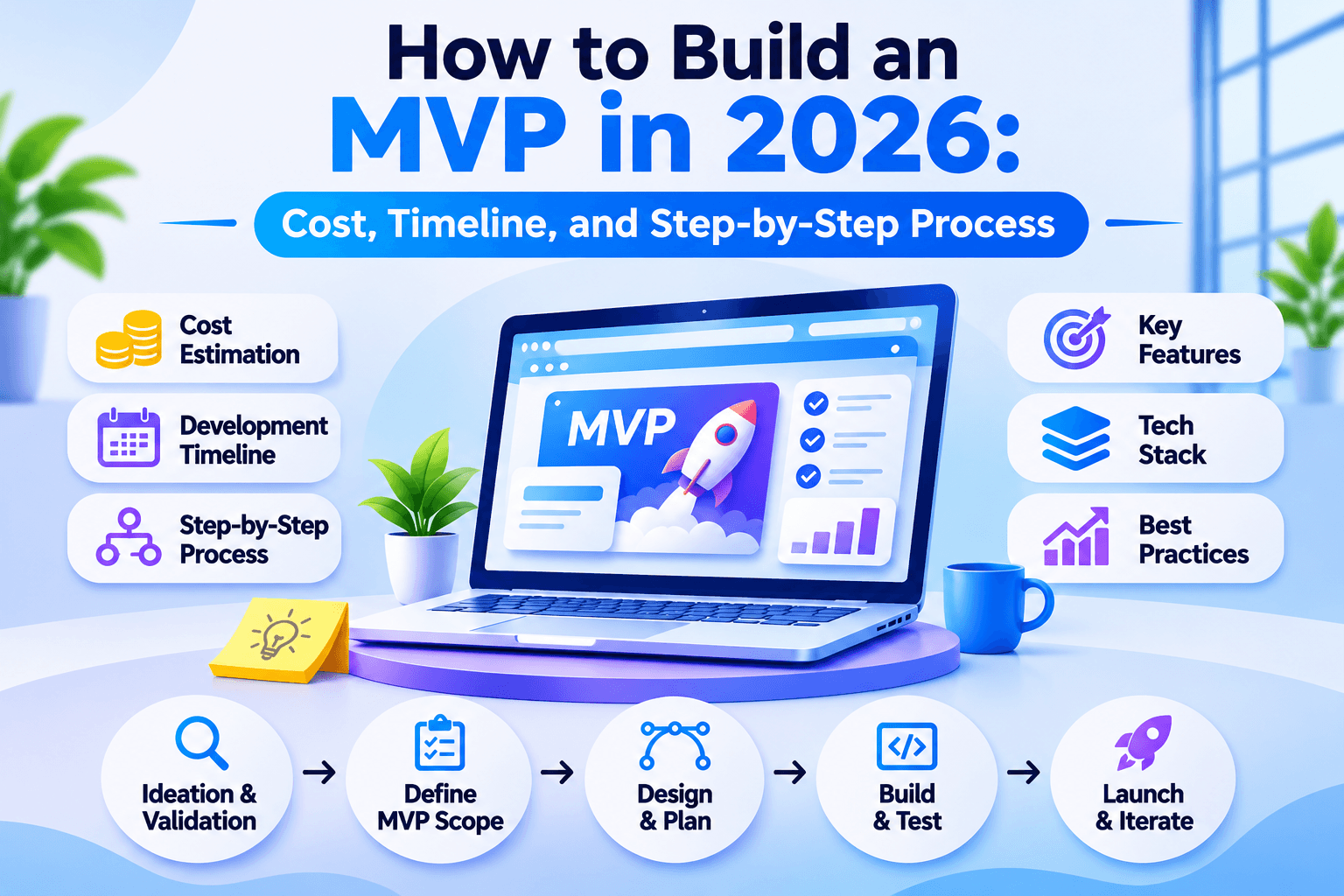
Quick Summary :- Learn how to build a Minimum Viable Product (MVP) in 2026 with this complete guide covering development steps, estimated costs, timelines, technology stacks, AI integration, and best practices. Discover how businesses can validate ideas, reduce development risks, and launch scalable digital products.
Building a successful digital product requires more than an innovative idea. Businesses need to understand their target audience, validate market demand, manage development costs, and deliver a product that solves a genuine problem. However, investing in a fully developed software product before understanding customer needs can create unnecessary financial and technical risks.
This is where a Minimum Viable Product (MVP) becomes valuable.
An MVP allows startups and established businesses to launch a simplified but functional version of their product with essential features. Instead of spending months developing a complete platform, businesses can introduce their core solution, collect feedback from real users, and improve the product based on actual requirements.
In 2026, MVP development is becoming increasingly important as businesses explore AI-powered applications, SaaS platforms, mobile applications, healthcare solutions, and enterprise software.
But how much does it cost to build an MVP? How long does development take? Which features should be included, and what steps should businesses follow?
This guide explains how to build an MVP in 2026, including its development process, estimated costs, timeline, essential technologies, common mistakes, and strategies for launching a successful product.
What Is a Minimum Viable Product (MVP)?
A Minimum Viable Product (MVP) is an early, functional version of a software product that includes only the essential features required to solve a specific customer problem.
The primary purpose of an MVP is to test a business idea with real users before investing heavily in complete product development.
According to Microsoft's guide to Minimum Viable Products, an MVP should deliver real value, support actual users, and generate meaningful product data that helps businesses make informed decisions.
For example, imagine a business wants to develop an online grocery delivery application.
Instead of initially building advanced recommendations, loyalty programs, multiple payment options, and complex delivery automation, the business can start with:
- User registration and login
- Product browsing
- Shopping cart
- Order placement
- Basic payment integration
- Order tracking
These features allow customers to complete the primary shopping journey. Once the business understands customer behaviour and receives feedback, it can introduce additional functionalities.
The objective is not to build an incomplete product. It is to build the smallest useful product that can validate the business idea.
MVP vs. Prototype vs. Full Product
These terms are often used interchangeably, but they represent different stages of product development.
Comparison | Prototype | MVP | Full Product |
Primary purpose | Test an idea or design | Validate market demand | Deliver a complete solution |
Functionality | Limited or simulated | Essential working features | Extensive functionality |
Real users | Usually limited testing | Actual target customers | Wider customer base |
Development cost | Low | Moderate | High |
Development time | Short | Moderate | Longer |
Main outcome | Design and feasibility feedback | Market validation | Business growth |
A prototype helps businesses understand how an idea might work. An MVP takes that idea further by introducing functional capabilities to real users. A full product expands the validated solution with additional features, integrations, and improvements.
Why Should Businesses Build an MVP in 2026?
Businesses are operating in competitive digital markets where customer expectations, technology, and product requirements change quickly. Developing an entire platform without validating its market potential can result in wasted resources.
An MVP provides a more controlled approach to product development.
1. Validate Market Demand Before Full Development
One of the biggest challenges businesses face is determining whether customers actually need their proposed solution.
A product idea may sound promising internally, but that does not guarantee market demand.
A useful warning comes from CB Insights' 2026 analysis of 431 failed VC-backed companies. Poor product-market fit was identified in 43% of the 385 companies for which failure reasons could be identified.
An MVP helps businesses test their assumptions by introducing a working solution to potential customers. Their feedback can reveal whether the product solves a meaningful problem and whether users are willing to adopt it.
2. Reduce Initial Development Costs
Developing a complete software platform requires investment in design, development, testing, infrastructure, and maintenance.
An MVP reduces the initial investment by concentrating development resources on essential functionality.
For example, a healthcare startup planning a complete patient management platform can initially develop patient registration, appointment scheduling, and basic medical record management before investing in advanced analytics and integrations.
3. Collect Real Customer Feedback
Customer feedback is more valuable when it comes from actual product usage.
An MVP allows businesses to understand:
- Which features customers use most frequently
- Where users experience difficulties
- Which workflows need improvement
- What additional functionality customers expect
- Whether users are willing to pay for the solution
These insights help product teams prioritize future development.
4. Launch Faster
Building every planned feature before launch can delay the product's market entry.
An MVP shortens the initial development cycle by reducing unnecessary functionality and focusing on the primary customer journey.
Businesses can introduce their solution earlier, learn from real-world usage, and make improvements through subsequent releases.
5. Attract Investors and Business Partners
A functional MVP can demonstrate that a business has moved beyond an idea.
It provides an opportunity to show potential investors:
- The core product concept
- Working functionality
- Initial user feedback
- Early adoption signals
- Future development opportunities
Although an MVP does not guarantee investment, it can help businesses present stronger evidence when discussing their product vision.
How to Build an MVP in 2026: Step-by-Step Process
Building an MVP requires a structured approach that connects business objectives with customer requirements and technical execution.
Here are eight important steps businesses should follow.
Step 1: Identify the Problem and Target Audience
Every successful MVP begins with a clearly defined problem.
Before selecting technologies or discussing features, businesses must understand who they are building the product for and what problem they want to solve.
Start by answering these questions:
- Who are the potential customers?
- What problems do they currently experience?
- How are they solving those problems?
- What limitations exist in existing solutions?
- Why would customers choose your product?
For example, consider a business planning to develop a project management application.
Its target audience might be small businesses that struggle with task allocation, deadline tracking, and team communication.
Instead of developing a platform for every possible business requirement, the company can focus on solving these specific problems.
Important activities:
- Conduct customer interviews.
- Research competitors.
- Identify customer pain points.
- Create user personas.
- Define the primary product problem.
The outcome should be a clear understanding of the customer and the problem the MVP must solve.
Step 2: Define Your MVP Goals and Value Proposition
Once the problem is identified, the next step is to determine what the product should achieve.
An MVP should have specific objectives rather than a general goal such as launching a new application.
For example, a business may want to:
- Validate demand for a subscription-based service.
- Test whether customers prefer mobile or web access.
- Determine whether users will pay for premium features.
- Validate a new business workflow.
- Test whether AI automation improves an existing process.
Your value proposition should explain why customers should use your product instead of existing alternatives.
A useful framework is:
We help [target audience] solve [specific problem] through [core solution].
For example:
"We help small businesses manage customer relationships through a simple CRM platform that centralizes contacts, sales activities, and follow-ups."
This statement provides direction for feature selection, product design, and development.
Step 3: Research Competitors and Validate Your Idea
Competitor research helps businesses understand the existing market and identify opportunities to differentiate their products.
Analyze competing products based on:
Research Area | What to Evaluate |
Features | Which functionalities do competitors provide? |
Pricing | Are products free, subscription-based, or usage-based? |
User Experience | Is the platform easy to navigate? |
Customer Feedback | What problems do existing users report? |
Integrations | Which third-party services are supported? |
Market Positioning | Which customer segments do competitors target? |
Do not simply copy competitor features.
Instead, identify gaps that your product can address more effectively.
For instance, if existing CRM platforms are too complicated for small businesses, your MVP could focus on a simpler interface and essential sales management workflows.
Step 4: Prioritize Features for Your MVP
Feature prioritization is one of the most important stages of MVP development.
Businesses frequently make the mistake of adding too many features because every stakeholder has different expectations.
However, an MVP should include only the functionality required to deliver its core value.
One useful approach is the MoSCoW prioritization method.
Priority | Meaning | Example |
Must Have | Essential for product functionality | User login and primary workflow |
Should Have | Important but not immediately essential | Email notifications |
Could Have | Useful additional functionality | Advanced filters |
Won't Have | Excluded from the initial release | Complex AI recommendations |
Consider an online learning platform.
Its initial MVP might include:
Must-have features:
- Student registration
- Course listings
- Course enrollment
- Video lessons
- Basic progress tracking
Should-have features:
- Email notifications
- Course search
- Basic instructor dashboard
Could-have features:
- AI-powered course recommendations
- Gamification
- Advanced learning analytics
Won't-have initially:
- Complex social networking
- Multiple subscription tiers
- Advanced automated learning paths
The key is to prioritize functionality that helps users experience the product's primary value.
Step 5: Create Wireframes and UI/UX Designs
Before development begins, businesses should create wireframes and user interface designs.
Wireframes provide a visual representation of how users will interact with the product.
They help product teams understand screen layouts, navigation, and important workflows before investing in coding.
The UI/UX design process generally includes:
- User journey mapping
- Information architecture
- Low-fidelity wireframes
- High-fidelity UI designs
- Interactive prototypes
- Usability testing
For example, a food delivery MVP should make it easy for users to browse restaurants, select food items, place orders, and track deliveries.
The design should focus on clarity and usability rather than unnecessary animations or complicated interactions.
A well-designed interface reduces user confusion and helps businesses collect more meaningful feedback after launch.
Step 6: Choose the Right Technology Stack
Technology selection affects development costs, performance, scalability, and long-term maintenance.
The ideal technology stack depends on the product's requirements, development team, integration needs, and expected growth.
Here are some commonly used technologies for MVP development in 2026.
Technology | Common Use Cases |
React.js | Interactive web applications |
Next.js | Modern web applications and SaaS platforms |
Node.js | Backend development and APIs |
Python | AI, machine learning, and backend services |
Django | Secure and structured web applications |
Flutter | Cross-platform mobile applications |
React Native | iOS and Android applications |
PostgreSQL | Relational database management |
MongoDB | Flexible document-based data storage |
AWS | Cloud infrastructure and deployment |
Firebase | Authentication, databases, and backend services |
How to Select the Right Technology
Consider the following factors before making a decision:
Scalability: Choose technologies that can support expected product growth.
Development speed: Prefer frameworks that help your team build and release features efficiently.
Security: Evaluate authentication, data protection, access control, and compliance requirements.
Integration: Make sure the stack supports the external APIs and services your product needs.
Maintenance: Consider developer availability, documentation, community support, and long-term maintenance costs.
Avoid selecting technologies simply because they are trending. The best technology is the one that supports your product requirements without introducing unnecessary complexity.
Step 7: Develop and Test the MVP
Once the design and technology stack are finalized, development begins.
Most MVP projects use an Agile development approach, where work is divided into smaller iterations or sprints.
A typical development workflow includes:
Frontend Development
The frontend is the part of the product users interact with. Developers build screens, forms, dashboards, navigation, and other user-facing components.
Backend Development
The backend handles business logic, authentication, database operations, API requests, and application functionality.
Database Development
The database stores user accounts, transactions, product information, and other application data.
API Integration
APIs connect the MVP with third-party services such as payment gateways, email platforms, maps, and external applications.
Quality Assurance
Testing helps identify bugs, usability issues, performance problems, and security vulnerabilities before launch.
Important testing activities include:
- Functional testing
- Integration testing
- Security testing
- Performance testing
- Cross-browser testing
- User acceptance testing
Testing should not be postponed until the final development stage. Continuous testing helps identify problems earlier and reduces expensive rework.
Step 8: Launch, Measure, and Improve
Launching an MVP is the beginning of product validation, not the end of development.
Once the product is available to real users, businesses should monitor its performance and collect feedback.
Important MVP metrics include:
Metric | What It Measures |
Acquisition | How users discover the product |
Activation | How many users experience its core value |
Retention | How many users return |
Conversion | How many users become paying customers |
Churn | How many customers stop using the product |
Customer Feedback | How users evaluate the product |
Reliability | How consistently the product works |
Use these insights to identify what should happen next.
Depending on the results, businesses may:
- Improve existing functionality.
- Add frequently requested features.
- Simplify difficult workflows.
- Change pricing or positioning.
- Target a different customer segment.
- Reconsider the original product concept.
An effective MVP development strategy follows a continuous Build-Measure-Learn cycle.
How Much Does It Cost to Build an MVP in 2026?
MVP development costs depend on the product's complexity, number of features, technology stack, development team, integrations, and security requirements.
A simple MVP with a few essential workflows requires less investment than a complex SaaS platform, healthcare application, or AI-powered product.
For businesses working with development teams in India, the following figures are indicative planning estimates rather than fixed industry averages.
Estimated MVP Development Cost by Complexity
MVP Type | Estimated Cost in India | Approximate Timeline |
Basic MVP | ₹3 lakh–₹6 lakh | 4–8 weeks |
Medium Complexity MVP | ₹6 lakh–₹15 lakh | 8–14 weeks |
Advanced MVP | ₹15 lakh–₹30 lakh+ | 14–24 weeks |
AI-Powered MVP | ₹10 lakh–₹35 lakh+ | 12–24 weeks |
These estimates assume a focused initial release and can vary based on the development scope, team composition, integrations, and infrastructure requirements.
Basic MVP: ₹3 Lakh–₹6 Lakh
A basic MVP generally includes a limited number of screens, straightforward workflows, and essential backend functionality.
Examples include:
- Basic booking applications
- Simple task management tools
- Landing-page-based platforms
- Basic inventory applications
- Small business management tools
These products usually have limited integrations and relatively straightforward database requirements.
Medium Complexity MVP: ₹6 Lakh–₹15 Lakh
A medium-complexity MVP includes more advanced functionality and multiple user roles.
Examples include:
- Customer relationship management platforms
- E-commerce applications
- Learning management systems
- Appointment scheduling platforms
- Subscription-based SaaS products
These applications may require payment integration, dashboards, notifications, reporting, and more advanced backend functionality.
Advanced MVP: ₹15 Lakh–₹30 Lakh+
Advanced MVPs involve complex workflows, multiple integrations, higher security requirements, and more sophisticated infrastructure.
Examples include:
- Enterprise management platforms
- Healthcare management systems
- Financial technology applications
- Multi-vendor marketplaces
- Logistics management platforms
Development costs increase when applications require complex permissions, real-time processing, regulatory controls, or extensive integrations.
AI-Powered MVP: ₹10 Lakh–₹35 Lakh+
AI-powered MVPs introduce additional development requirements.
Depending on the application, they may include:
- AI chatbot integration
- Document processing
- Recommendation engines
- Predictive analytics
- Retrieval-augmented generation (RAG)
- AI-powered automation
Costs depend heavily on whether the product uses existing AI APIs, open-source models, or custom-trained models. Model usage, infrastructure, data preparation, evaluation, and ongoing inference costs must also be considered.
MVP Development Cost Breakdown
A typical MVP budget can be divided into the following planning categories.
Development Activity | Estimated Budget Share |
Research and Planning | 10% |
UI/UX Design | 15% |
Frontend Development | 25% |
Backend Development | 25% |
Testing and QA | 15% |
Deployment and Launch | 10% |
What Factors Affect MVP Development Costs?
Understanding the factors that influence development costs helps businesses prepare realistic budgets.
1. Product Complexity
Product complexity is one of the biggest cost drivers.
A basic application with registration and simple data management requires less development effort than a platform with multiple user roles, real-time updates, and complex business logic.
2. Number of Features
Every additional feature introduces design, development, testing, and maintenance requirements.
For example, adding payment processing, notifications, analytics, and third-party integrations increases the overall development scope.
The best approach is to prioritize essential features and postpone non-critical functionality.
3. UI/UX Design Requirements
A simple interface requires less design effort than a highly customized application with complex workflows and interactive dashboards.
Design costs also depend on the number of screens, responsive layouts, accessibility requirements, and usability testing.
4. Technology Stack
Different technologies have different development and infrastructure requirements.
A cross-platform application may reduce the need to maintain separate mobile codebases, while a specialized backend or AI infrastructure may require additional engineering expertise.
5. Third-Party Integrations
Integrations with payment gateways, CRM platforms, maps, analytics tools, and communication services can increase both development and recurring costs.
Some services also charge subscription or usage-based fees.
6. Security and Compliance
Products that process sensitive customer information require additional security controls.
For example, healthcare and financial applications may need stronger access management, encryption, audit logging, data protection, and compliance-related processes.
7. Development Team Location
Development costs vary depending on the team's location, experience, and engagement model.
Working with an experienced offshore development team in India can provide access to technical expertise at different budget levels.
However, businesses should evaluate communication, quality assurance, security practices, and delivery capabilities rather than selecting a development partner based only on hourly rates.
MVP Development Timeline in 2026
The time required to build an MVP depends on its functionality, complexity, integrations, and team size.
A focused MVP may take approximately 4–8 weeks, while a more advanced product can require several months.
Here is an illustrative development timeline.
Development Phase | Estimated Duration |
Research and Discovery | 1–2 weeks |
Requirements and Planning | 1 week |
UI/UX Design | 1–3 weeks |
Frontend and Backend Development | 3–8 weeks |
Testing and Quality Assurance | 1–3 weeks |
Deployment and Launch | 1 week |
Some activities can happen in parallel, so these durations should not simply be added together to determine the total project timeline.
MVP Development Timeline Chart
Phase | Week 1 | Week 2 | Week 3 | Week 4 | Week 5–8 | Week 9–12 |
Research | ✓ | |||||
Planning | ✓ | ✓ | ||||
UI/UX Design | ✓ | ✓ | ||||
Development | ✓ | ✓ | ✓ | |||
Testing | ✓ | ✓ | ||||
Launch | ✓ |
This is an illustrative schedule for a moderately scoped project. A basic MVP may launch sooner, while complex products can require additional development and testing time.
Best Technology Stack for MVP Development in 2026
Selecting the right technology stack helps businesses balance development speed, performance, scalability, and cost.
The following combinations are useful starting points for different product categories.
Product Type | Frontend | Backend | Database |
SaaS Application | React / Next.js | Node.js | PostgreSQL |
AI-Powered Platform | React | Python / FastAPI | PostgreSQL / Vector Database |
E-commerce MVP | Next.js | Node.js | PostgreSQL |
Mobile Application | Flutter | Node.js / Firebase | PostgreSQL / Firebase |
Enterprise Platform | React / Angular | Java / .NET | PostgreSQL / SQL Server |
Data Analytics Platform | React | Python | PostgreSQL / Data Warehouse |
The technology stack should be selected according to the actual product requirements rather than following trends.
For example, Python is a strong option for AI-heavy products, while React and Next.js can support modern web application development.
How AI Is Changing MVP Development in 2026
Artificial intelligence is changing how businesses plan, design, develop, and test digital products.
AI-powered development tools can help teams accelerate selected development activities and reduce repetitive work.
However, AI should support engineering decisions rather than replace product strategy and technical expertise.
1. Faster Prototyping
AI-assisted design and development tools can help teams generate interface concepts, create initial layouts, and explore product ideas more quickly.
This allows businesses to evaluate different user experiences before committing to full development.
2. AI-Assisted Coding
AI coding assistants can help developers generate code suggestions, explain unfamiliar code, identify errors, and create repetitive components.
Developers must still review generated code for correctness, performance, maintainability, and security.
3. Automated Testing
AI-assisted testing tools can help generate test cases, identify potential edge cases, and analyze application behaviour.
This can improve testing efficiency, particularly when combined with automated test pipelines.
4. AI-Powered Product Features
Businesses can also introduce AI functionality directly into their MVPs.
Examples include:
- Intelligent chatbots
- Personalized recommendations
- Automated document processing
- Smart search
- Predictive analytics
- Workflow automation
However, AI features should be included only when they solve a real customer problem.
Adding AI simply because it is popular can increase development and operating costs without improving the product's value.
Common MVP Development Mistakes to Avoid
Even a promising business idea can struggle if the MVP development process is poorly planned.
Here are some common mistakes businesses should avoid.
1. Building Too Many Features
Adding every possible feature increases development time and costs.
Start with the essential functionality required to validate your product idea.
2. Ignoring Customer Research
Developing a product based entirely on internal assumptions can result in poor market adoption.
Talk to potential customers and understand their problems before finalizing requirements.
3. Choosing Technology Without a Clear Strategy
Selecting technologies only because they are popular can create unnecessary complexity.
Choose a stack that aligns with your product requirements, available expertise, and expected growth.
4. Neglecting UI/UX Design
A product may offer useful functionality but still struggle if users cannot navigate it easily.
Invest in clear navigation, accessible interfaces, and simple workflows.
5. Skipping Quality Assurance
Launching without sufficient testing can create security issues, application errors, and poor user experiences.
Include testing throughout the development process.
6. Ignoring Post-Launch Improvements
An MVP should evolve based on customer feedback and product performance.
Businesses should plan for ongoing maintenance, bug fixes, feature improvements, and infrastructure monitoring.
How to Choose the Right MVP Development Partner
Choosing the right development partner can significantly influence product quality, development costs, and time to market.
Whether you work with an in-house team, an offshore development company, or freelancers, evaluate the following factors.
Evaluation Criteria | What to Look For |
Technical Expertise | Experience with your required technologies |
Portfolio | Relevant projects and industry experience |
Communication | Clear updates and regular discussions |
Agile Methodology | Iterative development and sprint planning |
Security | Secure coding and data protection practices |
Quality Assurance | Structured testing and review processes |
Scalability | Architecture that supports future growth |
Post-Launch Support | Maintenance and ongoing improvements |
A reliable MVP development partner should understand your business objectives, challenge unnecessary requirements, and help prioritize features.
The objective is not simply to find a team that can write code. It is to find a partner that can translate your product vision into a functional solution.
Real-World Examples of Successful MVP Approaches
Several well-known digital businesses demonstrate how focused initial products can provide a foundation for future development.
Company | Early Product Approach | Key Lesson |
Amazon | Began as an online bookstore | Start with a focused market |
Uber | Initially focused on a simpler ride-booking service | Validate the primary customer journey |
Spotify | Focused on digital music streaming | Solve one important user problem well |
These examples are useful illustrations of focused product development, not evidence that every company followed an identical MVP methodology.
The common lesson is that businesses do not necessarily need to launch with every planned feature. They can begin with a focused offering and expand as customer needs become clearer.
What Happens After Your MVP Launch?
Launching your MVP is only the beginning of the product development journey.
Once customers start using the product, businesses need to evaluate whether the solution is delivering the expected value.
A structured post-launch strategy includes the following activities.
Monitor Product Performance
Track application speed, uptime, error rates, and infrastructure usage.
Analyze Customer Behaviour
Understand which features users interact with and where they leave the product.
Collect Feedback
Use interviews, surveys, support requests, and in-product feedback to identify improvements.
Prioritize Product Improvements
Focus on changes that improve customer experience and support business objectives.
Plan the Next Development Phase
Introduce additional features based on validated demand rather than assumptions.
Businesses should also review infrastructure, security, and architecture as usage grows. This helps prevent early technical decisions from becoming obstacles to future development.
Conclusion
Building an MVP in 2026 is a practical way for businesses to validate product ideas, control initial development costs, and understand customer requirements before investing in a complete solution.
The process begins with identifying a real customer problem and defining clear product goals. Businesses then prioritize essential features, select the right technology stack, design user-friendly interfaces, and develop a functional product that can be tested with real users.
MVP development costs can range from a few lakh rupees for basic applications to significantly higher budgets for advanced and AI-powered platforms. Similarly, development timelines depend on product complexity, integrations, and technical requirements.
The most important thing is to avoid overbuilding. Start with the features that deliver the greatest value, measure customer response, and improve the product through continuous feedback.
With the right strategy and development partner, an MVP can become the foundation for a scalable, successful digital product.
Frequently Asked Questions
An MVP is a functional product with essential features used to validate an idea with real customers.
MVP development in India can cost approximately ₹3 lakh to ₹30 lakh or more, depending on complexity and features.
A basic MVP may take 4–8 weeks, while complex products can require 3–6 months or longer.
Popular choices include React, Next.js, Node.js, Python, Flutter, PostgreSQL, and AWS.
An MVP should include essential features, user authentication, core workflows, basic security, and customer feedback mechanisms.
12 min read

Dhruv Patel
As CEO of Zyora Global, Dhruv Patel combines technical expertise with business leadership to drive innovation and growth. With experience in software engineering, product development, and emerging technologies, he is dedicated to helping organizations turn ideas into impactful digital solutions that deliver measurable results.