


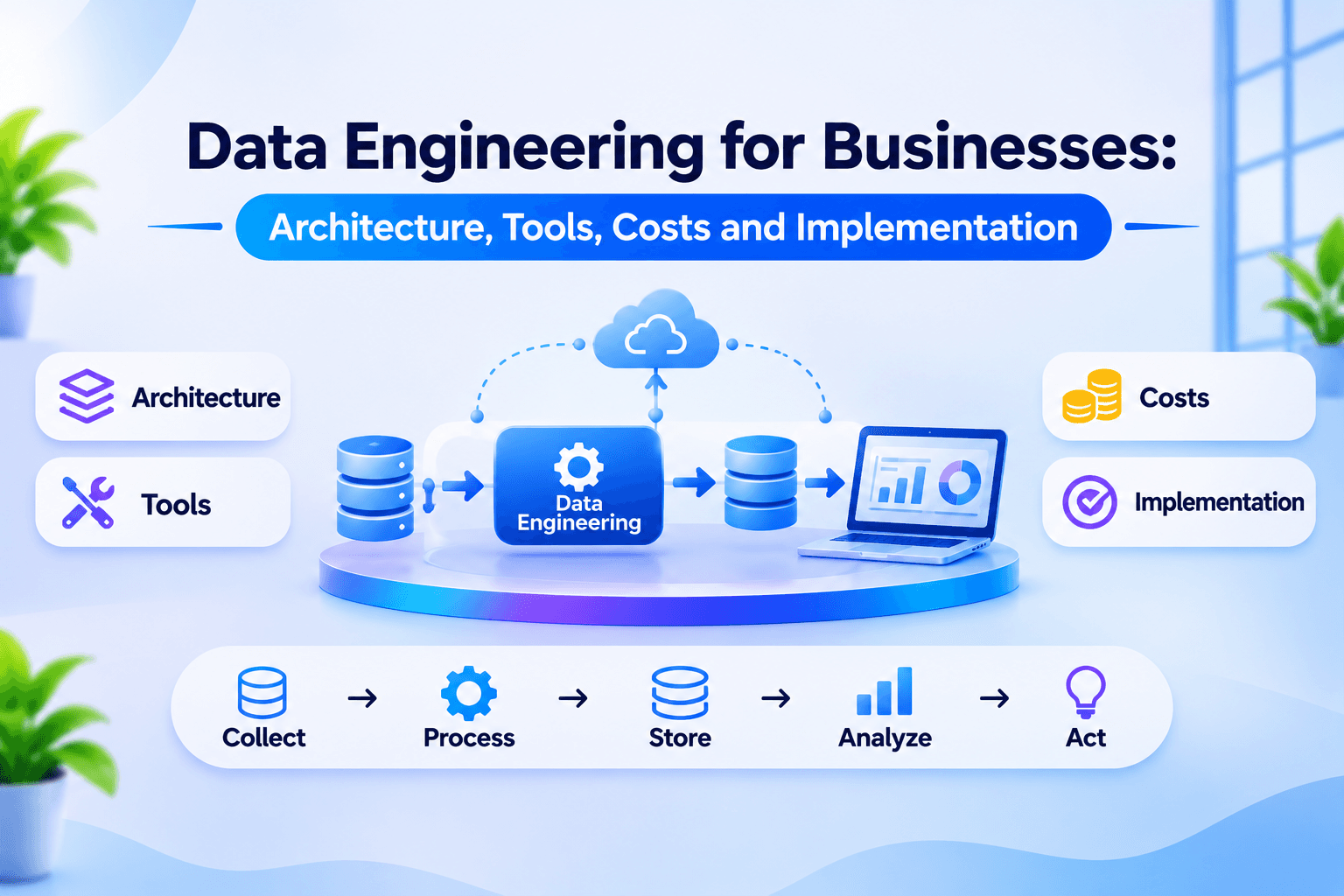
Quick Summary :- Data engineering helps businesses collect, clean, process, and manage data from multiple sources to make better business decisions. It creates a reliable foundation for business intelligence, reporting, analytics, and AI applications. By using technologies such as Apache Spark, Kafka, Airflow, dbt, Snowflake, and BigQuery, organizations can build scalable data pipelines and modern data platforms. This guide explores data engineering architecture, popular tools, industry use cases, implementation steps, estimated development costs in India, common challenges, and best practices to help businesses build an efficient and future-ready data infrastructure.
Data engineering is the foundation that helps businesses turn raw information into reliable, organized, and usable data. Every customer transaction, website interaction, payment, inventory update, marketing campaign, and operational activity generates data. However, collecting information is only the first step. Businesses must also bring data together, clean it, transform it, store it securely, and make it available for reporting, analytics, and artificial intelligence (AI).
As organizations expand their digital operations, managing data across disconnected applications and databases becomes increasingly difficult. A well-designed data engineering system solves this problem by creating reliable data pipelines and a structured architecture that supports business decisions.
For companies planning to improve reporting, develop AI-powered products, modernize legacy systems, or build scalable digital platforms, investing in data engineering can create long-term value. This guide explains data engineering for businesses, including its architecture, tools, implementation process, estimated costs, challenges, and best practices.
What Is Data Engineering?
Data engineering is the process of designing, developing, and maintaining systems that collect, process, transform, store, and deliver data for business use.
Businesses generate information through multiple systems, including:
- Customer relationship management (CRM) platforms.
- Enterprise resource planning (ERP) software.
- E-commerce websites and mobile applications.
- Payment gateways and financial systems.
- Marketing and advertising platforms.
- Internet of Things (IoT) devices.
- Customer support applications.
- Internal databases and spreadsheets.
The challenge is that this information is often stored in different formats and locations. One application may store customer details in a relational database, while another stores website activity in event logs and a third maintains sales information in spreadsheets.
Data engineering connects these systems and makes their information usable.
For example, consider an e-commerce business that wants to understand why its monthly revenue is declining. Its sales information may be stored in an order management system, advertising data in marketing platforms, customer details in a CRM, and payment records in a separate financial database.
A data engineering solution can collect information from these systems, standardize the records, remove duplicates, and combine the information into a central analytical environment. Business teams can then analyze sales performance, customer behavior, marketing costs, and payment trends using consistent data.
In simple terms, data engineering creates the infrastructure that allows businesses to trust and use their data.
Data Engineering vs. Data Analytics vs. Data Science
These three disciplines work together, but they solve different problems.
Area | Primary responsibility | Business outcome |
Data engineering | Collecting, processing, and preparing data | Reliable data infrastructure |
Data analytics | Examining data to identify trends and patterns | Better business decisions |
Data science | Applying statistical methods and machine learning | Predictions and intelligent models |
Business intelligence | Presenting information through reports and dashboards | Performance visibility |
For example, a retail company may use data engineering to combine sales information from multiple stores. Data analysts can use the prepared information to identify its best-performing products, while data scientists can develop demand forecasting models.
All these functions depend on accurate, accessible, and well-managed data.
Why Is Data Engineering Important for Businesses?
Data engineering is no longer limited to large technology companies. Retailers, healthcare providers, financial institutions, manufacturers, logistics companies, and startups can benefit from reliable data infrastructure.
Better Business Decision-Making
Businesses need accurate information to understand their performance. However, when different departments maintain separate records, reports may contain inconsistent numbers.
Data engineering creates standardized datasets that departments can use for reporting and analysis.
For example, a sales dashboard can combine information from CRM software, billing systems, and customer databases. Management can then review revenue, conversion rates, customer acquisition costs, and regional performance using consistent definitions.
Improved Data Quality
Incomplete, outdated, duplicated, or inconsistent information can lead to incorrect business decisions.
A data engineering pipeline can introduce automated checks to identify:
- Missing customer IDs.
- Duplicate transactions.
- Invalid email addresses.
- Incorrect date formats.
- Negative inventory quantities.
- Unexpected changes in data volume.
- Inconsistent product or customer categories.
Data quality should be treated as an ongoing process rather than a one-time cleaning activity.
A 2025 data quality survey by SYNQ's 2025 found that nearly 40% of surveyed companies planned to increase investment in data quality and observability tools. The survey also highlighted testing knowledge as a major challenge for data teams.
This reinforces an important point: building a pipeline is not enough. Businesses must continuously monitor whether the information flowing through it is correct.
Faster Reporting and Analytics
When employees manually collect information from multiple systems, preparing reports can take hours or days.
Automated data pipelines reduce repetitive work by transferring and processing information on a scheduled or continuous basis.
For example, a logistics company can combine delivery records, vehicle tracking information, warehouse inventory, and customer orders into a central reporting environment. Managers can use the resulting dashboards to identify delivery delays and operational bottlenecks.
Stronger AI and Machine Learning Capabilities
AI applications depend on the quality, availability, and relevance of their underlying data.
A machine learning model trained on incomplete or inconsistent information may produce unreliable predictions. Similarly, an AI assistant connected to outdated business records may return incorrect answers.
Data engineering supports AI initiatives by:
- Preparing structured and unstructured datasets.
- Combining information from different business systems.
- Managing historical data.
- Creating reusable data pipelines.
- Supporting feature engineering for machine learning.
- Maintaining data access controls and lineage.
Gartner's 2026 Data and Analytics Trends highlight the importance of continuous, event-driven data flows for AI applications and predict that adoption of data streaming for agentic AI will exceed 60% by 2028, compared with less than 15% in 2025.
Better Scalability
As a business grows, the volume and variety of its data increase. A system designed only for a small number of transactions may struggle when the organization expands into new markets or adds more applications.
A scalable data engineering architecture can support increasing workloads through cloud storage, distributed processing, workload management, and modular pipelines.
Improved Operational Efficiency
Data engineering reduces manual data movement and repetitive reporting tasks.
Instead of asking employees to download spreadsheets from several systems and combine them manually, businesses can automate the process. Employees can spend more time understanding results and improving operations.
Data Engineering Architecture: How Does It Work?
A data engineering architecture defines how information moves from its original source to the systems where it is stored, processed, analyzed, and consumed.
Data Sources Layer
The data sources layer contains the systems that generate or store business information.
Common sources include:
- SQL and NoSQL databases.
- CRM and ERP applications.
- Websites and mobile apps.
- Payment processing systems.
- APIs and third-party platforms.
- IoT devices and sensors.
- CSV, Excel, JSON, and XML files.
Before developing a pipeline, businesses should identify which sources are important, who owns them, how frequently the data changes, and whether the information contains sensitive details.
Data Ingestion Layer
Data ingestion is the process of collecting information from source systems and moving it into a storage or processing environment.
There are two common ingestion approaches.
Batch ingestion: Data is collected and transferred at scheduled intervals, such as every hour, every day, or every week.
For example, a company may transfer its previous day's sales transactions to a data warehouse every night.
Real-time or streaming ingestion: Data is transferred continuously or in small increments as new events occur.
For example, a payment platform may process transaction events continuously to identify suspicious activity.
Ingestion type | How it works | Suitable use cases |
Batch | Processes data at scheduled intervals | Daily reports, payroll, historical analysis |
Streaming | Processes events continuously | Fraud detection, tracking, live monitoring |
Micro-batch | Processes small groups of records frequently | Near-real-time dashboards and operational reports |
The choice depends on how quickly the business needs to use new information. Not every business requires real-time processing. Batch ingestion can be more cost-effective for workloads where a delay of several hours is acceptable.
Data Storage Layer
After ingestion, information must be stored in a system that supports the organization's requirements.
Common storage options include:
Data warehouse: A structured environment designed for analytical queries, reporting, and business intelligence.
Examples include Snowflake, Google BigQuery, and Amazon Redshift.
Data lake: A storage environment that can hold large amounts of raw structured, semi-structured, and unstructured information.
Examples include Amazon S3-based data lakes and Azure Data Lake Storage.
Data lakehouse: An architecture that combines aspects of data lakes and data warehouses, aiming to support flexible storage alongside analytical capabilities.
Technologies such as Delta Lake and Apache Iceberg are commonly used in lakehouse implementations.
Storage type | Main purpose | Best suited for |
Data warehouse | Structured analytics | BI, reporting, SQL analysis |
Data lake | Flexible storage of raw data | Large-scale and diverse datasets |
Data lakehouse | Unified storage and analytics | Mixed analytical and data science workloads |
The right storage model depends on data structure, query patterns, governance requirements, performance, and cost.
Data Processing and Transformation Layer
Raw information often cannot be used directly for business reporting. It may contain duplicate records, inconsistent formats, missing values, or unnecessary fields.
The processing and transformation layer converts raw data into useful datasets.
For example, an online retail business may receive the following order dates from different applications:
- 16/11/2026
- 2026-11-16
- Nov 16, 2026
A transformation pipeline can standardize these dates into a single format.
Other common transformations include:
- Removing duplicate records.
- Standardizing currencies and units.
- Joining customer and transaction information.
- Calculating revenue and profit.
- Categorizing products.
- Creating daily, weekly, and monthly summaries.
- Applying business rules.
Businesses can use ETL (Extract, Transform, Load) or ELT (Extract, Load, Transform) approaches.
ETL | ELT |
Data is transformed before loading into the target system | Data is loaded before transformation |
Useful when preprocessing is required before storage | Useful with scalable cloud data platforms |
Transformation occurs in a separate processing environment | Transformation often occurs inside the warehouse or lakehouse |
Neither approach is universally better. The choice depends on data sensitivity, processing requirements, infrastructure, and the capabilities of the destination platform.
Data Orchestration Layer
A data pipeline may contain several tasks that must run in a particular order.
For example:
- Extract customer data.
- Extract transaction data.
- Validate both datasets.
- Transform the information.
- Load the prepared data into a warehouse.
- Refresh the reporting tables.
- Notify the team if a task fails.
Orchestration tools manage these dependencies, schedules, retries, and failures.
Apache Airflow is widely used to author, schedule, and monitor workflows. Other options include Prefect, Dagster, and cloud-native orchestration services.
Data Quality and Governance Layer
Data quality and governance should operate across the entire architecture, not just at the final reporting stage.
Data quality checks evaluate whether information is accurate, complete, consistent, valid, and timely.
Data governance establishes rules for how information is collected, accessed, classified, retained, and protected.
Important governance activities include:
- Defining data ownership.
- Managing access permissions.
- Maintaining data catalogs.
- Tracking data lineage.
- Applying retention policies.
- Classifying sensitive information.
- Monitoring regulatory requirements.
Data Consumption Layer
The final layer makes processed information available to business users and applications.
Common consumers include:
- Business intelligence dashboards.
- Reporting systems.
- Machine learning applications.
- AI assistants.
- Financial forecasting tools.
- Operational applications.
- Customer analytics platforms.
For example, a sales manager may use a Power BI dashboard to review monthly revenue, while a machine learning model uses the same governed data to forecast product demand.
Popular Data Engineering Tools and Technologies
The data engineering ecosystem includes open-source frameworks, cloud services, databases, transformation tools, and monitoring platforms. Businesses should select technologies based on their actual workloads rather than adopting every popular tool.
Data Ingestion Tools
Tool | Main function | Common use case |
Apache Kafka | Distributed event streaming | Real-time event pipelines |
Apache NiFi | Data flow automation | Moving and routing data |
Fivetran | Managed data integration | Connecting business applications |
Airbyte | Data integration and replication | Moving data from multiple sources |
Debezium | Change data capture | Capturing database changes |
Apache Kafka is particularly useful when applications need to publish and consume continuous streams of events. It can support use cases such as payment activity, application events, and IoT data.
Data Processing Tools
Tool | Main function | Common use case |
Apache Spark | Distributed data processing | Large-scale transformations |
Apache Flink | Stateful stream processing | Real-time analytics |
Pandas | Data manipulation in Python | Smaller analytical workloads |
Dask | Parallel computing in Python | Scaling familiar Python workflows |
Apache Spark provides a unified engine for large-scale analytics, including SQL processing and structured or unstructured data workloads.
Data Transformation Tools
Tool | Main function |
dbt | SQL-based data transformation and modeling |
SQL | Querying and transforming relational data |
Python | Custom transformation and validation logic |
Spark SQL | Distributed SQL processing |
dbt is useful for teams that want to organize SQL transformations into reusable models with testing and documentation.
Data Storage and Cloud Platforms
Platform | Main capabilities |
Snowflake | Cloud data warehousing and data sharing |
Google BigQuery | Serverless analytical data warehouse |
Amazon Redshift | Cloud data warehousing |
Azure Data Lake Storage | Scalable cloud data storage |
Amazon S3 | Object storage for data lakes |
Databricks | Lakehouse and data intelligence platform |
Workflow Orchestration Tools
Tool | Main purpose |
Apache Airflow | Workflow scheduling and orchestration |
Dagster | Data asset orchestration |
Prefect | Workflow automation and monitoring |
AWS Step Functions | Cloud workflow coordination |
Azure Data Factory | Data integration and orchestration |
Data Quality and Monitoring Tools
Data teams need to monitor pipelines and datasets to detect problems before they affect business decisions.
Common tools include:
- Great Expectations for data validation.
- Soda for data quality monitoring.
- Monte Carlo for data observability.
- Elementary for dbt-focused observability.
- Cloud-native monitoring services for infrastructure and pipeline health.
The technology selection should consider integration, ease of maintenance, team expertise, licensing, security, and the total cost of ownership.
Modern Data Engineering Architecture Patterns
There is no single architecture that fits every business. Different patterns solve different storage, processing, and analytics requirements.
Traditional Data Warehouse Architecture
A traditional data warehouse architecture collects information from business systems, transforms it into structured datasets, and stores it for reporting and analytics.
Advantages:
- Structured and consistent reporting.
- Strong SQL support.
- Easier management of analytical datasets.
- Suitable for business intelligence workloads.
Limitations:
- Less flexible for some unstructured data workloads.
- Transformation and schema design may require planning.
- Large-scale storage and compute can become expensive if poorly managed.
Data Lake Architecture
A data lake stores large volumes of information in its original or lightly processed form.
It can hold structured records, JSON files, images, documents, logs, and other formats.
Advantages:
- Flexible storage.
- Supports diverse data types.
- Useful for machine learning and advanced analytics.
- Can separate storage and processing resources.
Limitations:
- Requires strong metadata and governance.
- Poorly managed lakes can become difficult to navigate.
- Data quality problems can spread if raw information is not controlled.
Lakehouse Architecture
A lakehouse combines the flexible storage model of a data lake with capabilities associated with analytical data warehouses.
It can support SQL analytics, data science, and machine learning on a shared data foundation.
Advantages:
- Supports multiple data formats.
- Can reduce unnecessary data duplication.
- Enables analytics and AI workloads.
- Supports open table formats in suitable implementations.
Limitations:
- Requires careful platform design.
- May involve additional engineering and governance complexity.
- Performance depends on table design, file management, and workload patterns.
Real-Time Data Architecture
Real-time architecture processes events as they are generated rather than waiting for a scheduled batch.
For example, a financial platform may use streaming pipelines to analyze transactions and identify unusual activity.
Real-time systems are useful when delays can affect customer experience, safety, financial risk, or operational performance. However, they require additional attention to event ordering, duplicate processing, retries, monitoring, and infrastructure costs.
Architecture Comparison
Architecture | Processing style | Best suited for | Complexity |
Data warehouse | Primarily batch or scheduled | BI and structured reporting | Medium |
Data lake | Batch and varied workloads | Raw data and data science | Medium |
Lakehouse | Batch and streaming options | Unified analytics and AI | Medium to high |
Real-time streaming | Continuous events | Immediate operational insights | High |
Data Engineering Use Cases Across Industries
Data engineering can support different business processes depending on the industry's data sources and operational requirements.
Retail and E-commerce
Retail businesses generate data through orders, payments, customer accounts, inventory, returns, and marketing campaigns.
Data engineering can combine this information to support:
- Customer segmentation.
- Inventory management.
- Product recommendations.
- Sales forecasting.
- Cart abandonment analysis.
- Customer lifetime value analysis.
For example, a retailer can connect purchase history with inventory information to identify products that are selling quickly and may require replenishment.
Banking and Financial Services
Financial organizations process large volumes of transactions and customer records.
Data engineering can support:
- Transaction monitoring.
- Fraud detection pipelines.
- Risk reporting.
- Customer behavior analysis.
- Regulatory reporting.
- Financial forecasting.
These systems require strong security, access management, auditability, and data retention controls.
Healthcare
Healthcare organizations manage patient records, appointment data, diagnostic information, billing records, and medical equipment data.
Data engineering can help integrate information from electronic health record systems, laboratory systems, pharmacy applications, and hospital management platforms.
Potential applications include:
- Hospital operational dashboards.
- Patient appointment analysis.
- Resource planning.
- Claims analytics.
- Clinical research datasets.
- Remote patient monitoring.
Healthcare data requires careful privacy protection and access controls. The architecture should follow applicable legal and regulatory requirements.
Manufacturing
Manufacturing organizations collect information from machines, sensors, production systems, supply chains, and quality inspection platforms.
Data engineering can help businesses:
- Monitor production performance.
- Identify equipment anomalies.
- Analyze manufacturing defects.
- Forecast maintenance requirements.
- Track raw material consumption.
- Improve supply chain visibility.
Logistics and Transportation
Logistics businesses manage vehicle tracking, delivery schedules, warehouse records, customer orders, and fuel consumption.
By connecting these datasets, companies can analyze delivery performance, improve route planning, identify delays, and monitor operational costs.
SaaS and Technology Companies
SaaS businesses generate data from application usage, customer accounts, subscription events, support tickets, and product interactions.
Data engineering can help measure:
- Monthly recurring revenue.
- Customer acquisition cost.
- Customer churn.
- Feature adoption.
- Product engagement.
- Subscription upgrades and downgrades.
Data Engineering Implementation: Step-by-Step Process
Building a data engineering platform requires more than selecting tools and connecting databases. Businesses should begin with their objectives and design a system around measurable outcomes.
Step 1: Identify Business Requirements
Start by identifying the business problem the data platform should solve.
Questions to consider include:
- Which business decisions need better data?
- Which departments will use the platform?
- What information is currently available?
- How frequently should data be updated?
- Are historical records required?
- What are the security and compliance requirements?
For example, a retail business may want a consolidated sales dashboard that updates every morning. This requirement does not necessarily justify a complex real-time architecture.
Step 2: Audit Existing Data Sources
Create an inventory of the systems that contain relevant information.
Document:
- Database type.
- Data format.
- Data volume.
- Update frequency.
- Data owner.
- Access method.
- Sensitive information.
- Data retention requirements.
This audit helps identify integration challenges before development begins.
Step 3: Select the Architecture
Choose an architecture based on the business use case.
A small organization may begin with a cloud data warehouse and scheduled batch pipelines. A larger company handling event-heavy workloads may need streaming infrastructure and distributed processing.
Consider:
- Current and expected data volume.
- Processing latency.
- Storage requirements.
- Analytical query patterns.
- Availability requirements.
- Budget.
- Internal technical skills.
Avoid introducing architectural complexity without a clear business need.
Step 4: Choose the Technology Stack
Select tools for ingestion, processing, storage, transformation, orchestration, and monitoring.
A practical example of a cloud-based stack could include:
Layer | Example technology |
Data ingestion | Airbyte or Kafka |
Processing | Python or Apache Spark |
Storage | Amazon S3 |
Data warehouse | Snowflake or BigQuery |
Transformation | dbt |
Orchestration | Apache Airflow |
Data quality | Great Expectations |
Visualization | Power BI or Tableau |
These are examples, not mandatory combinations. Existing cloud contracts, technical skills, and integration needs may make another stack more suitable.
Step 5: Develop Data Pipelines
Build pipelines that collect data from the identified sources and move it into the target environment.
Start with a limited number of high-value sources rather than attempting to connect every system at once.
Each pipeline should account for:
- Authentication and permissions.
- Incremental data extraction.
- Duplicate handling.
- Schema changes.
- Failed records.
- Retry logic.
- Logging and monitoring.
Step 6: Clean and Transform Data
Create standardized datasets for business use.
For example, an organization may receive sales information from multiple regions, each using different currency formats and product categories.
Transformation rules can standardize these records and calculate consistent business metrics.
Document important calculations so different teams do not create conflicting definitions of revenue, active customers, or conversion rates.
Step 7: Implement Data Quality and Governance
Introduce validation checks at appropriate stages of the pipeline.
Examples include:
- Every transaction must have a valid transaction ID.
- Order values must follow defined business rules.
- Customer identifiers should match the customer database.
- Required fields should not be empty.
- Daily transaction counts should remain within expected ranges.
Define access controls according to job responsibilities and data sensitivity.
Step 8: Connect Analytics and Business Applications
Once the datasets are ready, connect them to reporting tools, machine learning systems, or operational applications.
Ensure that users understand the meaning of each metric and the frequency at which the data is refreshed.
Step 9: Test and Validate the Platform
Testing should cover more than whether data reaches the destination.
Test:
- Data accuracy.
- Completeness.
- Pipeline performance.
- Failure recovery.
- Access permissions.
- Security controls.
- Scalability.
- Dashboard calculations.
Compare selected records against their source systems to verify that transformations are correct.
Step 10: Deploy, Monitor, and Improve
After deployment, continuously monitor pipeline execution, data quality, processing time, storage growth, and infrastructure costs.
Use alerts to notify the responsible team when important pipelines fail or data becomes stale.
Review the architecture periodically as business requirements change.
How Much Does Data Engineering Cost?
The cost of data engineering depends on project scope, data volume, number of source systems, processing complexity, cloud infrastructure, security requirements, and team experience.
A basic pipeline that transfers data from a few applications into a warehouse is significantly different from an enterprise platform supporting streaming analytics, machine learning, and strict governance requirements.
The following ranges are illustrative India-focused planning estimates, not verified industry averages or vendor quotations.
Estimated Data Engineering Development Cost in India
Project type | Estimated development cost |
Basic data pipeline | ₹2 lakh–₹5 lakh |
Small business data integration | ₹4 lakh–₹10 lakh |
Data warehouse implementation | ₹8 lakh–₹18 lakh |
Multi-source analytics platform | ₹12 lakh–₹30 lakh |
Real-time data processing system | ₹15 lakh–₹40 lakh |
Enterprise data lakehouse | ₹25 lakh–₹75 lakh+ |
The final budget may fall outside these ranges depending on the project.
Cost by Development Component
Component | Illustrative cost range |
Requirement analysis and architecture | ₹50,000–₹2 lakh |
Data source integration | ₹1 lakh–₹5 lakh |
Pipeline development | ₹1 lakh–₹6 lakh |
Data warehouse setup | ₹1 lakh–₹5 lakh |
Data transformation and modeling | ₹1 lakh–₹4 lakh |
Testing and validation | ₹50,000–₹2 lakh |
Deployment and documentation | ₹50,000–₹2 lakh |
These component ranges are indicative and should not be added mechanically to calculate a project quote. Actual costs depend on the number of pipelines, integrations, environments, and engineering effort.
Factors That Affect Data Engineering Costs
Number of data sources: Connecting two databases is usually simpler than integrating dozens of applications, APIs, and legacy systems.
Data volume: Larger datasets may require distributed processing, more storage, and higher compute capacity.
Processing frequency: Continuous streaming systems can require more infrastructure and operational effort than daily batch pipelines.
Data quality requirements: Complex validation, deduplication, reconciliation, and business rules increase implementation effort.
Security and compliance: Encryption, access controls, audit logs, data masking, and retention requirements add design and engineering work.
Cloud infrastructure: Storage, compute, data transfer, warehouse queries, and monitoring can create ongoing costs.
Team expertise: Specialized skills in streaming, distributed systems, cloud architecture, and data governance can affect project pricing.
Ongoing Data Engineering Costs
Development is only one part of the investment. Businesses should also plan for recurring costs.
Ongoing expense | What it covers |
Cloud storage | Storing raw and processed data |
Compute resources | Running transformations and queries |
Data integration | Managed connectors and data transfer |
Monitoring | Pipeline and infrastructure observability |
Maintenance | Fixes, upgrades, and schema changes |
Security | Access management and compliance controls |
Engineering support | Monitoring and improving pipelines |
A company should estimate operating costs using its expected workload rather than relying only on the initial development quote.
Example Budget for a Small Business
Consider a company that wants to combine customer, sales, and marketing data from three systems into a cloud data warehouse.
An illustrative first-phase budget might look like this:
Project activity | Estimated budget |
Requirements and architecture | ₹75,000 |
Source integrations | ₹1,50,000 |
Pipeline development | ₹2,00,000 |
Warehouse and transformations | ₹1,50,000 |
Testing and deployment | ₹75,000 |
Illustrative project budget | ₹6,50,000 |
This example assumes a limited number of integrations, manageable data volumes, and standard reporting requirements. It excludes ongoing cloud subscriptions, taxes, and major third-party licensing.
Data Engineering Challenges and How to Overcome Them
Even well-planned data platforms can face technical and organizational challenges.
Challenge | Business impact | Recommended solution |
Poor data quality | Inaccurate reports and decisions | Automated validation and monitoring |
Data silos | Incomplete business visibility | Standardized integration pipelines |
Growing infrastructure costs | Budget overruns | Workload optimization and cost monitoring |
Legacy systems | Difficult integrations | APIs, CDC, and phased modernization |
Security risks | Unauthorized data access | Encryption and access controls |
Pipeline failures | Delayed reports and applications | Alerts, retries, and recovery processes |
Lack of ownership | Conflicting definitions and accountability | Data owners and governance policies |
Managing Data Silos
Data silos develop when departments store information in separate systems without a reliable method of sharing it.
A central analytical platform can reduce this problem, but simply copying every dataset into one location is not enough. Businesses also need shared definitions, ownership, and integration standards.
Maintaining Data Quality at Scale
As pipelines grow, manually checking every dataset becomes impractical.
Automated tests should validate key fields, relationships, freshness, and business rules. Teams should also monitor unexpected changes in data volume and schema.
Controlling Cloud Costs
Cloud platforms make it easier to scale infrastructure, but poorly optimized workloads can create unnecessary spending.
Businesses can control costs by:
- Scheduling non-production workloads.
- Using incremental processing where appropriate.
- Optimizing SQL queries.
- Managing data retention.
- Compressing and partitioning data.
- Monitoring warehouse usage.
- Reviewing unused storage and compute resources.
Integrating Legacy Systems
Older applications may not provide modern APIs or reliable event streams.
Businesses can use database replication, change data capture, scheduled exports, or custom connectors where appropriate. Integration should be planned carefully to avoid putting excessive load on production systems.
Protecting Sensitive Data
Data platforms may contain financial, personal, operational, or confidential information.
Organizations should implement encryption, identity management, role-based access controls, audit logging, secure secrets management, and data masking where required.
For Indian businesses, privacy and security planning should consider applicable obligations under the Digital Personal Data Protection Act, 2023, and the rules and notifications in force at implementation time.
Data Engineering Best Practices for Businesses
A successful data engineering platform should be reliable, maintainable, secure, and aligned with business priorities.
Start with Business Outcomes
Do not build a complex data platform simply because a technology is popular.
Start with a clear business requirement, such as improving sales reporting, consolidating customer data, or creating a demand forecasting pipeline.
Build Modular Pipelines
Divide large workflows into smaller components that can be tested, reused, and maintained independently.
Modular design makes it easier to replace a source system or update a transformation without rebuilding the entire platform.
Automate Testing
Implement automated tests for schemas, required fields, unique identifiers, relationships, and business rules.
Testing should be part of the development lifecycle rather than an activity performed only before deployment.
Maintain Data Documentation and Lineage
Teams should know where a dataset comes from, how it is transformed, who owns it, and which reports or applications depend on it.
Documentation and lineage make debugging, auditing, and impact analysis easier.
Design for Security from the Beginning
Security should be included in architecture decisions, not added after development.
Use least-privilege access, encryption, secure authentication, and appropriate data classification.
Monitor Performance and Costs
Track pipeline failures, processing delays, query performance, data freshness, and infrastructure spending.
Monitoring helps teams identify operational problems before they affect business users.
Avoid Unnecessary Complexity
Not every company needs Kafka, Spark, a lakehouse, and multiple orchestration tools.
A small business may achieve its goals with a cloud warehouse, scheduled ingestion, SQL transformations, and a BI tool.
Choose the simplest architecture that meets current requirements while allowing reasonable future growth.
Future Trends in Data Engineering
Data engineering continues to evolve as organizations adopt cloud platforms, AI applications, streaming systems, and more distributed data architectures.
AI-Assisted Data Engineering
AI tools are increasingly being used to assist with SQL generation, documentation, code development, troubleshooting, and data analysis.
However, AI-generated transformations and pipeline changes still require testing and human review. Incorrect logic can affect every downstream report that uses the resulting data.
Real-Time Data Processing
Businesses increasingly want information to be available closer to the moment it is generated.
Real-time pipelines can support fraud detection, application monitoring, inventory updates, and operational decision-making.
Gartner's 2026 forecast on data streaming and agentic AI illustrates the expected importance of continuous data flows in future enterprise systems.
Data Products and Data as a Product
Instead of treating data as an internal technical output, organizations are increasingly managing important datasets as reusable products.
A data product should have a clear owner, documented purpose, quality expectations, access rules, and defined consumers.
This approach can help teams reduce duplicated work and improve trust in shared datasets.
Metadata and Data Governance Automation
As data platforms become more complex, metadata helps teams understand what information exists and how it is used.
Data catalogs, lineage systems, automated classification, and policy enforcement can improve discoverability and governance.
Gartner's 2025 data and analytics trends also emphasized metadata management and reusable data products as important capabilities for organizations.
Lakehouse Adoption
Lakehouse architectures continue to attract attention because they can support analytics, data science, and AI workloads on a shared data foundation.
Their suitability depends on the organization's workload patterns, governance needs, platform skills, and cost model.
Data Sovereignty and Local Infrastructure
Organizations operating across countries may need to consider where information is stored and processed.
India's Economic Survey 2025–26 reported that installed data centre capacity in India stood at approximately 1,280 MW as of June 2025, with industry estimates projecting expansion to around 4 GW by 2030.
This infrastructure expansion is relevant to businesses evaluating cloud availability, data residency, latency, and local hosting options.
How to Choose the Right Data Engineering Partner
Developing a data engineering platform requires expertise across databases, cloud infrastructure, integration, programming, data modeling, security, and analytics.
If a business does not have an experienced internal team, working with a data engineering partner can help accelerate implementation.
Before selecting a partner, evaluate the following:
Technical expertise: Check experience with SQL, Python, cloud platforms, distributed processing, data warehouses, and orchestration tools.
Architecture experience: Ask whether the team has designed data warehouses, lakes, lakehouses, batch pipelines, and streaming systems.
Industry understanding: A partner familiar with your business domain may understand relevant data structures, workflows, and compliance needs more quickly.
Security practices: Review how the partner handles credentials, sensitive information, access permissions, encryption, and auditability.
Scalability: Ask how the proposed solution will handle growing data volumes, additional sources, and changing business requirements.
Documentation and support: Ensure the project includes architecture documentation, pipeline documentation, testing procedures, deployment guidance, and post-launch support.
Transparent pricing: Understand what is included in development costs and which expenses, such as cloud usage or third-party subscriptions, are billed separately.
A suitable partner should be able to explain the architecture in business terms, identify trade-offs, and recommend a solution that fits the organization's actual needs.
Conclusion
Data engineering provides the foundation businesses need to turn scattered information into reliable, actionable data. By connecting different systems, building dependable pipelines, improving data quality, and establishing governance, organizations can strengthen reporting, streamline operations, and prepare for advanced analytics and AI applications. The right architecture may involve a data warehouse, data lake, lakehouse, or real-time streaming system, depending on business requirements.
Successful implementation starts with clear objectives, a realistic budget, and the right technology choices. Businesses should prioritize high-value use cases, build modular pipelines, automate quality checks, and monitor security and infrastructure costs continuously. With a scalable and well-managed data engineering strategy, organizations can make better decisions today while building a strong data foundation for future growth.
Frequently Asked Questions
Data engineering involves collecting, processing, transforming, and storing business data for analytics and decision-making.
It improves data quality, automates reporting, connects business systems, and supports analytics and AI applications.
Popular tools include Apache Spark, Kafka, Airflow, dbt, Snowflake, BigQuery, and Amazon Redshift.
A basic implementation may cost around ₹2 lakh–₹5 lakh, while complex enterprise platforms can cost ₹25 lakh or more. Actual pricing depends on project scope.
ETL transforms data before loading it into the target system, while ELT loads data first and transforms it afterward.
11 min read

Dhruv Patel
As CEO of Zyora Global, Dhruv Patel combines technical expertise with business leadership to drive innovation and growth. With experience in software engineering, product development, and emerging technologies, he is dedicated to helping organizations turn ideas into impactful digital solutions that deliver measurable results.