


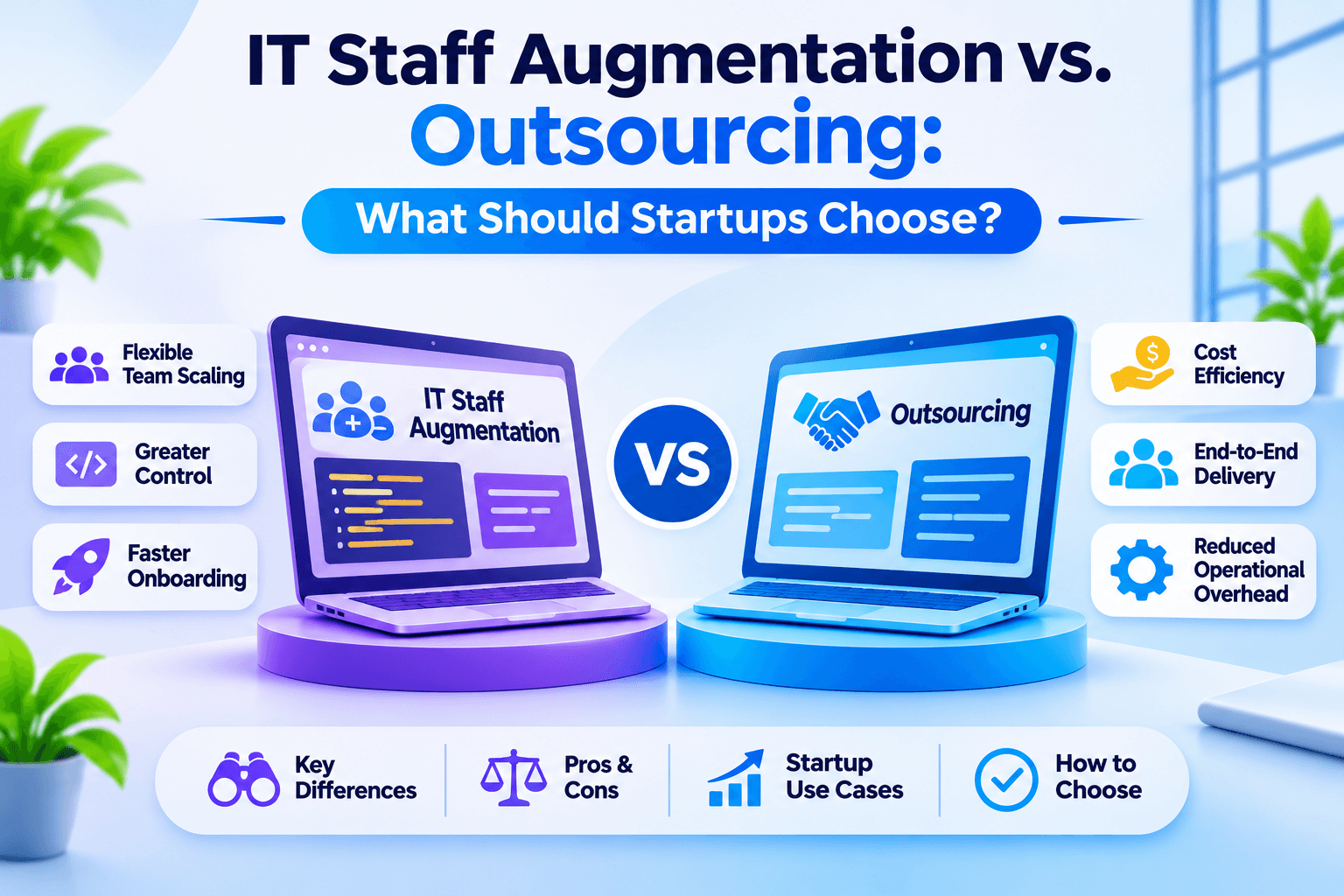
Quick Summary :- IT staff augmentation and outsourcing help startups access external technology talent without hiring a complete permanent team. Staff augmentation adds external professionals to an existing team, allowing startups to retain direct control over development. Outsourcing transfers responsibility for a defined project or technical function to an external provider. This guide compares both models, including costs, benefits, risks, use cases, and startup growth stages, to help founders choose the right approach.
Building a strong technology team is one of the biggest challenges startups face. Whether a company is developing its first minimum viable product (MVP), launching a mobile application, building an enterprise platform, or expanding an existing product, having the right technical expertise is essential. However, hiring a full-time development team can require significant investment, time, and management effort.
Startups often have limited budgets, changing product requirements, and pressure to bring products to market quickly. They may need experienced developers, UI/UX designers, QA engineers, cloud specialists, or technical architects without having the resources to hire every professional permanently. This is where external technology talent becomes valuable.
Two popular approaches are IT staff augmentation and IT outsourcing. Both allow startups to access external technical expertise, but they work differently. Staff augmentation adds external professionals to an existing internal team, while outsourcing transfers responsibility for a defined project or function to an external service provider.
Choosing the wrong model can create unnecessary costs, communication problems, delivery delays, and a lack of technical control. The right approach depends on the startup's development stage, internal capabilities, project complexity, budget, and long-term objectives.
In this guide, we will explore IT staff augmentation vs. outsourcing, compare their costs, benefits, limitations, use cases, and risks, and explain which model startups should choose at different stages of growth.
What Is IT Staff Augmentation?
IT staff augmentation is a hiring model in which a company brings external technology professionals into its existing team for a specific period or project.
Instead of recruiting permanent employees, the startup works with a staffing provider or technology partner to access developers and other specialists with the required skills.
These professionals work alongside the company's internal employees and follow its development processes, priorities, communication practices, and management structure.
The startup generally retains responsibility for assigning tasks, reviewing code, setting priorities, and managing day-to-day development.
For example, imagine a startup building a SaaS product with an internal team of three developers. The company wants to introduce AI-powered features but does not have an experienced machine learning engineer.
Rather than hiring a permanent specialist immediately, it can use IT staff augmentation to bring in an external AI engineer for the required period.
The specialist joins the development workflow, collaborates with internal developers, and contributes to the product under the startup's technical direction.
How IT staff augmentation works
- Identify skill gaps: The startup determines which technical roles or expertise are missing.
- Define requirements: It specifies the skills, experience, responsibilities, and expected duration.
- Select a staffing partner: The company evaluates providers that can supply suitable professionals.
- Interview candidates: The startup reviews technical capabilities and team compatibility.
- Onboard external professionals: Selected developers receive access to the required tools, documentation, and workflows.
- Manage daily activities: The startup assigns tasks, reviews progress, and manages priorities.
- Extend or conclude the engagement: The contract continues, changes, or ends according to business requirements.
Common roles provided through staff augmentation
Technical role | Responsibilities |
Frontend developer | Builds user interfaces and interactive application features |
Backend developer | Develops APIs, business logic, and server-side functionality |
Full-stack developer | Works across frontend and backend development |
Mobile app developer | Builds Android and iOS applications |
UI/UX designer | Creates user journeys, wireframes, and interfaces |
QA engineer | Performs functional, integration, and regression testing |
DevOps engineer | Manages deployment, infrastructure, and automation |
Cloud engineer | Designs and manages cloud environments |
Data engineer | Builds data pipelines and data infrastructure |
AI/ML engineer | Develops and integrates AI and machine learning capabilities |
Key characteristics of IT staff augmentation
- External professionals work as an extension of the internal team.
- The startup usually controls daily priorities and task assignments.
- Engagements can be short-term or long-term.
- Businesses can access specialized skills without permanent recruitment.
- Team size can be adjusted according to project requirements.
- Technical leadership and delivery accountability generally remain with the startup.
Staff augmentation is particularly useful for startups that already understand what they want to build but need additional people or expertise to execute the work.
What Is IT Outsourcing?
IT outsourcing is a business arrangement in which a startup hires an external technology company to handle a specific software development project, technical function, or ongoing service.
Unlike staff augmentation, where external professionals join the internal team, outsourcing usually transfers responsibility for an agreed scope of work to the service provider.
The outsourcing company may manage developers, designers, testers, project managers, infrastructure specialists, and other professionals required to complete the project.
For example, a startup wants to launch an e-commerce application but does not have an internal technology team. It can partner with a software development company to manage the complete project, including requirement analysis, UI/UX design, frontend development, backend development, testing, and deployment.
The startup defines its business objectives and expected deliverables, while the outsourcing partner manages the agreed development activities.
How IT outsourcing works
- Define the business objective: The startup identifies the product or technical service it wants to develop.
- Prepare project requirements: It documents features, functionality, timelines, budget, and expected outcomes.
- Choose an outsourcing partner: The company evaluates potential development providers.
- Agree on the project scope: Both parties define responsibilities, milestones, deliverables, and payment terms.
- Begin development: The outsourcing partner assembles and manages the required team.
- Review progress: The startup participates in milestone reviews, demonstrations, and feedback sessions.
- Test and deploy: The provider completes testing and prepares the application for launch.
- Continue support: Depending on the contract, the provider may maintain and improve the software after deployment.
Common types of IT outsourcing
Outsourcing type | Description | Example |
Project-based outsourcing | An external company delivers a defined project | Developing an MVP |
Dedicated development team | A provider supplies a team that works on the startup's product | Building and maintaining a SaaS platform |
Managed IT services | A provider manages an ongoing IT function | Application monitoring and infrastructure support |
Offshore outsourcing | Work is assigned to a provider in another country | Hiring an India-based development company |
Nearshore outsourcing | Work is assigned to a provider in a nearby country or time zone | Working with a development team in a neighbouring region |
Onshore outsourcing | Work is assigned to a provider in the same country | Partnering with a local software company |
Key characteristics of IT outsourcing
- The external provider manages the agreed development activities.
- Project responsibilities are defined through a contract or statement of work.
- The provider may supply an entire team.
- The startup focuses on requirements, business decisions, and feedback.
- Payment may be based on milestones, fixed scope, time and materials, or a recurring agreement.
- Delivery accountability depends on the agreed contract and service model.
IT outsourcing is especially useful when a startup wants to develop a product without establishing and managing an entire internal engineering department.
IT Staff Augmentation vs. Outsourcing: Key Differences
Both approaches provide access to external technology talent, but the most important difference is who manages the work and who is responsible for delivery.
With staff augmentation, the startup generally manages the external professionals directly. With outsourcing, the service provider usually manages the development process and delivers the agreed scope.
Understanding these differences can help founders choose a model that matches their operational capabilities.
Comparison factor | IT staff augmentation | IT outsourcing |
Working model | External professionals join the internal team | External company handles defined work |
Project management | Managed by the startup | Generally managed by the provider |
Technical control | Higher direct control | Shared through requirements and reviews |
Team structure | Adds individuals to an existing team | Can provide a complete development team |
Hiring responsibility | Provider sources candidates | Provider assembles the project team |
Delivery responsibility | Primarily remains with the startup | Defined contractually with the provider |
Communication | Direct communication with augmented professionals | Communication through project leads and teams |
Pricing | Commonly hourly, daily, or monthly rates | Fixed-price, time-and-materials, or managed agreements |
Flexibility | Easy to adjust individual skills and capacity | Changes depend on project scope and contract |
Internal management | Requires strong internal technical leadership | Requires product ownership and vendor coordination |
Best suited for | Filling skill gaps and expanding teams | Delivering projects or managing technical functions |
Understanding the practical differences
1. Management and control
Staff augmentation gives startups more direct control over external professionals. Internal managers can assign tasks, review work, and change priorities as needed.
Outsourcing gives the provider greater responsibility for organizing the work. The startup still controls business objectives and approves major decisions, but the provider manages execution within the agreed scope.
2. Team ownership
In staff augmentation, external developers work within the startup's existing team structure.
In outsourcing, the provider generally maintains its own team structure, processes, and delivery management.
3. Project accountability
Staff augmentation supplies development capacity, but the startup remains responsible for coordinating the team and delivering the overall product.
In outsourcing, the provider takes responsibility for the deliverables defined in the contract. This does not mean every business risk transfers to the provider: unclear requirements, delayed approvals, scope changes, and client-side dependencies can still affect delivery.
4. Flexibility
Staff augmentation makes it easier to add a specific developer or specialist when a new skill gap appears.
Outsourcing can also accommodate changes, but significant changes to scope, timelines, or deliverables may require contract adjustments.
5. Internal expertise
Staff augmentation works best when a startup has someone capable of directing technical work.
Outsourcing can be more appropriate when the startup does not have a complete engineering team or technical delivery management capability.
Why Startups Are Considering External Technology Teams
Startups operate under different conditions from established enterprises. They may have limited funding, small teams, uncertain product requirements, and pressure to validate ideas quickly.
Building an internal technology department from the beginning can consume resources that could otherwise be invested in product development, customer acquisition, and market research.
External technology teams offer another way to access specialized expertise.
According to Silicon Valley Bank's State of the Markets H1 2025 report, approximately 60% of companies already outsource app development. The report discusses how startups are considering overseas talent pools and external development resources as part of their technology strategies.
This is a useful indication of how outsourcing has become part of the software development landscape. However, the figure should not be interpreted as a startup-only statistic.
Hiring challenges also affect the availability of technical talent. HackerRank's 2025 Developer Skills Report found that 78% of surveyed tech leaders struggle to find skilled candidates, while 72% identified hiring competition as a major challenge. The report surveyed 13,732 developers, engineering managers, recruiters, executives, and students across 102 countries.
For startups, these challenges can make traditional recruitment difficult, especially when they need experienced specialists for a limited period.
What these trends mean for startups
- External teams can help startups access specialized technical skills.
- Businesses can avoid recruiting permanent employees for every temporary requirement.
- Startups can adjust team capacity as product priorities change.
- Experienced development partners can provide established engineering processes.
- Founders can focus more time on business strategy, customers, and product validation.
However, external teams are not automatically cheaper or more effective. Their value depends on how well the engagement model matches the startup's needs.
Advantages of IT Staff Augmentation for Startups
Staff augmentation can be an effective option for startups that have an established product team but need additional development capacity.
It allows founders and technical leaders to bring in experienced professionals without going through the complete permanent recruitment process.
Access to specialized technical skills
Startups often need expertise that is not available within their existing teams.
For example, a company developing a web application may have frontend and backend developers but need additional expertise in cloud architecture, cybersecurity, data engineering, or AI integration.
Staff augmentation makes it possible to bring in specialists for specific responsibilities without creating permanent positions for every skill.
Faster team expansion
Traditional recruitment involves job descriptions, applications, interviews, technical assessments, negotiations, and onboarding.
Staff augmentation can shorten the process because the staffing provider already has access to potential candidates.
The actual time required still depends on the availability of suitable professionals, interview requirements, and onboarding procedures.
Greater control over development
One of the strongest advantages of staff augmentation is that the startup retains direct control over daily development activities.
Its technical lead can:
- Assign tasks and responsibilities.
- Prioritize product features.
- Review code and technical decisions.
- Monitor development progress.
- Conduct sprint planning.
- Change priorities when business requirements evolve.
This is useful for startups developing products where requirements change frequently based on customer feedback.
Flexible team size
A startup may need five additional developers during a major product development phase but only one specialist after the product launches.
Staff augmentation allows businesses to adjust team capacity according to demand.
For example, a startup can bring in additional QA engineers before a major release and reduce the engagement after the testing phase is completed.
Reduced permanent hiring commitments
Hiring full-time employees involves more than salaries. Businesses may also need to consider recruitment expenses, benefits, equipment, training, workspace, and ongoing employment obligations.
Staff augmentation changes the engagement structure by allowing the startup to pay for external expertise according to agreed contract terms.
It does not eliminate management, onboarding, or administrative costs, but it can reduce the need to establish permanent positions for temporary requirements.
Easier integration with internal workflows
Augmented professionals can work with the startup's existing development tools and processes.
They may participate in daily stand-ups, sprint planning, code reviews, project discussions, and product demonstrations.
This can help maintain consistency between internal and external development activities.
Disadvantages of IT Staff Augmentation
Although staff augmentation provides flexibility, it also requires active management from the startup.
The model is less effective when the organization does not have clear technical leadership or well-defined development processes.
Requires internal technical management
External developers do not automatically take responsibility for the complete product.
The startup must assign work, review output, manage dependencies, and ensure that development follows its technical standards.
If the company does not have an experienced CTO, engineering manager, or technical lead, managing multiple augmented developers can become difficult.
Communication and coordination challenges
When internal and external employees work together, communication needs to be organized.
Differences in time zones, working hours, documentation practices, and communication styles can create delays.
Startups should establish clear communication channels, meeting schedules, reporting practices, and escalation procedures.
Knowledge retention risks
External professionals may leave when their contracts end.
If technical knowledge exists only in their individual understanding, the startup may struggle to maintain or extend the application.
To reduce this risk, companies should require:
- Technical documentation
- Code reviews
- Repository access
- Architecture records
- Deployment documentation
- Knowledge-transfer sessions
Variable quality of talent
Not every staffing provider offers professionals with the same technical ability or experience.
A developer may have the required programming language experience but lack the problem-solving skills or product understanding needed for the role.
Startups should conduct technical interviews and review relevant project experience before onboarding candidates.
Unclear accountability
If the startup manages the external developers but does not define ownership properly, important responsibilities can fall between team members.
For example, developers may complete assigned tasks while no one takes responsibility for the overall architecture, testing strategy, or production readiness.
Clear ownership is essential, especially when working with several external professionals.
Advantages of IT Outsourcing for Startups
IT outsourcing is particularly useful for startups that want to develop a product without building and managing every technical function internally.
An outsourcing partner can provide the people, processes, and technical capabilities required to deliver an agreed project.
Access to an established development team
A software development company can provide different professionals under one engagement.
Instead of independently recruiting frontend developers, backend developers, designers, QA engineers, and project managers, the startup can work with a provider that already has these capabilities.
This can simplify project coordination.
Less day-to-day engineering management
In an outsourcing arrangement, the provider usually manages the development team and delivery activities.
This can reduce the amount of daily engineering coordination required from founders.
The startup still needs to define requirements, provide feedback, approve deliverables, and make important product decisions.
Access to established development processes
Experienced outsourcing companies may already follow structured practices for:
- Requirement gathering
- UI/UX design
- Sprint planning
- Software development
- Quality assurance
- Deployment
- Documentation
- Maintenance
These processes can help startups establish a more organized development environment.
Suitable for startups without internal technical teams
Non-technical founders may have a clear business idea but limited software development experience.
Outsourcing can provide access to a complete development team that helps translate the idea into a working application.
However, the founder should still retain product ownership and ensure that technical decisions support the business model.
Ability to focus on core business activities
Founders have several responsibilities beyond software development, including fundraising, customer acquisition, partnerships, marketing, and business operations.
When an external provider manages development execution, founders can spend more time on these priorities.
Access to broader technical expertise
A development partner may have experience across different industries, platforms, and technology stacks.
This can help startups evaluate architectural choices, identify potential risks, and select suitable technologies for their products.
Disadvantages of IT Outsourcing
Outsourcing can reduce internal development responsibilities, but it introduces a different set of risks.
Startups need to select providers carefully and establish clear expectations before development begins.
Less direct control over daily development
The outsourcing provider manages its own team and development activities.
The startup can define priorities and review milestones, but it may not have the same direct involvement in every task as it would with staff augmentation.
This can be challenging when the product roadmap changes frequently.
Dependency on the outsourcing provider
When a startup depends heavily on one external company, switching providers may become difficult.
The startup may rely on the provider for technical knowledge, infrastructure access, documentation, and ongoing maintenance.
To reduce dependency, contracts should define source-code access, intellectual property ownership, documentation requirements, and transition support.
Communication delays
Outsourcing teams may operate in different time zones or follow different working schedules.
If communication is not structured, requirement clarifications and approvals can take longer.
Regular meetings, shared project management tools, written documentation, and agreed response times help reduce these problems.
Scope changes can increase costs
A fixed-price outsourcing agreement usually defines specific deliverables.
If the startup introduces new features or changes requirements after development begins, the provider may need to revise the project estimate and timeline.
Startups should avoid assuming that unlimited changes are included in a fixed project price.
Quality depends on provider selection
An outsourcing partner may have a strong portfolio but still fail to understand the startup's technical or business requirements.
The startup should evaluate the actual team, development process, testing approach, and communication structure rather than selecting a provider based only on its website or quoted price.
Security and confidentiality concerns
External teams may need access to business information, source code, databases, or customer-related systems.
Startups should establish appropriate confidentiality agreements, access controls, security requirements, and data-handling responsibilities before providing access.
IT Staff Augmentation vs. Outsourcing: Cost Comparison
Cost is one of the biggest factors influencing a startup's decision.
However, staff augmentation and outsourcing have different pricing structures, so comparing only the hourly rate or project quotation can lead to an incorrect conclusion.
Staff augmentation cost structure
In staff augmentation, the startup generally pays for the time and expertise of external professionals.
Common pricing models include:
- Hourly rates
- Daily rates
- Monthly rates
- Long-term resource agreements
The total cost depends on the number of professionals, experience level, engagement duration, technical specialization, and provider pricing.
Outsourcing cost structure
Outsourcing providers may charge using different models.
Pricing model | How it works | Suitable for |
Fixed price | A defined amount is agreed for a specified scope | Projects with clear requirements |
Time and materials | Payment is based on actual time and resources used | Evolving requirements |
Dedicated team | A recurring fee covers an agreed team | Long-term product development |
Milestone-based | Payments are linked to completed project stages | Projects with measurable deliverables |
Managed services | A recurring fee covers an ongoing technical function | Infrastructure, support, and maintenance |
Factors that influence software development costs
Cost factor | Impact on cost |
Project complexity | More complex functionality requires additional development effort |
Team size | More professionals generally increase the overall engagement cost |
Experience level | Senior and specialized professionals may command higher rates |
Technology stack | Specialized tools or platforms can affect resource availability |
Project duration | Longer engagements increase total expenditure |
Integration requirements | Third-party systems may require additional engineering work |
Security requirements | Compliance and security controls can add development and testing effort |
Maintenance | Ongoing support and improvements create recurring costs |
Illustrative cost comparison for startups
The following is a hypothetical planning example in Indian rupees. It is intended to demonstrate how costs can be structured, not to represent market-average prices or verified vendor quotations.
Assume a startup needs a small team to develop a web application over six months.
Scenario A: Staff augmentation
Resource | Monthly cost assumption | Duration | Total |
Frontend developer | ₹1,20,000 | 6 months | ₹7,20,000 |
Backend developer | ₹1,40,000 | 6 months | ₹8,40,000 |
QA engineer | ₹90,000 | 3 months | ₹2,70,000 |
Total | ₹18,30,000 |
Scenario B: Project outsourcing
Cost component | Illustrative amount |
Requirement analysis and planning | ₹1,50,000 |
UI/UX design | ₹1,50,000 |
Frontend and backend development | ₹10,00,000 |
Testing and quality assurance | ₹2,00,000 |
Deployment and documentation | ₹1,00,000 |
Total | ₹16,00,000 |
These examples assume different scopes and delivery responsibilities. They are not a like-for-like price comparison. Infrastructure, taxes, post-launch maintenance, project management, and scope changes may add costs.
The staff augmentation example gives the startup direct control over the external developers but requires internal management. The outsourcing example includes defined project activities, with delivery coordination handled by the provider.
Chart: Illustrative engagement costs
Example six-month engagement costs
Hypothetical INR estimates; different scopes and responsibilities, not market benchmarks.
₹0 lakh₹5 lakh₹10 lakh₹15 lakh₹20 lakhStaff augmentationProject outsourcing
The numbers should not be interpreted as proof that outsourcing is always cheaper. A well-scoped project and a suitable provider may offer predictable delivery, while staff augmentation may be more economical when the startup already has strong technical management and needs only temporary capacity.
How startups can control external development costs
- Define a clear project scope before requesting quotations.
- Separate essential features from optional enhancements.
- Compare the total engagement cost rather than only hourly rates.
- Establish milestone-based progress reviews.
- Avoid unnecessary changes during development.
- Include maintenance and support in financial planning.
- Confirm what is included and excluded in the agreement.
When Should Startups Choose IT Staff Augmentation?
Staff augmentation is a strong option when a startup already has technical leadership and needs additional development capacity.
It is particularly useful when the company understands its product roadmap but lacks enough developers or specialized skills to complete the work.
Situation 1: You already have an internal development team
If your startup has a CTO, engineering manager, or technical lead, augmented developers can work under the existing management structure.
For example, a SaaS startup with four developers may need two additional backend developers to complete a major product release.
Instead of restructuring the entire engineering department, the company can add external professionals to its current team.
Situation 2: You need specialized technical expertise
A startup may need a cloud architect, cybersecurity specialist, AI engineer, or data engineer for a specific project.
Hiring such professionals permanently may not be justified if the requirement is temporary.
Staff augmentation allows the company to access the expertise for the required duration.
Situation 3: Your product requirements change frequently
Startups often update their roadmaps based on user feedback, market conditions, and product experiments.
When internal technical leaders need to change development priorities regularly, direct access to augmented professionals can be useful.
Situation 4: You need additional capacity before a product launch
Product launches often require more development and testing resources.
A startup may temporarily add frontend developers, backend developers, QA engineers, and DevOps specialists to prepare for the release.
After launch, the team can be adjusted according to the remaining workload.
Situation 5: You want to retain control over your product architecture
If your technology is central to your business strategy, you may want internal technical leaders to make the important architecture and engineering decisions.
Staff augmentation allows external professionals to contribute while the startup retains direct technical direction.
When Should Startups Choose IT Outsourcing?
Outsourcing is more suitable when a startup wants an external company to manage a defined project or technical function.
It can be particularly useful for non-technical founders and businesses without established engineering departments.
Situation 1: You do not have an internal technical team
A startup may have a business idea, market research, and a product concept but no developers.
An outsourcing company can provide the team required to design, build, test, and deploy the application.
Situation 2: You want to develop an MVP
A minimum viable product helps startups test their ideas with real users before investing in a complete application.
Outsourcing can be suitable when the MVP has a defined scope and the startup wants an external partner to manage the development process.
For example, a startup launching a food delivery platform may outsource the development of:
- Customer registration and login
- Restaurant listings
- Menu management
- Shopping cart
- Payment integration
- Order tracking
- Basic administration dashboard
The provider manages development, while the startup focuses on validating the business idea and collecting customer feedback.
Situation 3: You need a complete software development lifecycle
Some startups need support beyond coding.
They may require business analysis, UI/UX design, development, testing, deployment, and maintenance.
An outsourcing partner can manage these activities under one agreement.
Situation 4: You want predictable project responsibilities
When the project scope is clearly defined, outsourcing can establish specific deliverables, milestones, responsibilities, and payment terms.
This makes it easier for founders to track progress without managing every development task.
Situation 5: You need ongoing technical support
A startup may outsource application maintenance, cloud infrastructure management, testing, or technical support.
This can help the company maintain its software without establishing separate internal departments for every function.
Which Model Should Startups Choose at Different Growth Stages?
A startup's technology requirements change as the business moves from idea validation to product development, market expansion, and scaling.
The best engagement model may therefore change over time.
Startup stage | Typical technical requirement | Recommended approach |
Idea stage | Validate feasibility and create a prototype | Outsourcing or a small specialist engagement |
MVP stage | Build the first working product | Project outsourcing or a dedicated development team |
Early growth | Improve the product and add features | Staff augmentation or a hybrid model |
Scaling stage | Increase engineering capacity and introduce new capabilities | Staff augmentation with an internal core team |
Mature startup | Manage specialized projects and ongoing operations | Hybrid model with selective outsourcing |
Stage 1: Idea validation
At the idea stage, the startup is still determining whether its product solves a real customer problem.
It may not need a large internal development team.
A project-based outsourcing engagement can help develop a prototype or initial version of the product.
The startup should avoid investing heavily in features that have not yet been validated.
Stage 2: MVP development
During MVP development, the startup needs to build essential features and launch a product that users can test.
If the founder does not have an internal engineering team, a dedicated outsourcing partner may be the more practical option.
However, the startup should retain ownership of the product vision, requirements, and customer feedback.
Stage 3: Early growth
After launching the MVP, the startup begins improving the product based on real usage.
It may need additional developers to introduce features, fix issues, improve performance, and integrate new services.
Staff augmentation can help expand the internal development team without immediately committing to permanent recruitment.
Stage 4: Scaling
At the scaling stage, product complexity and technical responsibilities increase.
The startup may need dedicated technical leadership, internal developers, external specialists, and managed technical services.
A hybrid approach can provide the flexibility required to manage different types of work.
Stage 5: Mature operations
As the startup becomes more established, it may build a permanent engineering organization for its core product.
External providers can still support specialized activities such as infrastructure management, security testing, application maintenance, or development of separate business applications.
The important point is that the engagement model should evolve with the business rather than remain fixed indefinitely.
Staff Augmentation vs. Outsourcing: Real-World Startup Scenarios
The following examples demonstrate how startups can select the right model based on their actual requirements.
Scenario 1: A fintech startup developing a payment application
A fintech startup has an internal team of five developers working on its payment platform.
The company wants to introduce additional fraud detection capabilities and improve transaction monitoring.
It already has a technical lead who understands the architecture and development process.
Recommended approach: IT staff augmentation
The startup can add external specialists in data engineering, backend development, and security testing.
Its internal team retains control over the architecture, development priorities, and integration process.
This approach is useful because the company needs specific expertise rather than an entirely new development organization.
Scenario 2: A non-technical founder building an e-commerce platform
A founder wants to launch an online marketplace but does not have software development experience.
The project requires frontend development, backend development, payment integration, product management, and quality assurance.
Recommended approach: IT outsourcing
The startup can partner with a software development company to manage the complete MVP development process.
The founder defines the business requirements, reviews prototypes, provides feedback, and approves deliverables.
This reduces the need to independently recruit and manage a complete engineering team.
Scenario 3: A SaaS startup expanding its existing product
A SaaS startup already has an established engineering team but needs to launch several new modules.
Its internal developers are responsible for the core product architecture, while the new modules require additional frontend and backend capacity.
Recommended approach: IT staff augmentation
The company can bring in external developers who work within its existing engineering process.
This allows the startup to expand development capacity while maintaining internal technical direction.
Scenario 4: A healthcare startup building a patient management system
A healthcare startup wants to build a patient management platform with registration, appointment scheduling, medical records, billing, and reporting.
The company does not have an established engineering department.
Recommended approach: IT outsourcing
An experienced software development partner can help with requirements, application design, development, testing, and deployment.
The startup should ensure that privacy, access control, security, and applicable healthcare regulations are addressed from the beginning.
Scenario 5: A startup modernizing its cloud infrastructure
A growing technology company has an internal development team but needs temporary expertise in cloud architecture, infrastructure automation, and deployment optimization.
Recommended approach: Hybrid model
The startup can use staff augmentation to bring in a cloud specialist who works with the internal team.
It may also outsource ongoing infrastructure monitoring or support if that function has clearly defined responsibilities and service levels.
Can Startups Combine Staff Augmentation and Outsourcing?
Yes. Startups do not need to choose only one model for every technology requirement.
A hybrid approach combines an internal core team, augmented professionals, and outsourced services.
This can be useful because different types of work require different levels of control and delivery responsibility.
For example, a startup might retain its CTO, product manager, and core developers internally, use augmented engineers to increase development capacity, and outsource application security testing to a specialized provider.
Benefits of a hybrid model
- Maintains internal ownership of important product decisions.
- Provides additional developers when workloads increase.
- Allows specialized work to be handled by external providers.
- Reduces the need to build every technical function internally.
- Offers flexibility as the startup's requirements evolve.
What should startups keep internally?
Startups should generally retain ownership of their product vision, customer understanding, business priorities, and critical architectural decisions.
These responsibilities influence the long-term direction of the company and should not be left unclear between multiple vendors.
External teams can provide execution capacity and specialist expertise, but the startup should always know who owns the product and its technical direction.
How to Choose the Right IT Staff Augmentation or Outsourcing Partner
Selecting the right technology partner can have a major impact on development quality, project timelines, and overall costs.
A low quotation does not necessarily indicate a good partnership. Startups should evaluate the provider's technical capabilities, working methods, communication practices, and contractual responsibilities.
Evaluate technical expertise
Check whether the provider has experience with the technologies required for your project.
For example, a startup developing a web application may need expertise in React, Next.js, Node.js, Python, cloud infrastructure, APIs, and databases.
Review relevant case studies, technical portfolios, and examples of previous work.
Understand the actual team
Do not evaluate a provider only through its sales or business development team.
Ask who will work on the project, what their experience levels are, and who will manage technical decisions.
For staff augmentation, interview the individual professionals who will join your team.
For outsourcing, understand the roles and responsibilities of the project manager, technical lead, developers, and QA team.
Review communication practices
A reliable provider should have a clear communication structure.
Ask about:
- Daily or weekly updates
- Project management tools
- Sprint demonstrations
- Issue escalation
- Documentation
- Time-zone overlap
- Response expectations
Check security and confidentiality
Startups often share sensitive information with external technology providers.
Before granting access, establish appropriate agreements and technical controls.
Important considerations include:
- Non-disclosure agreements
- Data access restrictions
- Role-based permissions
- Secure development practices
- Source-code repository access
- Encryption and backup policies
- Vulnerability management
- Incident notification procedures
Define ownership and intellectual property rights
The agreement should clearly state who owns the software, source code, documentation, designs, and other project deliverables.
It should also explain how third-party libraries, open-source components, and pre-existing vendor tools are handled.
Avoid relying on informal promises about ownership.
Understand post-development support
Software development does not end at deployment.
Ask whether the provider offers bug fixes, maintenance, security updates, infrastructure support, and future feature development.
Define the duration and scope of post-launch support in the agreement.
Start with a clearly defined engagement
Before committing to a long-term relationship, consider a pilot engagement or a small initial milestone.
This helps evaluate technical quality, communication, delivery discipline, and the provider's ability to understand business requirements.
Common Mistakes Startups Should Avoid
Even when startups choose the right engagement model, poor planning can create unnecessary costs and project delays.
Here are some common mistakes to avoid.
Choosing a provider only because of low pricing
A low hourly rate or project quotation may look attractive, but it does not guarantee good development quality.
Poor communication, inexperienced developers, missed deadlines, and technical rework can increase the overall cost.
Evaluate the provider based on experience, delivery quality, technical expertise, and long-term value.
Starting development without clear requirements
Unclear requirements can create misunderstandings between startups and external teams.
Before starting, define the product objectives, essential features, expected deliverables, technical requirements, and acceptance criteria.
Ignoring technical leadership
Staff augmentation requires someone to manage the external professionals and make technical decisions.
Even with outsourcing, startups need an internal person who understands the product requirements and can review important decisions.
Without clear ownership, development can become disconnected from business objectives.
Not defining intellectual property ownership
Startups should never assume that paying for development automatically resolves every intellectual property question.
Contracts should specify ownership of source code, designs, documentation, custom-developed components, and other deliverables.
Depending entirely on external developers
External teams can provide valuable expertise, but startups should avoid creating a situation where only one provider understands the entire product.
Maintain internal access to repositories, technical documentation, architecture decisions, deployment procedures, and credentials.
Failing to plan for scalability
An MVP may have a limited number of users, but the application should still be designed with reasonable future requirements in mind.
Discuss expected traffic, data volumes, integrations, security, and infrastructure needs before development begins.
Ignoring post-launch maintenance
Startups sometimes focus entirely on development and launch costs.
However, applications need monitoring, bug fixes, security updates, infrastructure management, and feature improvements after launch.
Define these responsibilities before signing the agreement.
Future Trends Shaping IT Staff Augmentation and Outsourcing in 2026
The technology services market continues to evolve as businesses adopt AI, cloud platforms, automation, and distributed development models.
These changes are influencing how startups access external technical expertise.
AI-assisted software development
AI coding assistants and development tools are changing how software teams write, test, debug, and document applications.
Startups can benefit from developers who understand how to use these tools effectively while maintaining code quality, security, and architectural standards.
Both augmented developers and outsourcing partners can provide AI-assisted development capabilities.
However, businesses should evaluate the quality of the delivered software rather than relying on claims about AI-driven productivity.
Greater demand for specialized technical skills
As products become more complex, startups increasingly need expertise in areas such as:
- Artificial intelligence and machine learning
- Cloud architecture
- Cybersecurity
- Data engineering
- DevOps and automation
- API development
- Blockchain engineering
Staff augmentation can provide access to individual specialists, while outsourcing can provide teams with multiple complementary capabilities.
Distributed and remote development teams
Remote collaboration allows startups to work with developers and service providers across different locations.
This can expand the available talent pool, but it also makes documentation, communication, project visibility, and security more important.
HackerRank's 2025 Developer Skills Report found that 79% of surveyed developers prefer hybrid or remote work, indicating the importance of flexible working arrangements in the technology talent market.
Outcome-focused outsourcing agreements
Businesses are increasingly interested in measurable project outcomes rather than simply paying for development hours.
This can involve defining delivery milestones, quality expectations, service levels, and business objectives.
For startups, clear outcome-based agreements can make it easier to evaluate whether an outsourcing partnership is delivering value.
Flexible technology partnerships
Startups may use different engagement models at different stages.
For example, they may outsource MVP development, use staff augmentation to expand an internal engineering team, and outsource infrastructure support after launch.
This flexible approach allows businesses to select resources based on actual requirements instead of following one model for every technical activity.
Final Decision: Staff Augmentation or Outsourcing?
The following decision guide can help startups identify the most suitable approach.
Your startup's situation | Recommended model |
You have a CTO and need additional developers | Staff augmentation |
You need one or two specialized technical professionals | Staff augmentation |
You want direct control over daily development | Staff augmentation |
You have a defined project but no development team | Outsourcing |
You want an external company to manage the complete MVP | Outsourcing |
You need an ongoing external development team | Dedicated development team |
You need internal product ownership and external execution | Hybrid model |
You need specialized services alongside internal development | Hybrid model |
A simple decision rule
Choose staff augmentation
You know what to build and have someone to manage the developers.
You need additional capacity, specific technical skills, or direct control over development.
Choose outsourcing
You need a partner to manage the development and deliver an agreed project.
You lack an internal engineering team or want to transfer execution responsibility to an external company.
Choose a hybrid model
You want internal ownership with external development support.
You have a core team but need additional specialists and outsourced technical services.
Conclusion
IT staff augmentation and outsourcing both help startups access technical expertise without building a complete permanent development team. Staff augmentation is suitable for startups that already have technical leadership and need additional developers or specialized skills while retaining direct control over development. Outsourcing is a better option for businesses that want an external partner to manage a defined project, develop an MVP, or handle specific technical functions. The right choice depends on the startup's budget, internal capabilities, product complexity, and delivery requirements.
For many startups, a hybrid approach can provide the best balance by combining an internal core team with augmented developers and outsourced services. Before selecting a partner, evaluate technical expertise, communication, security practices, project ownership, and long-term support. A well-planned engagement model can help startups control development costs, accelerate product delivery, and build technology that supports sustainable business growth.
Frequently Asked Questions
Staff augmentation adds external professionals to an internal team, while outsourcing assigns project or service responsibilities to an external company.
Not always. Costs depend on team size, experience, project duration, management requirements, and contract structure.
Staff augmentation suits startups with technical leadership, while outsourcing is useful for startups that need an external team to manage development.
Yes. Startups can retain an internal core team, use augmented developers, and outsource specialized technical services.
Yes. Outsourcing can help startups develop, test, and launch an MVP without building a complete internal engineering team.
14 min read

Dhruv Patel
As CEO of Zyora Global, Dhruv Patel combines technical expertise with business leadership to drive innovation and growth. With experience in software engineering, product development, and emerging technologies, he is dedicated to helping organizations turn ideas into impactful digital solutions that deliver measurable results.