


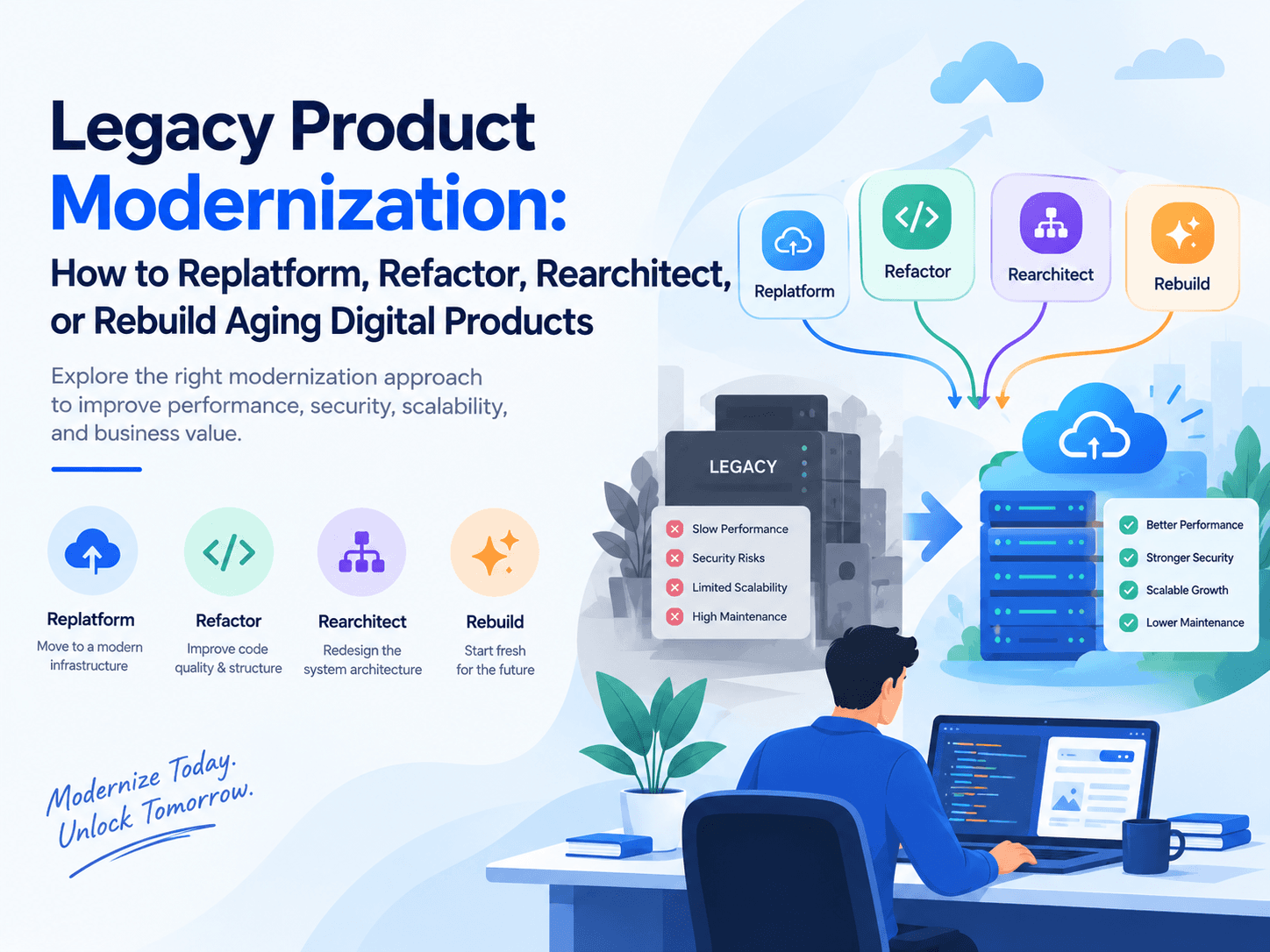
Quick Summary :- Legacy product modernization helps businesses transform aging digital products that have become difficult to maintain, scale, secure, or improve. The blog explains when modernization is needed and compares key approaches such as replatforming, refactoring, rearchitecting, rebuilding, and retiring legacy systems. It also covers incremental modernization, AI-assisted modernization, technical debt, modernization roadmaps, common mistakes, and strategies for preventing future legacy problems.
Digital products rarely become outdated overnight. More often, they gradually accumulate technical debt, outdated dependencies, fragmented integrations, inefficient workflows, and architectural limitations until making even a small change becomes difficult.
A product that once gave a business a competitive advantage can eventually become one of its biggest constraints.
This is the dead zone of the digital product lifecycle: the stage where a product is still too important to retire, but too outdated to support future growth efficiently.
Legacy product modernization provides a way out.
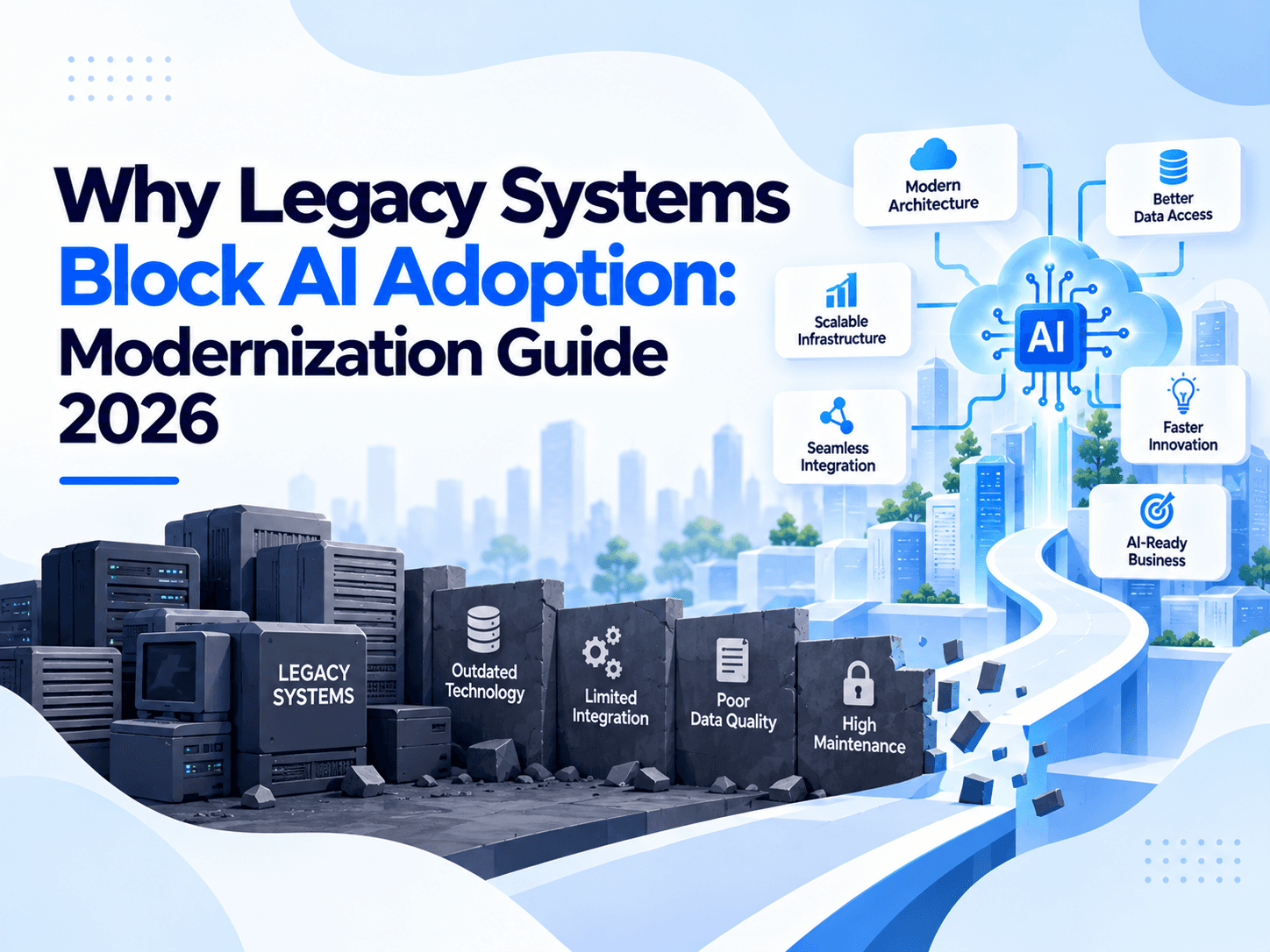
Instead of simply replacing an old product with something new, modernization involves understanding what still creates business value, identifying what has become a liability, and choosing the right transformation strategy whether that means replatforming, refactoring, rearchitecting, rebuilding, or retiring parts of the product.
The need is significant. McKinsey reports that as much as 70% of software used by Fortune 500 companies was developed 20 or more years ago, highlighting how deeply legacy technology remains embedded in large organizations.
At the same time,McKinsey research has found that technical debt can represent 20% to 40% of the value of an organization's technology estate, while some CIOs report diverting part of their technology budgets toward resolving technical-debt issues instead of building new capabilities.
The question, therefore, is not simply:
“Should we modernize our legacy product?”
The more important question is:
“What should we modernize, why should we modernize it, and which modernization strategy creates the most business value?”
What Is Legacy Product Modernization?
Legacy product modernization is the process of transforming an aging digital product so that it can support current and future business, customer, technology, security, and scalability requirements.
A legacy product does not necessarily mean an old product that nobody uses.
In fact, some of the most difficult modernization projects involve products that are still heavily used and generate significant revenue.
A product can become “legacy” when its:
- Architecture is difficult to modify
- Technology stack is outdated
- Infrastructure is expensive to maintain
- Integrations are fragile
- Security controls are difficult to update
- User experience no longer matches customer expectations
- Data architecture limits analytics and automation
- Development cycle is too slow
- Documentation is incomplete
- Talent availability is declining
- Operating costs continue increasing
This is why modernization should be viewed as a business transformation initiative, not simply a software upgrade.
Your original digital product lifecycle may look like:
Strategy → Design → Development → Launch → Growth → Evolution
But when evolution is neglected for too long, another stage appears:
Evolution → Technical Debt → Stagnation → Modernization
The goal of modernization is to move the product back into a sustainable cycle of continuous evolution.
Why Legacy Products Become a Business Problem
Technology naturally ages.
A framework that was considered modern ten years ago may no longer receive meaningful support. An architecture designed for thousands of users may struggle when serving millions. An application built as a monolith may become difficult to integrate with APIs, cloud services, analytics platforms, or AI systems.
The problem becomes especially serious when the business continues adding features without addressing the underlying architecture.
Each new feature can introduce another dependency.
Each workaround can add another layer of complexity.
Eventually, the product team spends more time maintaining the existing system than creating new capabilities.
McKinsey describes technical debt as the accumulation of technology work that organizations need to address in the future. Its research found that technical debt can account for 20%–40% of the value of an organization's technology estate.
Selected legacy modernization indicators
The following statistics illustrate the scale of the problem, although they come from different studies and populations and therefore should not be treated as directly comparable.
For example, a 2025 U.S. Governemnt Accountability Office review found that federal agencies typically reported spending about 80% of their IT investments on operations and maintenance of existing systems, including legacy systems.
Meanwhile, a 2025 survey of more than 500 U.S. IT professionals reported that 62% of organizations still rely on legacy software.
These figures point to the same broader issue: legacy technology can consume significant resources while making future change harder.
The Hidden Costs of an Aging Digital Product
The cost of a legacy product is rarely limited to its maintenance bill.
The bigger cost can be the opportunities the product prevents the business from pursuing.
1. Slower Product Development
When the architecture is difficult to change, even simple features require extensive investigation and regression testing.
A feature that should take two weeks can become a multi-month project.
This affects:
- Time to market
- Customer satisfaction
- Product experimentation
- Competitive response
- Engineering productivity
McKinsey has found that companies with higher levels of technical debt are more likely to experience incomplete or canceled modernization programs.
2. Rising Maintenance Costs
Older systems often require specialized skills.
If the technology stack uses outdated languages, frameworks, or proprietary infrastructure, finding engineers who understand the system can become increasingly difficult.
The business may then become dependent on a small number of specialists.
That creates operational risk.
3. Security and Compliance Risks
Older products may rely on:
- Unsupported libraries
- Outdated authentication methods
- Unpatched infrastructure
- Weak encryption standards
- Hard-coded credentials
- Legacy APIs
- Poor access-control models
Modernization does not automatically make a product secure, but it creates an opportunity to redesign security around current requirements.
4. Poor Customer Experience
Customers do not care whether an application is technically old.
They care whether it works.
They expect:
- Fast interfaces
- Mobile-friendly experiences
- Reliable transactions
- Personalized interactions
- Simple navigation
- Real-time information
- Seamless integrations
A product can therefore become outdated from a customer-experience perspective even when its underlying technology continues functioning.
5. Integration Limitations
Modern digital ecosystems depend heavily on APIs, cloud platforms, analytics systems, automation tools, and third-party services.
Legacy architecture can make these integrations expensive and fragile.
A product may technically support integration, but if every integration requires custom middleware and manual workarounds, its architecture is becoming a constraint.
When Should You Modernize a Legacy Product?
Not every old product needs to be modernized.
Sometimes the correct decision is to keep it stable.
Sometimes it should be retired.
Sometimes only one part of the system needs to change.
A useful modernization decision begins by asking five questions:
Question | What It Reveals |
Is the product strategically important? | Business value |
Is the technology limiting growth? | Modernization urgency |
Is maintenance becoming expensive? | Financial pressure |
Are customers experiencing problems? | Experience impact |
Can the architecture support future capabilities? | Long-term viability |
If the product remains profitable, stable, secure, and fit for purpose, modernization may not need to be immediate.
But if the product is strategically important and increasingly difficult to evolve, modernization becomes more compelling.
The 5 Main Legacy Product Modernization Strategies
Modernization does not have one universal solution.
The right approach depends on the product's architecture, business value, technical debt, risk tolerance, budget, and future roadmap.
The five common strategies are:
- Replatform
- Refactor
- Rearchitect
- Rebuild
- Retire or Replace
Let's examine each.
1. Replatforming: Move Without Completely Rebuilding
Replatforming means moving an existing application to a newer platform while making relatively limited changes to the application's core architecture.
For example, an organization might move an application from traditional infrastructure to a modern cloud environment while preserving much of the existing application logic.
Replatforming is useful when:
- The existing application still works reasonably well
- Infrastructure is the main limitation
- Cloud scalability is needed
- The organization wants to reduce infrastructure management
- A full rewrite would create unnecessary risk
Example
Imagine an e-commerce platform running on aging physical servers.
Instead of rebuilding the entire application, the company could migrate the application to a cloud platform, modernize its deployment pipeline, improve monitoring, and gradually replace problematic components.
Main advantage
Lower disruption compared with a complete rebuild.
Main limitation
The application may still contain significant technical debt.
Moving old architecture to new infrastructure does not automatically make the architecture modern.
2. Refactoring: Improve the Code Without Changing the Product
Refactoring focuses on improving the internal structure of existing software without fundamentally changing what the product does.
Typical refactoring activities include:
- Removing duplicated code
- Improving code organization
- Updating dependencies
- Simplifying complex functions
- Improving automated tests
- Reducing technical debt
- Improving maintainability
The customer may see almost no difference.
That is intentional.
The objective is to make the product easier and safer to change.
When should you refactor?
Refactoring is particularly useful when the architecture remains suitable but the implementation has become difficult to maintain.
It can also be incorporated into normal product development rather than treated as one enormous transformation project.
3. Rearchitecting: Change the Technical Foundation
Rearchitecting goes deeper.
Instead of simply cleaning up existing code, the organization changes the architecture to support new business requirements.
For example, a monolithic application might be decomposed into modular services.
An old data layer might be redesigned.
A tightly coupled system might be transformed into an API-driven architecture.
Rearchitecting can help when:
- The current architecture prevents scalability
- New integrations are difficult
- Deployment is slow
- Components are tightly coupled
- The organization needs greater flexibility
- The product needs to support significantly different workloads
However, rearchitecting introduces greater complexity and risk than simple refactoring.
The architecture should therefore be changed because the business needs it—not simply because a newer architectural pattern is fashionable.
4. Rebuilding: Create a New Product Around Existing Business Knowledge
Sometimes the legacy product is simply too constrained.
In such situations, rebuilding may make more sense.
A rebuild means developing a new implementation while retaining useful knowledge from the existing product.
That knowledge might include:
- Customer workflows
- Business rules
- Data models
- Product requirements
- Operational processes
- User research
- Lessons from previous failures
A rebuild should not mean copying every feature from the legacy system.
Instead, it is an opportunity to ask:
“If we were building this product today, what would we keep, remove, redesign, and add?”
This distinction is critical.
A poor modernization project simply reproduces the old product using new technology.
A successful rebuild uses modernization as an opportunity to improve the product itself.
5. Retire or Replace: Sometimes the Best Modernization Is Removal
Not every legacy application deserves another life.
Some products:
- Have declining usage
- Duplicate another application
- Have low strategic value
- Are expensive to maintain
- Exist only because nobody has formally retired them
In these situations, retirement may produce more value than modernization.
McKinsey's research emphasizes that technical debt is not evenly distributed across technology estates, meaning organizations should prioritize the assets where modernization can create meaningful business value rather than attempting to modernize everything indiscriminately.
Modernization Strategy Comparison
Strategy | Change Level | Risk | Best For | Typical Goal |
Replatform | Low–Medium | Low–Medium | Infrastructure limitations | Move to a better platform |
Refactor | Medium | Medium | Code complexity | Improve maintainability |
Rearchitect | High | Medium–High | Architectural limitations | Enable scalability and flexibility |
Rebuild | Very High | High | Fundamentally outdated products | Create a modern product |
Retire/Replace | Strategic | Variable | Low-value legacy products | Remove unnecessary complexity |
The important point is that these approaches are not always mutually exclusive.
A company might:
Replatform → Refactor → Rearchitect → Retire specific components
over several years.
The Strangler Pattern: Modernize Without Switching Everything at Once
One of the biggest challenges with legacy modernization is the “big bang” problem.
If an organization tries to replace the entire product simultaneously, the project can become expensive, risky, and difficult to control.
A gradual approach is often more manageable.
One popular pattern is the Strangler Fig Pattern.
The basic idea is:
- Keep the existing application running.
- Identify one business capability.
- Build the modern version.
- Route traffic to the new capability.
- Monitor its performance.
- Gradually reduce dependency on the legacy component.
- Repeat the process.
This creates a transition from:
Legacy Product → Hybrid Product → Modern Product
rather than:
Legacy Product → Big Bang Rewrite → Unknown Outcome
Google Cloud has also advocated lean modernization approaches that emphasize incremental modernization and smaller teams rather than attempting to transform everything at once.
How to Build a Legacy Modernization Roadmap
Modernization should begin with discovery, not coding.
Phase 1: Inventory the Product
Create a complete inventory of:
- Applications
- Services
- Databases
- APIs
- Integrations
- Infrastructure
- Dependencies
- Vendors
- User journeys
- Business processes
Without an accurate inventory, modernization decisions are based on assumptions.
Phase 2: Measure Technical Debt
Do not simply label an application “old.”
Measure the actual problem.
Useful indicators include:
- Number of outdated dependencies
- Code complexity
- Deployment frequency
- Incident frequency
- Mean time to recovery
- Infrastructure cost
- Maintenance hours
- Security vulnerabilities
- Integration complexity
- Defect rates
- User satisfaction
McKinsey recommends creating granular transparency into technical debt by connecting individual technology assets with their business value.
Phase 3: Map Business Value
A technically problematic application may still be extremely valuable.
Create a simple matrix:
Business Value | Technical Health | Recommended Action |
High | High | Continue evolving |
High | Low | Modernize |
Low | High | Maintain selectively |
Low | Low | Retire or replace |
This prevents teams from spending large modernization budgets on applications that no longer matter strategically.
Phase 4: Choose the Right Modernization Strategy
Once the product is assessed, decide whether each component should be:
Keep → Replatform → Refactor → Rearchitect → Rebuild → Retire
The decision should consider both technical and business factors.
For example:
Component A
High revenue + outdated infrastructure
→ Replatform
Component B
High complexity + valuable architecture
→ Refactor
Component C
Severe architectural limitations
→ Rearchitect
Component D
Low business value + high maintenance cost
→ Retire
This component-level approach is often more practical than trying to classify an entire product with one modernization strategy.
Phase 5: Build a Modernization Business Case
Technology teams should not present modernization only as:
“We need to upgrade the technology.”
Executives need to understand the business impact.
A modernization business case can include:
- Reduced maintenance costs
- Faster feature delivery
- Lower infrastructure costs
- Improved security
- Reduced downtime
- Better customer experience
- Improved scalability
- Faster experimentation
- Easier hiring
- Better analytics capabilities
McKinsey reports that technology can account for as much as 71% of the value generated by business transformations in some sectors, emphasizing why technology decisions can have significant business implications.
Phase 6: Modernize in Controlled Increments
Avoid attempting to modernize everything simultaneously.
Instead:
Step 1
Select a high-value, manageable capability.
Step 2
Create the modern version.
Step 3
Run automated and business testing.
Step 4
Release to a controlled user group.
Step 5
Measure results.
Step 6
Increase adoption.
Step 7
Decommission the legacy component.
Step 8
Move to the next capability.
This approach reduces risk while creating measurable progress.
What Role Does AI Play in Legacy Modernization?
Artificial intelligence is increasingly becoming part of modernization programs.
AI can potentially assist with:
- Legacy code analysis
- Code documentation
- Code translation
- Test generation
- Dependency analysis
- Architecture discovery
- Data mapping
- Documentation generation
- Migration planning
- Automated code review
McKinsey report in 2024 that its experience with generative-AI-assisted modernization indicated potential acceleration of modernization timelines by 40%–50% and reductions in technology-debt-related costs of around 40% in certain applications and contexts. These are McKinsey's reported observations, not universal benchmarks for every modernization program.
The important distinction is that AI should not simply translate old code into a new programming language.
That can move technical debt from one technology stack to another.
The better question is:
“What business capability should this code support, and what should the modern implementation look like?”
Common Legacy Modernization Mistakes
1. Rebuilding Everything
A complete rewrite sounds attractive.
But it can take years.
During that time, the existing product continues to evolve, meaning the new system can become outdated before it is finished.
2. Modernizing Technology Without Modernizing the Product
Replacing an old framework does not automatically create a better customer experience.
Modernization should consider:
Technology + Architecture + Data + Processes + UX + Business Goals
3. Ignoring Data
Data is often the most difficult part of modernization.
Legacy products may contain:
- Duplicate records
- Inconsistent schemas
- Historical databases
- Hidden business rules
- Manual data processes
Ignoring these issues can create problems after migration.
4. Forgetting the User
A modernization project can become so focused on architecture that product teams forget the people using the product.
Customer research should remain part of the process.
5. Measuring Technical Progress Instead of Business Outcomes
Counting migrated applications is not enough.
Instead, track outcomes such as:
Metric | Before Modernization | Target |
Deployment time | Baseline | Reduced |
Release frequency | Baseline | Increased |
Critical incidents | Baseline | Reduced |
Infrastructure cost | Baseline | Reduced |
Page/API response time | Baseline | Improved |
Customer satisfaction | Baseline | Improved |
Development cycle time | Baseline | Reduced |
Legacy dependencies | Baseline | Reduced |
The exact targets should be established from the organization's baseline rather than copied from another company.
A Practical Legacy Modernization Framework
A useful framework is:
Assess → Prioritize → Design → Modernize → Validate → Decommission → Evolve
Assess
Understand the existing technology, architecture, users, data, dependencies, and business value.
Prioritize
Determine which systems and components deserve attention first.
Design
Define the target architecture and product experience.
Modernize
Use the appropriate strategy for each component.
Validate
Measure technical and business outcomes.
Decommission
Remove obsolete components instead of allowing them to remain indefinitely.
Evolve
Continue improving the modernized product.
This final step is crucial.
The goal of modernization is not to create another legacy product five years from now.
How to Prevent the Next Legacy Product
Modernization should ultimately change how products are built.
Organizations can reduce future technical debt by:
- Automating testing
- Maintaining documentation
- Using modular architecture
- Regularly updating dependencies
- Monitoring system health
- Reviewing architecture periodically
- Establishing technology standards
- Measuring technical debt
- Removing unused features
- Retiring obsolete services
- Incorporating security throughout development
Google Cloud's research around modern software engineering emphasizes practices such as integrating security earlier in the development lifecycle and using modern engineering approaches to improve business outcomes.
The objective is to move from periodic modernization projects to continuous product evolution.
Legacy Modernization vs. Digital Transformation
These concepts are related but different.
Legacy Modernization | Digital Transformation |
Focuses on existing technology | Focuses on broader business change |
Often targets applications and architecture | Can involve business models and operating models |
Reduces technical debt | Creates new digital capabilities |
Improves scalability and maintainability | Changes how organizations operate |
Can be a component of transformation | Often includes modernization as one workstream |
Modernization can therefore serve as an important foundation for broader digital transformation.
The Future of Legacy Product Modernization
Legacy modernization is becoming less about replacing old code and more about creating adaptable digital products.
Cloud infrastructure, APIs, automation, AI-assisted development, observability, modular architecture, and continuous delivery are changing how organizations approach aging technology.
But technology alone will not solve the problem.
The most important shift is strategic:
Stop treating legacy products as technical problems and start treating them as business assets that need lifecycle decisions.
Some components should be modernized.
Some should be rebuilt.
Some should be redesigned.
Some should be replaced.
And some should simply be retired.
The objective is not to make every piece of technology new.
The objective is to make the overall product ecosystem valuable, maintainable, secure, scalable, and capable of evolving.
Conclusion
Every digital product eventually reaches a stage where its original architecture, technology, and infrastructure no longer fully support changing business and customer needs. Legacy product modernization provides a structured way to address these challenges without automatically replacing everything from scratch.
The right approach depends on the product’s condition and business goals. Organizations may choose replatforming, refactoring, rearchitecting, rebuilding, or retiring different parts of the product based on their value, technical limitations, and future requirements.
Successful modernization is rarely about changing everything at once. It is about prioritizing the right areas, modernizing incrementally, measuring outcomes, and continuously improving the product. The ultimate goal is not simply to remove legacy technology, but to create a digital product that can evolve, scale, and stay relevant without becoming the next legacy system.
Frequently Asked Questions
Upgrading or replacing aging digital products to meet modern business and technology needs.
Replatforming, refactoring, rearchitecting, rebuilding, and retiring or replacing.
Look for high maintenance costs, outdated technology, security issues, poor scalability, and slow development.
It depends on the product. Rebuild when the architecture is fundamentally limiting; modernize when valuable components can be retained.
AI can assist with code analysis, documentation, testing, dependency analysis, and code transformation.
Use modular architecture, automated testing, monitoring, regular updates, and continuous modernization.
14 min read

Dhruv Patel
Dhruv Patel is the CEO of Zyora Global, bringing a strong technology background and a passion for building scalable digital solutions. With expertise in software development, product strategy, and business growth, he leads the company in delivering innovative web, mobile, AI, and enterprise solutions that help businesses accelerate their digital transformation.