



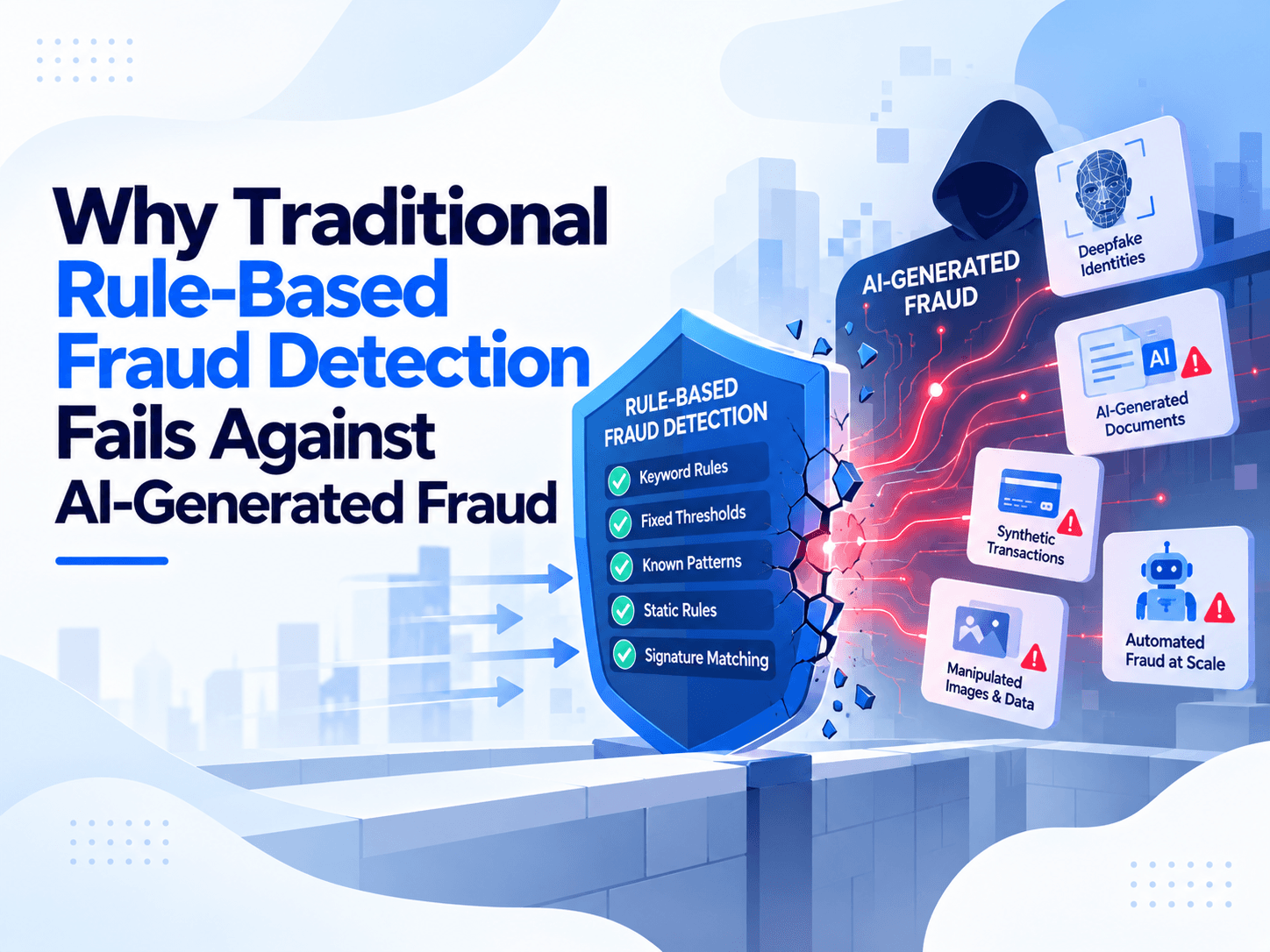
Quick Summary :- Traditional rule-based fraud detection can identify known fraud patterns, but it struggles with AI-generated documents, manipulated images, synthetic identities, and increasingly sophisticated fraud schemes. This blog explains the limitations of static rules and how machine learning, computer vision, NLP, graph analytics, and human investigation can help insurers build a more adaptive fraud detection strategy.
Insurance fraud is no longer limited to exaggerated claims, fake accidents, or fabricated paperwork. The rise of generative AI and sophisticated digital editing tools has made it easier to create convincing documents, alter images, manipulate videos, and produce believable narratives that can pass basic verification checks.
This is creating a new problem for insurers: fraud detection systems are often designed to identify known patterns, while modern fraudsters are constantly creating new ones.
According to the Coalition Against Insurance Fraud, insurance fraud costs American consumers approximately $308.6 billion every year. That scale makes fraud detection more than an operational concern it is a major financial and customer-experience issue.
At the same time, the fraud landscape is becoming increasingly digital. Verisk’s State of Insurance Fraud research found that 98% of insurers surveyed agree that AI-powered editing tools are driving an increase in digital media fraud, while 99% have encountered manipulated or AI-altered documentation and 76% say submissions have become more sophisticated over the previous year.
These changes expose a fundamental weakness in traditional rule-based fraud detection.
Rules can identify what insurers already know.
AI-powered fraud detection can help identify what insurers have not seen before.
What Is Rule-Based Insurance Fraud Detection?
Traditional insurance fraud detection generally relies on predefined business rules, thresholds, red flags, and manual investigation.
For example, an insurer might create rules such as:
- Flag a claim submitted shortly after a policy begins.
- Flag claims above a specific dollar amount.
- Flag multiple claims from the same address.
- Flag a claimant with a previous history of suspicious activity.
- Flag a vehicle involved in multiple accidents.
- Flag invoices containing specific suspicious patterns.
- Send claims with certain characteristics to a Special Investigation Unit (SIU).
This approach is not inherently bad.
In fact, rule-based systems remain useful because they are relatively easy to understand, audit, and implement. The problem occurs when insurers rely on them as the primary defense against increasingly sophisticated fraud.
The National Association of Insurance Commissioners' insurance fraud guidance notes that insurers are increasingly moving beyond traditional business rules and red flags toward predictive modeling, link analysis, and artificial intelligence.
The fundamental problem is simple:
A rule can only detect a condition that someone has already thought to define.
Modern fraudsters are increasingly exploiting everything outside those predefined conditions.
Why Traditional Fraud Detection Is Struggling
Traditional systems were designed around relatively predictable fraud patterns.
AI-enabled fraud changes the equation.
A fraudster can potentially create a realistic-looking repair invoice, modify vehicle damage images, generate supporting documentation, or construct a convincing claimant narrative without using exactly the same indicators that an insurer's existing rules are designed to detect.
That creates several weaknesses.
Traditional challenge | Why it matters | How AI can help |
Static rules | Fraud patterns evolve faster than rule updates | Models can learn from new patterns |
Claim-by-claim analysis | Hidden relationships may be missed | Graph analytics connects entities |
Manual document review | Large volumes are difficult to review consistently | AI can analyze documents at scale |
Image inspection | Manipulations can be difficult to spot manually | Computer vision detects visual inconsistencies |
Fixed thresholds | Sophisticated fraud can stay below thresholds | Risk models evaluate multiple signals |
High false positives | Investigators waste time on legitimate claims | Risk scoring prioritizes cases |
Limited historical context | Individual claims may appear normal | AI can compare against broader claim histories |
The result is not necessarily that traditional rules become useless.
Instead, rules become one layer of a broader fraud detection architecture.
AI-Generated Fraud Is Changing the Threat Landscape
The most important change is accessibility.
Advanced digital manipulation is no longer restricted to highly skilled technical attackers. Consumer-facing AI and editing tools have made sophisticated content creation significantly easier.
Verisk’s research found that 57% of surveyed consumers had used AI editing tools, and 41% said they knew someone who had used AI editing tools to alter or create a photo, video, or document for financial gain.
This does not mean every AI-edited image represents insurance fraud.
It does mean insurers need to consider a different threat model.
Fraudulent evidence can potentially look increasingly legitimate.
Examples include:
- AI-assisted document alteration
- Manipulated vehicle damage photographs
- Reused or modified claim images
- Synthetic identities
- Fabricated supporting documents
- Automatically generated claimant narratives
- Coordinated fraudulent applications
- Altered invoices
- Digitally manipulated medical or repair documentation
The challenge is therefore no longer simply:
"Is this claim suspicious?"
It becomes:
"Can we verify whether the evidence supporting this claim is authentic, consistent, and connected to reality?"
The Biggest Weakness of Rule-Based Systems: Static Logic
Consider a simple rule:
If claim amount > $50,000, flag for investigation.
This rule is easy to understand.
But what happens if a fraudster submits five claims worth $10,000 each?
The rule may never trigger.
Now consider another rule:
If two claims come from the same address, investigate.
What if fraudsters use several addresses but share the same repair shop, phone number, vehicle, bank account, or healthcare provider?
Again, the individual rules may not identify the larger pattern.
This is where AI and graph-based analysis can provide a significant advantage.
Instead of asking:
"Does this claim violate a rule?"
an AI system can ask:
"How unusual is this claim compared with millions of previous claims, and what relationships does it have with other entities?"
That is a much broader question.
AI vs. Rule-Based Fraud Detection
The difference becomes clearer when comparing how both approaches process information.
Capability | Rule-Based Detection | AI-Powered Detection |
Static business rules | Excellent | Excellent |
Known fraud patterns | Strong | Strong |
Unknown anomalies | Limited | Stronger |
Large-scale data analysis | Limited | Strong |
Image analysis | Limited | Strong |
Document analysis | Limited | Strong |
Relationship detection | Limited | Strong with graph analytics |
Continuous learning | Usually manual updates | Can learn from validated outcomes |
Explainability | Usually high | Depends on model |
Adaptability | Low to moderate | High |
Human investigation support | Alerts | Risk scores + evidence |
Real-time risk scoring | Possible | Strong use case |
The best approach is therefore not necessarily AI replacing rules.
It is AI working alongside rules, investigators, and existing claims infrastructure.
How AI Detects Fraud That Rules Miss
AI-powered insurance fraud detection can combine multiple technologies rather than relying on one model.
The major components include machine learning, natural language processing, computer vision, anomaly detection, predictive analytics, and graph analytics.
1. Machine Learning and Anomaly Detection
Machine learning models can analyze historical claims to identify patterns associated with legitimate and suspicious behavior.
Instead of relying only on fixed thresholds, models can evaluate combinations of variables.
For example, a claim may contain:
- A relatively normal claim amount
- A recently issued policy
- A repair shop with unusual activity
- A claimant with multiple historical claims
- A suspicious document
- A vehicle appearing in another claim
- A timing pattern associated with previous fraud cases
Each signal may appear harmless independently.
Together, however, they could produce a significantly higher risk score.
This is one of the biggest differences between traditional rules and machine learning.
A rule evaluates a condition.
A model can evaluate relationships among many conditions simultaneously.
2. Computer Vision Can Examine Claim Images
Images are becoming increasingly important in insurance claims.
Auto insurers may receive photographs of:
- Vehicle damage
- Accident scenes
- Repair work
- Parts
- Odometers
- Property damage
Traditional workflows may depend heavily on human inspection or simple image checks.
Computer vision can provide another layer of analysis.
AI can potentially compare visual evidence against:
- Previous claim images
- Vehicle information
- Damage descriptions
- Repair estimates
- Historical photographs
- Other claims involving the same vehicle
It can also identify visual inconsistencies that deserve investigation.
This is particularly relevant as AI editing tools make image manipulation easier.
Verisk reported that 99% of surveyed insurers had encountered manipulated or AI-altered documentation.
That makes document and image authenticity an increasingly important part of modern claims fraud prevention.
3. NLP Can Analyze Claimant Statements
Insurance claims contain enormous amounts of unstructured information.
Examples include:
- Claim descriptions
- Adjuster notes
- Emails
- Medical reports
- Recorded statements
- Customer communications
- Repair descriptions
Natural language processing can analyze this information for inconsistencies and unusual patterns.
For example, an AI system might compare a claimant's initial accident description with later statements.
It could identify:
- Contradictory dates
- Conflicting descriptions
- Changes in reported circumstances
- Unusual terminology
- Inconsistent descriptions of damage
The purpose is not to automatically declare someone fraudulent.
Instead, NLP can surface information that an investigator should examine more closely.
4. Graph Analytics Can Reveal Fraud Rings
Some of the most difficult fraud schemes are organized.
A single claim may look legitimate.
A network of claims may reveal something completely different.
Imagine that an insurer discovers:
- 12 claimants
- 4 repair shops
- 3 vehicles
- 5 addresses
- 2 phone numbers
- Several overlapping claims
A conventional claim-by-claim system might evaluate each case independently.
Graph analytics can map relationships between these entities.
Simplified fraud network
Claimant A
|
Vehicle 1
|
Repair Shop X
/ \
Claimant B Claimant C
| |
Address 1 Phone Number 2
\ /
Claimant D
The individual claims may not trigger traditional rules.
The network can reveal a suspicious relationship structure.
This is why graph analytics is becoming an important component of advanced fraud detection.
Why False Positives Matter
Fraud detection has another major problem:
Not every suspicious claim is fraudulent.
If an insurer flags too many legitimate claims, several problems occur.
Investigators spend time reviewing legitimate customers.
Claims processing becomes slower.
Customers experience unnecessary friction.
SIU teams become overloaded.
Operational costs increase.
This creates a balancing problem:
Detect more fraud without investigating everyone.
AI-powered risk scoring can help by assigning different levels of risk rather than producing a simple yes/no decision.
For example:
Risk level | Example action |
Low | Straight-through processing |
Medium | Additional automated verification |
High | Adjuster review |
Very high | SIU investigation |
This approach allows insurers to reserve human investigation for cases that require it.
The goal should not be:
"Use AI to reject suspicious claims."
The goal should be:
"Use AI to identify which claims deserve deeper investigation."
How AI Changes the Insurance Claims Workflow
A modern AI-assisted workflow can operate across the entire claims lifecycle.
Step 1: First Notice of Loss
The claim enters the system.
The insurer collects:
- Policy information
- Claimant information
- Accident details
- Images
- Documents
- Location information
- Historical claim information
Step 2: Data Validation
AI checks the submitted information against existing records.
It can identify:
- Missing information
- Inconsistencies
- Duplicate data
- Suspicious documentation
- Unusual claim characteristics
Step 3: Fraud Risk Assessment
Machine learning evaluates the claim against historical patterns.
Computer vision analyzes images.
NLP analyzes text.
Graph analytics evaluates relationships.
The system generates a risk score.
Step 4: Intelligent Routing
Low-risk claims can continue through automated processing.
Higher-risk claims receive additional scrutiny.
Step 5: Investigator Review
Investigators receive supporting evidence rather than simply an alert.
This could include:
- Risk factors
- Similar historical claims
- Suspicious documents
- Image inconsistencies
- Connected entities
- Claimant history
Step 6: Resolution
The claim is ultimately:
- Approved
- Adjusted
- Escalated
- Investigated
- Rejected where appropriate
Step 7: Continuous Learning
Confirmed outcomes can be incorporated into future model development and monitoring.
This creates a feedback loop that helps fraud detection evolve.
Why AI Is Better Suited to Changing Fraud Patterns
The biggest advantage of AI is not simply speed.
It is adaptability.
Fraud evolves.
A fraudster who discovers that insurers are checking one indicator can change behavior to avoid that indicator.
Traditional systems then require a new rule.
That creates a cycle:
New fraud → manual discovery → new rule → fraud adaptation → new investigation
AI can shorten this cycle by continuously analyzing patterns and identifying anomalies.
However, this does not mean AI automatically learns every new fraud technique without human involvement.
Models still require:
- Quality data
- Monitoring
- Validation
- Model governance
- Investigator feedback
- Regular testing
- Appropriate retraining
AI improves adaptability, but it does not eliminate the need for people.
AI Adoption in Insurance Is Already Expanding
AI-powered fraud detection is not simply a theoretical future use case.
The National Association of Insurance Commissioners (NAIC) AI overview reports that among surveyed insurers, 88% of responding auto insurers, 70% of home insurers, 58% of life insurers, and 92% of health insurers said they use, plan to use, or plan to explore AI/ML in their operations.
The NAIC also reports that AI is being used or explored in insurance claims and fraud detection, including areas such as accident image analysis, claim settlement estimation, and fraud detection.
Why Human Investigators Still Matter
One common misconception is that AI will completely replace fraud investigators.
That is unlikely to be the ideal operating model.
The NAIC's current AI guidance emphasizes that insurers remain responsible for complying with insurance laws and consumer protection requirements when AI is used, including considerations around fairness, accuracy, explainability, and human oversight.
AI is particularly valuable for processing enormous amounts of information.
Investigators are valuable for judgment.
For example, AI might identify that:
Claim A shares several unusual characteristics with 17 previous claims.
An investigator can then determine whether those similarities represent:
- Legitimate behavior
- A recurring business pattern
- Data quality problems
- Coincidence
- Or coordinated fraud
This is why the strongest model is human + AI, rather than AI alone.
Explainability Becomes Critical
A fraud detection system should not simply say:
"Risk score: 94/100."
Investigators need to understand why.
A better output could be:
High-risk indicators include repeated vehicle involvement, document similarity with previous claims, unusual repair-provider relationships, and inconsistent accident descriptions.
This provides actionable evidence.
Explainability also matters because insurance is a highly regulated industry.
The NAIC’s AI principles emphasize areas including fairness, accountability, compliance, transparency, and safe and robust AI systems.
The NAIC’s 2026 work also includes development of tools intended to help regulators evaluate insurers' AI systems, governance, risk mitigation, data inputs, and potentially high-risk models.
Therefore, insurers should treat explainability and governance as part of fraud detection architecture not as features added later.
The Challenge of Legacy Insurance Systems
Replacing an insurer's entire claims infrastructure is rarely realistic.
Many insurers operate complex environments containing:
- Policy administration systems
- Claims management platforms
- Document systems
- Customer databases
- SIU applications
- Data warehouses
- Third-party services
AI therefore needs to integrate with existing workflows.
Should Insurers Abandon Rule-Based Fraud Detection?
No.
Rules still have important advantages.
They are:
- Easy to understand
- Fast to execute
- Simple to audit
- Useful for regulatory controls
- Effective for known patterns
- Easy to configure for specific business requirements
The better strategy is a hybrid fraud detection model.
For example:
Layer | Purpose |
Business rules | Detect known conditions |
Machine learning | Identify complex patterns |
Anomaly detection | Find unusual behavior |
Computer vision | Analyze images |
NLP | Analyze text and statements |
Graph analytics | Find connected fraud |
Human investigators | Apply judgment |
Feedback loop | Improve future detection |
This architecture gives insurers the predictability of rules and the adaptability of AI.
7 Signs Your Fraud Detection Strategy Needs an AI Layer
Your existing system may need modernization if:
1. Your rules require constant manual updates
If fraud teams continually create new rules because old ones become ineffective, the system may be too dependent on static logic.
2. Investigators receive too many alerts
A high number of false positives can reduce investigation efficiency.
3. You analyze claims individually
Fraud networks often involve relationships across multiple claims.
4. Your team manually reviews thousands of documents
Document AI can help prioritize and compare large volumes of evidence.
5. Your organization struggles with image manipulation
Computer vision can provide an additional layer of evidence validation.
6. Fraud detection happens too late
If suspicious claims are discovered only after payment, prevention opportunities have already been lost.
7. Your fraud system cannot learn from outcomes
A modern system should incorporate validated investigation results into model monitoring and improvement processes.
How Insurers Can Transition From Rules to AI
Moving from rule-based fraud detection to AI does not require a complete transformation overnight.
A phased approach is usually more practical.
Phase 1: Identify the biggest fraud gaps
Start by analyzing:
- Fraud losses
- False-positive rates
- Investigation volume
- Claim processing delays
- Common fraud types
- Data availability
Phase 2: Choose a focused use case
Start with a high-value problem such as:
- Duplicate claims
- Document fraud
- Auto damage analysis
- Provider fraud
- Claims triage
Phase 3: Build the data foundation
AI requires reliable data.
Connect relevant:
- Claims data
- Policy data
- Customer data
- Historical investigation outcomes
- Documents
- Images
- External signals where legally appropriate
Phase 4: Introduce risk scoring
Rather than immediately automating decisions, use AI to prioritize claims for human review.
This creates a safer starting point.
Phase 5: Add advanced analytics
Once the foundation is working, insurers can introduce:
- Computer vision
- NLP
- Graph analytics
- Anomaly detection
- Generative AI assistants
- AI agents
Phase 6: Continuously monitor performance
Track:
- Fraud detection rate
- False positives
- Investigator productivity
- Claims cycle time
- Model drift
- Customer impact
- Compliance metrics
The Future of Insurance Fraud Detection
The next generation of insurance fraud detection will likely be less dependent on a single fraud score.
Instead, insurers will increasingly use interconnected AI systems.
One AI component may analyze documents.
Another may inspect images.
Another may analyze claimant communications.
Another may evaluate relationships.
Another may summarize the evidence for an investigator.
These systems can work together while keeping human investigators in the decision-making loop.
The shift is therefore from:
Rules → Alerts → Manual Investigation
to:
Rules + AI → Risk Intelligence → Evidence-Based Investigation
That distinction is important.
The objective is not simply to catch more fraud.
It is to create a claims operation that can distinguish legitimate customers from increasingly sophisticated fraudulent activity while minimizing unnecessary friction.
Conclusion
Traditional rule-based fraud detection is not disappearing, but relying on static rules alone is becoming increasingly difficult as fraudsters gain access to AI-powered editing, synthetic content, sophisticated document manipulation, and coordinated digital techniques. The scale of the problem is substantial, with the Coalition Against Insurance Fraud estimating that insurance fraud costs American consumers $308.6 billion annually. Meanwhile, Verisk's research shows that insurers are increasingly encountering AI-altered documentation and more sophisticated digital fraud. The solution is not to replace traditional fraud rules, but to build a layered fraud detection strategy that combines business rules, machine learning, computer vision, NLP, graph analytics, and human investigation. While rules remain effective for known fraud patterns, AI enables insurers to analyze complex relationships, identify unusual behavior, evaluate unstructured evidence, and detect emerging patterns at scale. For insurers, the key question is therefore no longer simply whether their systems can detect known fraud, but whether those systems can adapt as fraud continues to evolve. This is where AI-powered insurance fraud detection can deliver significant value by helping insurers reduce fraudulent payouts, improve investigation efficiency, minimize unnecessary claim delays, and build a more adaptable and resilient fraud prevention strategy.
Frequently Asked Questions
Rule-based systems rely on predefined conditions, making them less effective against new and constantly changing AI-generated fraud techniques.
AI can identify unusual patterns, relationships, and manipulated evidence that traditional rule-based systems may overlook.
Examples include manipulated images, AI-altered documents, synthetic identities, fabricated invoices, and coordinated fraudulent claims.
No. Rules remain useful for known fraud patterns, while AI can add adaptive detection and deeper analysis.
Insurers can combine existing rules with machine learning, computer vision, NLP, graph analytics, automated workflows, and human investigator review.
12 min read

Dhruv Patel
Dhruv Patel is the CEO of Zyora Global, bringing a strong technology background and a passion for building scalable digital solutions. With expertise in software development, product strategy, and business growth, he leads the company in delivering innovative web, mobile, AI, and enterprise solutions that help businesses accelerate their digital transformation.