


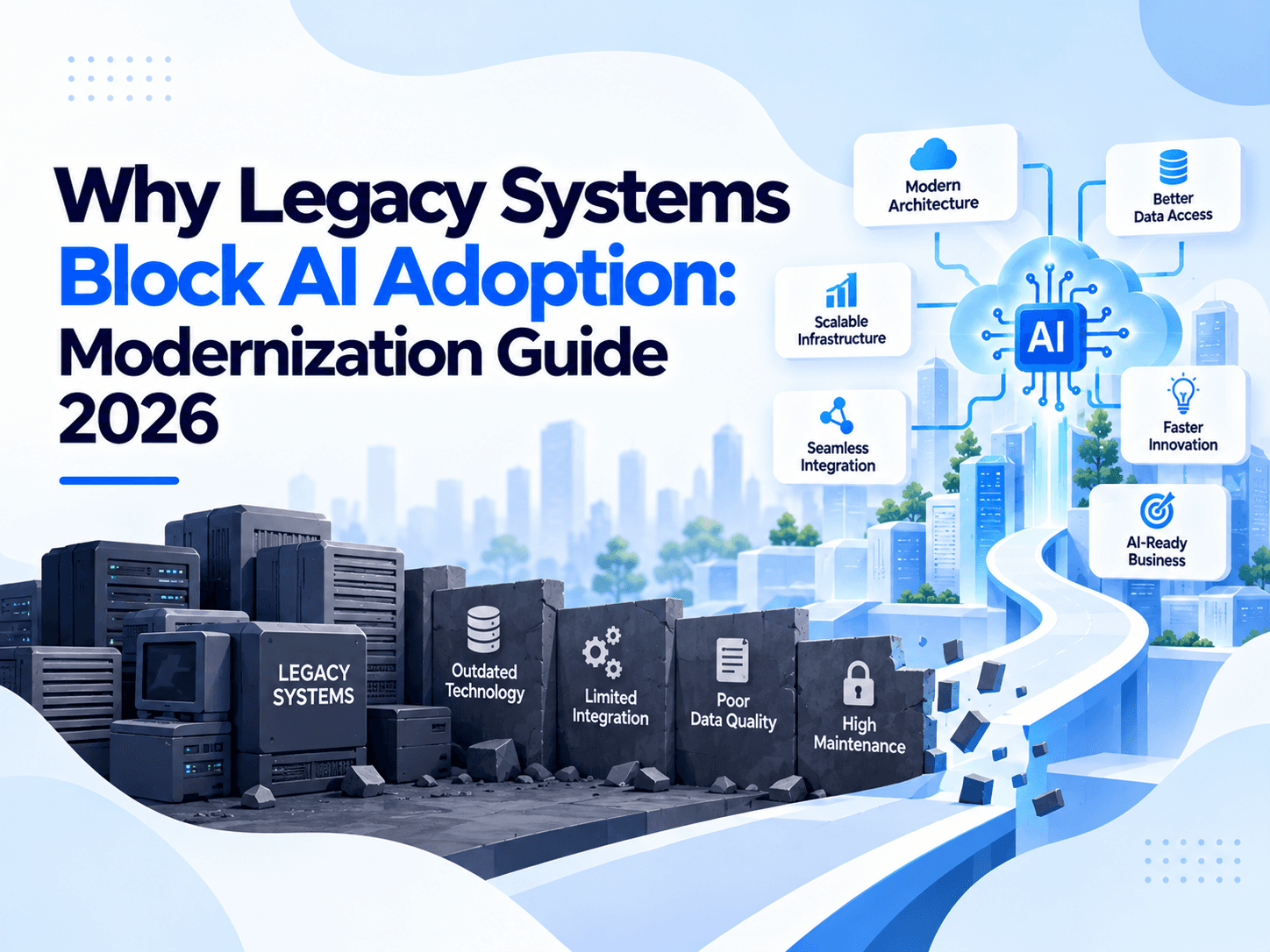
Quick Summary :- Legacy systems can limit AI adoption through fragmented data, outdated integration, and technical debt. Discover how AI-assisted modernization, secure architecture, and phased implementation help enterprises prepare existing applications for AI.
Artificial intelligence is changing how enterprises develop software, analyze data, automate workflows, and make business decisions. Yet many organizations struggle to move AI initiatives beyond experimentation. The problem is not always the AI model, the development team, or the use case. In many cases, the underlying technology infrastructure was never designed to support modern AI workloads.
Legacy systems often contain years of business logic, fragmented databases, tightly coupled applications, outdated interfaces, and undocumented dependencies. These systems may continue to support essential business operations, but they can make it difficult to connect AI applications to reliable data, integrate new capabilities, and introduce changes without disrupting existing processes.
The challenge is becoming increasingly relevant as organizations move from AI experimentation to enterprise-wide implementation. According to Deloitte's Tech Trends 2026 report, 71% of surveyed organizations are modernizing core infrastructure to support AI implementation. This demonstrates that preparing existing technology for AI is becoming a significant part of enterprise technology strategy.
The solution does not necessarily involve replacing every legacy application. Enterprises can use AI-assisted code analysis, API modernization, data integration, automated testing, and phased migration to improve existing systems while protecting critical business operations.
This guide explains why legacy systems block AI adoption, how AI-powered modernization addresses these challenges, which strategies enterprises should consider, and how to measure the results.
Key Takeaways
- Legacy systems restrict AI adoption through fragmented data, outdated interfaces, architectural limitations, and undocumented business rules.
- AI-powered modernization can accelerate code analysis, documentation, dependency mapping, refactoring, and testing.
- Enterprises do not always need a complete system replacement; selective modernization can address the most important limitations.
- Human review, security controls, and regression testing remain essential when AI changes business-critical software.
- A phased modernization strategy helps organizations measure progress and manage risk before expanding to more applications.
Why Legacy Systems Are Becoming a Barrier to AI Adoption
Legacy systems are not necessarily outdated because they are old. Many continue to support reliable financial transactions, customer records, manufacturing processes, and operational workflows.
The problem arises when their architecture prevents them from exchanging data efficiently, supporting modern interfaces, or adapting to new business requirements.
For example, an enterprise might introduce an AI assistant to answer customer questions. The assistant may be capable of understanding natural language, but it cannot provide accurate account information if the relevant records are spread across disconnected databases or accessible only through an old application with no suitable integration interface.
Similarly, an AI forecasting model may generate useful predictions but struggle to influence purchasing decisions if the inventory system cannot accept updated recommendations through a controlled interface.
These limitations create a gap between what AI can theoretically accomplish and what an organization can implement in production.
The Growing Need for AI-Ready Infrastructure
The relationship between AI adoption and modernization is becoming more apparent in enterprise technology planning.
Deloitte reports that 71% of surveyed organizations are modernizing core infrastructure to support AI implementation. The same report states that 23% are investing 6% to 10% of annual revenue in modernizing core enterprise systems.
These findings suggest that infrastructure modernization is not simply a maintenance activity. It is increasingly connected to an organization's ability to introduce new digital capabilities and deliver measurable business outcomes.
Four Major Reasons Legacy Systems Block AI Adoption
The following issues explain why introducing AI into an established enterprise environment often requires more than deploying a model or purchasing an AI platform.
1. Fragmented Data and Limited Accessibility
AI systems depend on relevant, consistent, and accessible data. However, enterprise information is frequently distributed across relational databases, spreadsheets, on-premises applications, file servers, data warehouses, and third-party platforms.
A legacy customer relationship management (CRM) system might store customer details separately from an enterprise resource planning (ERP) application that manages orders and invoices. An AI assistant working with only one source could provide an incomplete answer or overlook an important transaction.
Data quality creates another challenge. Duplicate customer records, inconsistent naming conventions, missing fields, and outdated information can reduce the usefulness of AI-generated results.
The scale of this problem is reflected in Gartner's February 2025 research on AI-ready data. Gartner reported that 63% of organizations either lacked the right data management practices for AI or were unsure whether they had them. The research also forecast that through 2026, organizations would abandon 60% of AI projects unsupported by AI-ready data.
This is a forecast, not a confirmed 2026 outcome. It nevertheless highlights why enterprises should evaluate data readiness before scaling AI.
How modernization helps: Organizations can introduce governed data pipelines, standardize data formats, improve data quality, and create secure access layers that allow AI applications to retrieve information from approved sources. The objective is not necessarily to consolidate every database into one platform. It is to make the right data available with clear ownership, quality standards, and access controls.
2. Outdated APIs and Integration Limitations
Many older enterprise applications were built for predictable transactions rather than continuous communication with modern AI services. Some expose no APIs, while others depend on batch processing, proprietary protocols, or tightly coupled integrations.
Consider an AI-powered inventory forecasting application. It might predict a shortage several days before it occurs, but the prediction has limited operational value if the inventory system cannot accept recommendations or provide updated stock levels in a timely manner.
Integration problems also affect AI assistants, fraud detection, predictive maintenance, document processing, and automated customer service.
According to Gartner's April 2026 supply-chain technology survey, 56% of surveyed chief supply chain officers identified integration of AI with legacy systems and processes as a major challenge. The same survey found that 50% reported limited internal expertise or talent to implement and manage AI.
How modernization helps: Enterprises can build API layers, introduce event-driven integration where appropriate, and establish secure service interfaces between legacy applications and AI platforms. These changes let organizations retain reliable core systems while adding new capabilities around them.
3. Monolithic Architecture and Technical Debt
A monolithic application may contain customer management, billing, reporting, inventory, and other functions in one closely connected codebase. Over time, even a small change can affect multiple components.
This creates difficulties when teams attempt to introduce AI features. Developers may not know which functions depend on a particular module, whether a database change could affect other applications, or which undocumented rules must remain unchanged.
Technical debt makes the problem worse. Outdated libraries, duplicate logic, unsupported components, inconsistent coding practices, and limited test coverage increase the effort needed to make changes safely.
Moving a monolithic application to the cloud does not automatically remove these limitations. If the underlying architecture remains tightly coupled, the organization may simply operate the same constraints on a different infrastructure platform.
How modernization helps: Teams can map dependencies, document important business rules, separate selected functions into modules, and modernize the components that create the greatest barriers to AI integration. Microservices may be appropriate for some applications, but a modular monolith or a carefully designed API layer may be more practical for others.
4. Infrastructure That Cannot Support AI Workloads
Traditional enterprise infrastructure is often optimized for predictable workloads, scheduled processing, and established transaction volumes. AI workloads may require different compute capacity, high-throughput data access, rapid experimentation, and consistent response times.
For example, a legacy reporting platform might process overnight data successfully but struggle to support an AI application that needs current information throughout the day. Similarly, infrastructure that performs well for ordinary business transactions may not meet the latency requirements of real-time fraud detection.
In its September 2026 article, AWS described the infrastructure constraints that can block AI success. Citing a study of 501 senior executives by Tata Communications and Bloomberg Media Studios, AWS reported that 65% of enterprises operated legacy infrastructure not designed for AI's data and integration demands, while 29% said their systems could scale with changing business requirements.
These findings point to a need to assess infrastructure capacity, data access, application architecture, and operating processes together rather than assuming that a cloud migration alone makes a business AI-ready.
How AI-Powered Legacy Modernization Solves These Problems
AI is both a reason to modernize legacy systems and a tool that can assist with modernization itself. Generative AI and other automation techniques can help engineering teams understand existing applications, generate documentation, identify dependencies, propose code changes, and create tests.
However, AI-generated outputs must be checked against the actual system and its business requirements. The objective is to reduce repetitive engineering effort without surrendering control over critical software.
1. AI-Powered Code Analysis and Discovery
Legacy applications frequently contain code written decades ago, with incomplete documentation and business rules that are understood by only a small number of experienced employees.
AI-assisted code analysis can help explain functions, summarize modules, identify repeated logic, and suggest relationships between application components. It can also help teams investigate older languages such as COBOL, PL/I, and legacy versions of Java or C++.
For example, an insurance company may use a legacy application to calculate premiums based on customer information, policy conditions, and historical business rules. AI can help engineers locate relevant functions and document the sequence of calculations before they begin modifying the system.
This process makes modernization planning more informed, but generated explanations should be verified against source code, production behavior, and approved business documentation.
2. Automated Dependency Mapping
An application rarely operates in isolation. It may depend on databases, authentication services, scheduled jobs, external APIs, reporting tools, and other internal applications.
AI-assisted analysis can help identify dependencies by examining source code, configuration files, database queries, and available technical documentation. This can help teams understand the potential impact of changing a particular component.
The resulting dependency map supports decisions about migration order, testing scope, and integration design.
For instance, before changing an order-processing module, engineers can identify the invoicing, inventory, and reporting functions that rely on it. Those connections can then be included in regression testing and rollout planning.
3. AI-Assisted Code Refactoring and Translation
Refactoring improves code structure while preserving intended behavior. Code translation converts software from one language or framework to another.
AI tools can assist with both activities by suggesting equivalent code, explaining syntax, identifying obsolete patterns, and generating candidate replacements. This can be useful when modernizing selected COBOL modules into Java, updating older frameworks, or replacing unsupported libraries.
However, syntactically valid code is not necessarily behaviorally equivalent code.
Legacy systems may contain rounding rules, exception handling, date calculations, transaction sequences, and regulatory requirements that are not fully documented. An AI-generated replacement may overlook these details.
A controlled translation process should therefore include:
- Mapping existing business rules and dependencies.
- Establishing expected behavior through existing tests and approved specifications.
- Generating code changes in manageable units.
- Reviewing changes with experienced engineers and business owners.
- Comparing outputs between the original and modernized implementations.
- Testing performance, security, and failure scenarios before deployment.
AI can accelerate parts of this work, but it cannot independently guarantee that a complex enterprise application has been translated correctly.
4. Automated Test Generation and Regression Testing
Testing is one of the most important controls in AI-assisted modernization. A legacy application may work reliably despite having limited formal documentation because its behavior has been refined through years of production use.
Replacing that application without understanding its existing behavior can introduce defects that are difficult to detect immediately.
AI can help generate test cases, identify boundary conditions, propose synthetic test data, and create regression tests from existing code and documented requirements. Engineers can then compare the outputs of the old and modernized systems.
For example, a banking application might calculate interest using rules that depend on transaction dates, account types, and rounding conventions. A modernization team should verify that both implementations produce the expected results across ordinary transactions, boundary cases, and exceptional conditions.
Test generation should complement, not replace, established testing methods. Sensitive production data must also be protected, and generated tests must be reviewed for completeness and correctness.
5. Better Documentation and Knowledge Transfer
A major modernization challenge is the loss of institutional knowledge when experienced employees leave or move to other roles.
AI can help create initial technical documentation from source code, configuration files, interface definitions, and existing manuals. It can summarize functions, describe data flows, and produce draft explanations for developers who are unfamiliar with the system.
This documentation can shorten the time needed to investigate existing applications and provide a foundation for future maintenance.
Nevertheless, generated documentation should be treated as a draft until verified. Source code may reveal what a function does, but it may not fully explain why a business rule exists or whether that rule remains mandatory.
AI Modernization Capabilities at a Glance
Modernization activity | How AI helps | Essential control |
Code discovery | Summarizes modules and identifies patterns | Engineer verification |
Dependency mapping | Highlights relationships and potential impacts | Validate against runtime behavior |
Code translation | Suggests equivalent code in a target language | Functional and security testing |
Documentation | Generates technical explanations and draft manuals | Review by system owners |
Test generation | Proposes test cases and edge conditions | Coverage review and test execution |
Data preparation | Helps identify inconsistencies and transformation rules | Data governance and validation |
Architecture assessment | Supports analysis of modernization options | Architecture review and business alignment |
The greatest benefit comes when these capabilities operate within a controlled engineering workflow. Automating code generation without improving data quality, integration, testing, and governance can simply move existing problems into a new technology stack.
Choosing the Right Legacy Modernization Strategy
Not every legacy application needs the same treatment. Some systems can be retained with improved interfaces, while others need architectural changes or a complete replacement.
The right decision depends on business criticality, technical complexity, security requirements, integration needs, cost, and the expected lifespan of the application.
Four Common Modernization Approaches
Approach | What it involves | When it makes sense | Main consideration |
Retain and integrate | Keep the system and add secure interfaces | The system is stable and its core functions remain suitable | Existing technical limitations may remain |
Replatform | Move to a different infrastructure or managed platform with limited code changes | Infrastructure support or operational requirements need improvement | Application-level constraints may persist |
Refactor and rearchitect | Improve code structure, modularity, and integration | Technical debt prevents new capabilities from being introduced efficiently | Requires careful dependency analysis and testing |
Replace or rebuild | Introduce a new application to take over the existing system's role | The existing platform is no longer viable or maintainable | High migration complexity and business continuity risks |
AI can assist with evaluating these approaches by analyzing code, summarizing dependencies, and identifying candidate modules for change. The final choice should be based on business value and technical evidence, not simply on the availability of an AI modernization tool.
AI-Assisted vs. Traditional Modernization
AI-assisted modernization can reduce repetitive analysis and transformation work, but it does not eliminate the need for experienced engineers.
Evaluation factor | Traditional approach | AI-assisted approach |
Code analysis | Primarily manual investigation and existing tools | AI-assisted summaries and pattern identification |
Documentation | Created and maintained by engineering teams | AI-generated drafts reviewed by engineers |
Code transformation | Developer-led changes | AI-generated suggestions with human approval |
Testing | Existing automated and manual test processes | Potentially faster test creation alongside existing controls |
Decision-making | Architecture and business reviews | Same reviews, supported by additional analysis |
Risk management | Depends on established engineering controls | Requires controls for both software changes and AI-generated outputs |
The comparison does not imply that AI-assisted modernization is always faster or less expensive. Results depend on code quality, the availability of tests, system complexity, the tools used, and the amount of human review required.
A useful principle is to automate repeatable tasks while retaining human responsibility for architecture, business rules, and production approvals.
A Four-Phase Roadmap for AI-Powered Legacy Modernization
Enterprises should avoid starting with a large-scale code rewrite. A phased approach provides a way to identify constraints, validate the proposed solution, and establish measurable results before expanding the initiative.
Phase 1: Assess systems and AI readiness
Inventory applications, programming languages, databases, interfaces, dependencies, data quality, technical debt, and security requirements. Identify which limitations are directly blocking business or AI initiatives.
Phase 2: Prepare data and integration
Improve data quality, establish secure API access, review identity and access controls, and prepare isolated development and testing environments. Define how AI tools can access source code and enterprise information.
Phase 3: Run a controlled pilot
Select a small, well-understood module or application. Use AI for tasks such as code discovery, documentation, or test generation. Compare results against agreed criteria for functionality, security, effort, and maintainability.
Phase 4: Validate and scale
Review pilot results, document lessons, refine testing and governance procedures, and expand to additional modules only when the evidence supports doing so. Keep rollback plans and operational monitoring in place.
What Should an Enterprise Modernize First?
A practical starting point is an application that creates measurable business problems but can be changed within a manageable scope.
For example, a company might begin with a reporting module that depends on an outdated database interface. Modernizing that interface could improve access to operational data without replacing the entire transaction-processing system.
A useful prioritization matrix considers two factors: business impact and implementation complexity.
Priority | Business impact | Complexity | Recommended action |
High | High | Low to moderate | Assess for an early modernization pilot |
Strategic | High | High | Plan in stages with extensive validation |
Selective | Low to moderate | Low | Modernize when there is a clear business case |
Defer or retain | Low | High | Avoid unnecessary changes until priorities shift |
This is a planning framework, not a universal rule. Regulatory deadlines, security vulnerabilities, vendor support ending, or major operational risks may justify prioritizing a technically difficult system.
Common Risks of AI-Powered Legacy Modernization
AI can help modernize enterprise software, but introducing automation into business-critical systems creates risks that require explicit controls.
Incorrect Interpretation of Business Logic
AI may generate code that appears correct but changes an important calculation, exception, or workflow. This is particularly concerning in banking, insurance, healthcare, and other environments where small errors can have significant consequences.
Mitigation: Maintain approved business rules, use regression tests, compare old and new outputs, and require appropriate engineering and business approval.
Security and Data Exposure
Source code may contain sensitive business logic, credentials, infrastructure details, or information subject to contractual and regulatory restrictions. Sending this material to an unapproved AI service can create additional exposure.
Mitigation: Establish approved AI environments, apply role-based access controls, remove secrets from source code, and review data retention, processing, and access policies.
Uncontrolled Scope and Unexpected Costs
A modernization initiative can expand from a limited code transformation into a broad architecture redesign. Additional licensing, infrastructure, testing, retraining, and parallel operations can also affect the budget.
Mitigation: Define the scope, acceptance criteria, budget assumptions, and change approval process before work begins. Track engineering effort and rework separately.
Downtime and Migration Failures
Changes to a shared application can affect other systems, scheduled jobs, reporting processes, or integrations.
Mitigation: Use staged deployment, parallel validation where appropriate, monitoring, backup procedures, and tested rollback plans. Do not assume that a successful test environment guarantees safe production behavior.
Overestimating AI Capabilities
AI-generated code may require substantial correction, and a tool that works well on a small module may not behave consistently across a large, interconnected application.
This concern is reflected in Gartner's June 2026 prediction about mainframe exit projects. Gartner predicted that more than 70% of mainframe exit projects initiated in 2026 would fail to deliver their intended benefits because organizations overestimated generative AI tools.
This is a prediction about a specific category of modernization projects, not a measured failure rate for every AI-assisted modernization initiative. It reinforces the importance of realistic planning and technical validation.
How to Measure the ROI of Legacy Modernization
Modernization should deliver improvements that can be observed and measured. Completing a migration or generating a large volume of code does not necessarily mean that the business is better off.
Enterprises should establish a baseline before starting and compare it with results after each modernization phase.
KPI | What to measure | Why it matters |
Maintenance cost | Engineering and support effort spent on legacy applications | Shows whether ongoing maintenance becomes more manageable |
Change lead time | Time from approved change to production release | Measures delivery efficiency |
Change failure rate | Proportion of production changes requiring remediation or rollback | Helps evaluate release quality |
Mean time to recovery (MTTR) | Average time required to restore service after an incident | Measures operational resilience |
Test coverage | Coverage of relevant code paths and business rules | Helps identify gaps in validation |
Integration effort | Time required to connect or update dependent applications | Shows whether interfaces are becoming easier to manage |
AI task productivity | Time and effort required for selected analysis, documentation, or testing tasks | Helps isolate the contribution of AI |
Total modernization cost | Engineering, tools, infrastructure, training, testing, and parallel operations | Provides a realistic view of investment |
Example: Calculating Modernization ROI
Consider a hypothetical enterprise modernization project with the following assumptions:
- Initial modernization investment: ₹40 lakh.
- Annual maintenance savings after modernization: ₹18 lakh.
- Additional annual operational savings: ₹7 lakh.
- Annual recurring modernization-related costs: ₹5 lakh.
The estimated annual net benefit would be:
₹18lakh + ₹7lakh - ₹5lakh = ₹20lakh
The simple annual ROI on the initial investment would be:
ROI = (₹20lakh / ₹40 lakh) x 100 = 50%
Illustrative example only. These are assumed values, not measured industry averages or a guarantee of project savings. The calculation excludes factors such as discount rates, taxes, and changes in future costs.
This approach helps decision-makers evaluate whether modernization delivers sufficient value to justify the investment. It also makes it easier to compare modernization options and identify where AI meaningfully reduces effort rather than simply adding another tool to the technology stack.
Industry Use Cases: Where Legacy Modernization Enables AI
The modernization priorities of an enterprise depend on its industry, regulatory obligations, and the systems supporting its core operations.
Banking and Financial Services
Banks often depend on core banking platforms, mainframes, transaction-processing systems, and long-established risk engines. These systems may be reliable, but integrating them with real-time fraud detection, AI-powered customer support, and automated compliance workflows can be challenging.
AI-assisted modernization can help teams analyze COBOL applications, document transaction rules, map database dependencies, and develop interfaces that expose selected functions to modern applications.
For example, a bank could retain its existing transaction-processing engine while introducing a secure API layer that allows a fraud-detection service to retrieve approved transaction information. The AI model can then evaluate transactions without directly replacing the core banking platform.
The essential requirement is to protect transaction integrity, access controls, auditability, and regulatory compliance throughout the modernization process.
Healthcare
Healthcare organizations rely on electronic health records, hospital management systems, laboratory platforms, billing applications, and patient scheduling software.
AI applications can support administrative automation, document processing, operational forecasting, and information retrieval. However, disconnected records and incompatible interfaces may limit their effectiveness.
Modernization can improve interoperability, standardize data exchange, and establish controlled interfaces between existing healthcare applications and approved AI services.
For example, a hospital could modernize the interfaces connecting its patient management system and laboratory application before introducing an AI-assisted administrative workflow. Patient information would remain subject to appropriate access controls, privacy requirements, and human review.
Manufacturing and Supply Chain
Manufacturing organizations often operate ERP platforms, warehouse management systems, production systems, and equipment-monitoring applications that were developed at different times.
These systems may store useful operational information but provide limited access to the timely, consistent data required for predictive maintenance, demand forecasting, and inventory optimization.
AI-enabled modernization can improve data integration, introduce event-driven interfaces, and connect selected legacy functions to modern analytics and AI applications.
For example, a manufacturer could integrate equipment sensor data with an existing maintenance management application. An AI model might identify patterns associated with equipment failure, while the established system continues to manage maintenance records and work orders.
The value comes from connecting new intelligence to existing operations without creating unnecessary disruption.
Best Practices for Building an AI-Ready Enterprise Architecture
Successful modernization requires more than introducing AI tools. Enterprises need an architecture that supports reliable data access, controlled integration, maintainable software, and secure operations.
The following practices provide a useful foundation.
- Modernize based on business priorities. Identify applications that create measurable costs, integration problems, security concerns, or barriers to important AI initiatives.
- Improve data quality before scaling AI. Establish clear data ownership, validation rules, access policies, and processes for correcting inconsistent information.
- Use APIs and modular boundaries where appropriate. Expose selected legacy capabilities through controlled interfaces instead of making every application dependent on direct database access.
- Keep AI-generated changes reviewable. Track code changes, test results, approvals, and the reasons for important technical decisions.
- Preserve critical business rules. Document essential calculations, exceptions, and transaction behavior before changing the underlying implementation.
- Build testing into every modernization phase. Use regression testing, security testing, performance testing, and business acceptance criteria to validate changes.
- Avoid unnecessary architectural complexity. Choose monoliths, modular monoliths, microservices, or other patterns based on actual requirements rather than adopting a technology trend without a business case.
- Measure outcomes continuously. Track cost, reliability, engineering effort, integration quality, and the results of AI-assisted tasks before expanding the program.
These practices help organizations modernize incrementally while maintaining control over systems that continue to support day-to-day operations.
Conclusion
Legacy systems are becoming a significant barrier to enterprise AI adoption because many were designed around different assumptions about data access, application integration, computing capacity, and software delivery. Fragmented databases, outdated interfaces, technical debt, and undocumented business rules can prevent AI applications from delivering reliable results, even when the underlying models are capable.
AI-powered legacy modernization provides a way to address these limitations. Code analysis, dependency mapping, automated documentation, code translation, and test generation can help engineering teams understand and improve existing applications. However, these capabilities work best when combined with sound architecture, secure data access, regression testing, and human oversight.
Enterprises do not necessarily need to replace every legacy application to become AI-ready. A more practical approach is to identify the systems that create the greatest business constraints, modernize the relevant components, and validate the results through controlled pilots. By measuring operational improvements, managing risks, and expanding only when the evidence supports it, organizations can build a stronger foundation for AI adoption without sacrificing the reliability of their existing business systems.
The objective is not simply to make legacy systems newer. It is to make enterprise technology more adaptable, secure, maintainable, and capable of supporting the next generation of AI-driven business applications.
Frequently Asked Questions
Legacy systems often have fragmented data, outdated interfaces, limited scalability, and tightly coupled architectures that make AI integration difficult.
AI can assist with code analysis, documentation, dependency mapping, code transformation, and test generation, reducing repetitive engineering work.
No. Businesses can retain stable systems and modernize selected components, interfaces, and data pipelines to support AI applications.
Key risks include incorrect business logic, security exposure, incomplete testing, unexpected costs, and production disruption.
Enterprises can track maintenance costs, change lead time, system reliability, integration effort, test coverage, and measurable productivity improvements.
10 min read

Dhruv Patel
Dhruv Patel is the CEO of Zyora Global, bringing a strong technology background and a passion for building scalable digital solutions. With expertise in software development, product strategy, and business growth, he leads the company in delivering innovative web, mobile, AI, and enterprise solutions that help businesses accelerate their digital transformation.