


Quick Summary :- One of the most common questions startup founders ask is: How long does it take to build an MVP? The answer depends on product complexity, feature requirements, development resources, and business goals. While some startups can launch a basic MVP in as little as 4–8 weeks, more advanced products may require several months of development. This guide explores realistic MVP development timelines, factors that impact delivery speed, common delays, and proven strategies to help startups launch faster and achieve product-market fit.
Introduction:
For startups, speed can be the difference between leading a market and falling behind competitors. The faster you validate your idea and gather feedback from real users, the sooner you can refine your product and grow your business.
That's why one of the first questions founders ask is:
"How long does it take to build an MVP?"
The answer varies depending on the product, industry, and development approach. However, understanding the typical timeline can help you plan budgets, allocate resources, and launch with confidence.
Whether you're building a SaaS platform, healthcare application, marketplace, or mobile app, this guide will help you understand every stage of the MVP development process and what impacts the timeline.
What Is an MVP?
A Minimum Viable Product (MVP) is a simplified version of a product that includes only the essential features needed to solve a specific problem for users.
Instead of spending months building a complete solution, startups focus on minimum viable product development to test assumptions, validate demand, and gather user feedback.
Many successful companies started with MVPs before becoming global brands.
Why Startups Choose MVP Development
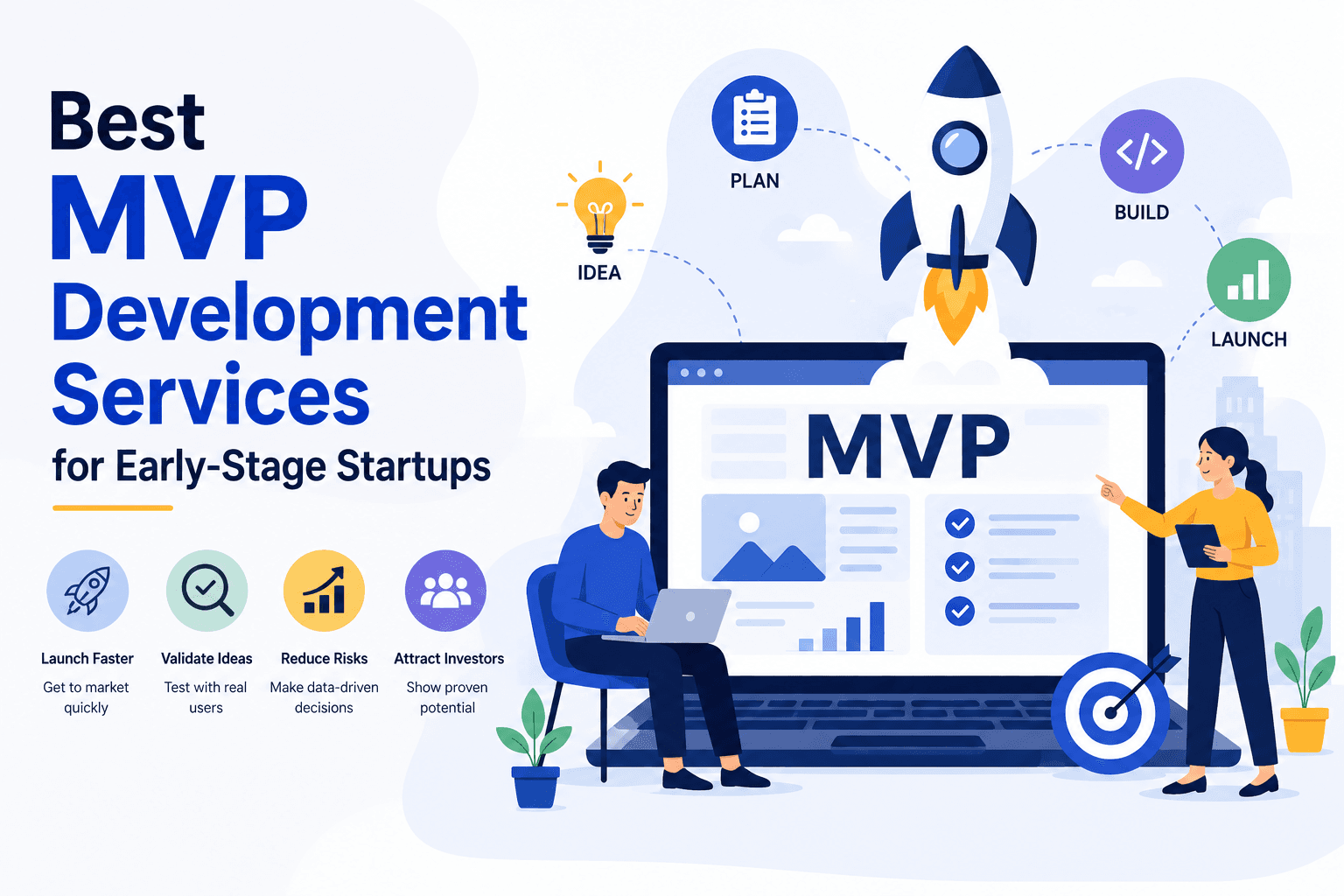
Startups often operate with limited budgets, tight timelines, and high uncertainty. This is where MVP development services provide tremendous value.
Benefits include:
- Faster time-to-market
- Lower development costs
- Reduced business risk
- Better customer feedback
- Improved investor confidence
- Faster path to product-market fit
By focusing on validation first, founders can avoid spending significant resources on features users may never need.
Why MVP Development Is Critical for Startup Success in 2026
Today's startup ecosystem is more competitive than ever. Founders must move quickly while ensuring they are building products customers actually want.
Professional startup MVP development enables businesses to validate ideas before investing in full-scale development.
Rather than relying on assumptions, startups can gather real-world data, understand customer behavior, and refine their solutions based on actual market demand.
Whether you're creating a SaaS platform, marketplace, healthcare solution, or enterprise application, MVP software development helps reduce risk and accelerate learning.
Companies that prioritize product validation early often have a stronger chance of securing investment and achieving sustainable growth.
Average MVP Development Timeline
The timeline for building an MVP depends primarily on complexity.
Simple MVP
Estimated Timeline: 4–8 Weeks
Examples:
- Basic SaaS applications
- Landing page products
- Appointment booking tools
- Internal business software
These MVPs typically focus on core functionality and minimal integrations.
Medium Complexity MVP
Estimated Timeline: 8–16 Weeks
Examples:
- Subscription platforms
- Marketplaces
- Customer portals
- Service management systems
These products often require custom UI/UX design and third-party integrations.
Advanced MVP
Estimated Timeline: 16–24+ Weeks
Examples:
- Healthcare applications
- FinTech solutions
- AI-powered products
- Enterprise software platforms
Advanced MVPs require more planning, compliance measures, and technical architecture.
MVP vs Full Product Development Timeline
Many founders debate whether to launch an MVP or build a full product immediately.
Development Approach | Typical Timeline |
MVP Development | 4–24 Weeks |
Full Product Development | 6–12+ Months |
MVP Development
Focuses on:
- Core functionality
- User validation
- Faster launch
- Lower investment
Full Product Development
Focuses on:
- Advanced functionality
- Enterprise architecture
- Extensive testing
- Long-term scalability
For most startups, it's smarter to build an MVP first and use customer feedback to guide future development decisions.
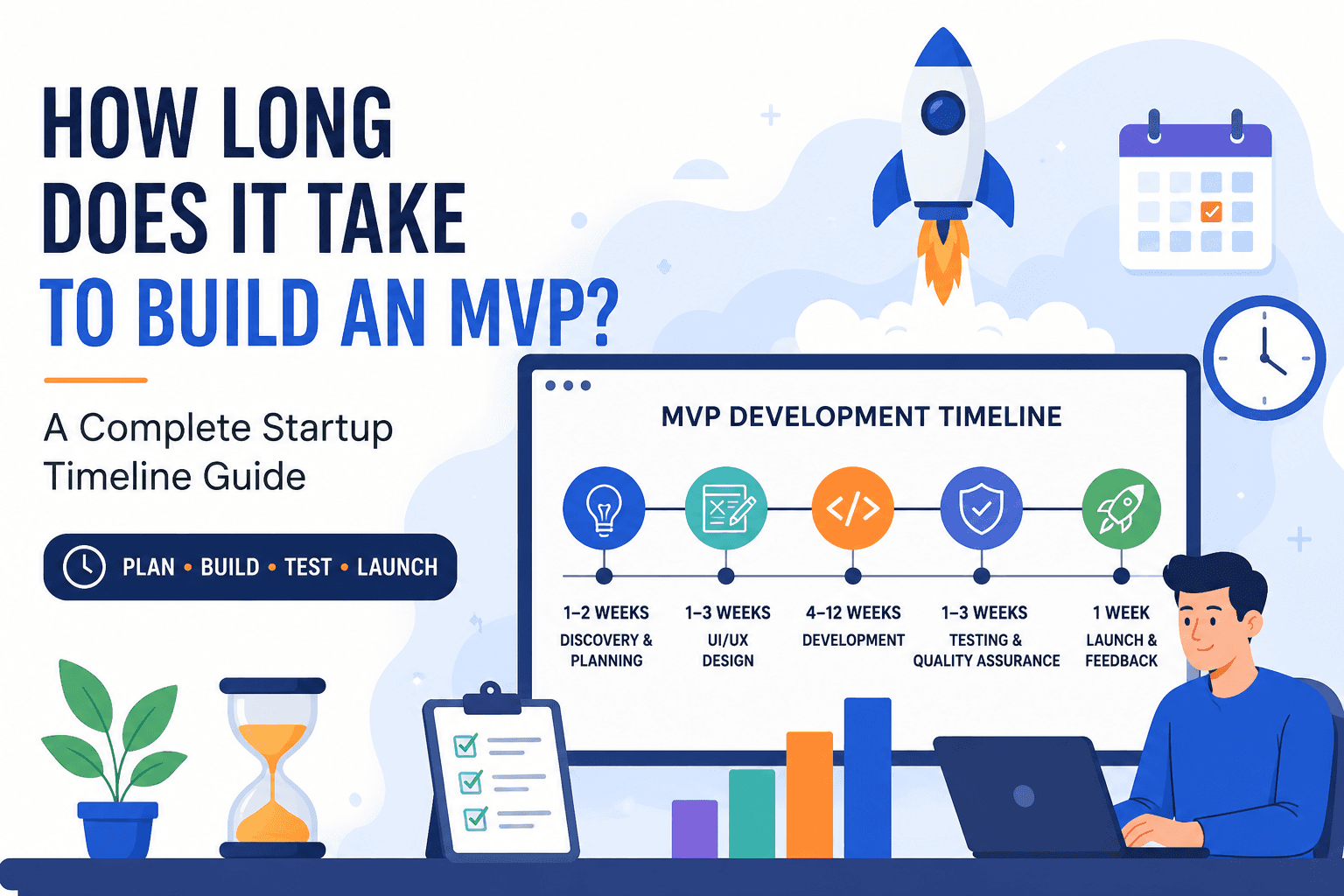
Key Phases of MVP Development
Understanding each phase helps startups create realistic expectations and avoid delays.
Product Discovery and Planning
Estimated Timeline: 1–2 Weeks
Every successful MVP begins with research and planning.
Activities include:
- Market research
- Competitor analysis
- User persona creation
- Feature prioritization
- Business requirement gathering
A strong discovery phase prevents costly mistakes later in development.
Explore our Product Discovery Services to validate your startup idea before development begins.
UI/UX Design
Estimated Timeline: 1–3 Weeks
The design phase focuses on creating intuitive and user-friendly experiences.
Activities include:
- Wireframes
- User journeys
- Clickable prototypes
- Interface design
Great design improves adoption rates and increases customer retention.
MVP Development
Estimated Timeline: 4–12 Weeks
This is the stage where your idea becomes a working product.
Development activities include:
- Frontend development
- Backend development
- Database architecture
- API integrations
- Security implementation
The timeline varies depending on feature complexity and technical requirements.
Common MVP Technologies
Modern custom MVP development often uses:
- React
- Next.js
- Node.js
- Python
- AWS
These technologies support faster development and future scalability.
Quality Assurance and Testing
Estimated Timeline: 1–3 Weeks
Testing ensures the product performs reliably before launch.
Activities include:
- Functional testing
- Performance testing
- Security testing
- Bug fixes
Skipping testing can create user frustration and damage product credibility.
MVP Launch and User Feedback
Estimated Timeline: 1 Week
After deployment, startups begin collecting real-world feedback.
The launch phase includes:
- Performance monitoring
- User feedback collection
- Analytics tracking
- Feature improvement planning
Remember: launching the MVP is the beginning of the learning process—not the end.
Typical MVP Timelines by Industry
Different industries require different levels of complexity.
SaaS MVP Development
Timeline: 6–12 Weeks
Common features:
- User authentication
- Subscription billing
- Dashboards
- Analytics
Mobile App MVP
Timeline: 8–14 Weeks
Common features:
- User profiles
- Push notifications
- In-app messaging
- Mobile analytics
Healthcare MVP Development
Timeline: 12–20 Weeks
Additional requirements:
- HIPAA compliance
- Secure data storage
- Appointment scheduling
- Data encryption
Marketplace MVP Development
Timeline: 8–16 Weeks
Common features:
- Buyer and seller accounts
- Product listings
- Payments
- Order management
Factors That Affect MVP Development Timelines
Feature Complexity
The more features you include, the longer development will take.
Successful startups focus on:
- Core functionality
- Essential workflows
- Validation-focused features
Custom Design Requirements
Highly customized designs often require additional development effort.
Third-Party Integrations
Integrations such as:
- Payment gateways
- CRM platforms
- Analytics tools
- Marketing automation systems
can increase timelines significantly.
Team Experience
An experienced MVP development company can streamline the development process and avoid common mistakes.
Learn how our MVP Development Services help startups launch faster and more efficiently.
Common Reasons MVP Projects Get Delayed
Changing Requirements
Frequent changes during development can extend timelines significantly.
Poor Feature Prioritization
Trying to build every feature at once often results in delays.
Inadequate Communication
Clear communication between founders and developers is essential.
Lack of User Validation
Building features without user feedback can lead to unnecessary development work.
How to Build an MVP Faster
Start With a Clear Product Vision
Before development begins, define:
- Target audience
- Core problem
- Value proposition
Use Agile MVP Development
Agile MVP development enables faster releases and continuous improvements.
Benefits include:
- Faster iteration cycles
- Better collaboration
- Improved adaptability
Prioritize Essential Features
Ask yourself:
"What is the smallest version of this product that provides value?"
Build that first.
Choose an Experienced Development Partner
A reliable startup technology partner can help reduce delays, improve quality, and accelerate delivery.
Realistic MVP Timeline Example
For a typical SaaS startup:
Phase | Timeline |
Discovery & Planning | 1 Week |
UI/UX Design | 2 Weeks |
Development | 8 Weeks |
Testing | 2 Weeks |
Launch | 1 Week |
Total Timeline: Approximately 12–14 Weeks
This timeline provides enough flexibility for quality development while maintaining startup speed.
Conclusion
So, how long does it take to build an MVP?
For most startups, the answer ranges from 4 to 24 weeks, depending on product complexity, features, integrations, and development resources.
The most important goal isn't simply launching fast-it's launching smart. A strategic approach to minimum viable product development allows founders to validate ideas, gather meaningful feedback, and reduce business risk before investing heavily in full-scale software product development.
By partnering with the right team, focusing on essential functionality, and following an Agile approach, startups can accelerate their journey from concept to market-ready solution.
The most successful startups don't wait for perfection-they launch, learn, improve, and grow.
Frequently Asked Questions
Most SaaS MVP development projects take between 6 and 12 weeks, depending on complexity.
Simple MVPs can sometimes be launched within 4–6 weeks if the scope is well-defined.
Most startups successfully launch within 8–16 weeks.
MVP development services help startups validate ideas, reduce costs, gather user feedback, and achieve product-market fit faster.
5 min read

Dhruv Patel
Dhruv Patel is the CEO of Zyora Global, bringing a strong technology background and a passion for building scalable digital solutions. With expertise in software development, product strategy, and business growth, he leads the company in delivering innovative web, mobile, AI, and enterprise solutions that help businesses accelerate their digital transformation.