


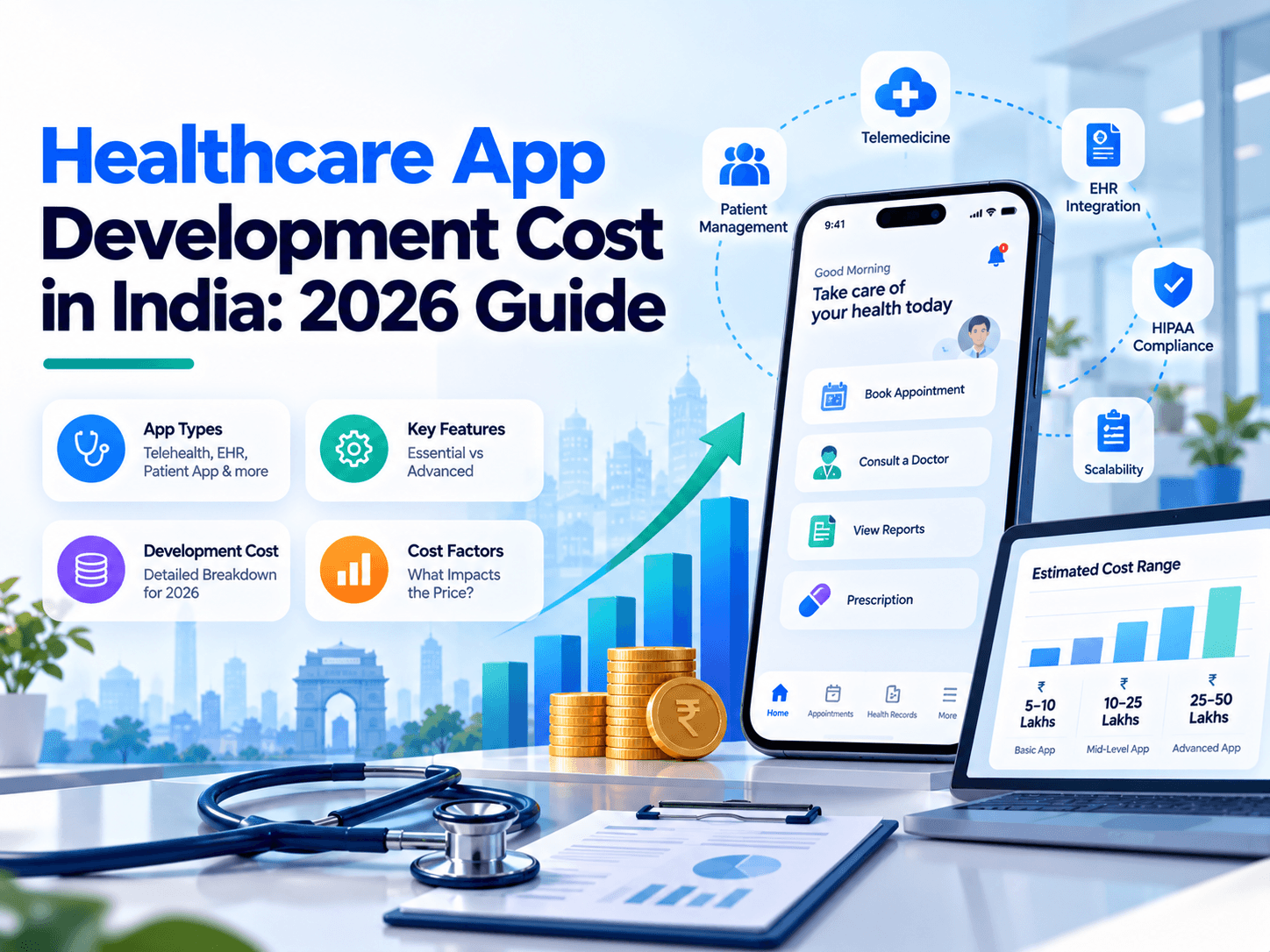
Quick Summary :- Healthcare app development costs in India depend on application complexity, features, integrations, technology stack, and security requirements. This guide explores estimated development costs, different healthcare app types, essential features, development timelines, compliance considerations, and practical ways to reduce expenses in 2026.
A healthcare app can transform how hospitals, clinics, doctors, pharmacies, and patients interact with one another. From online appointment booking and telemedicine consultations to electronic health records and remote patient monitoring, digital healthcare solutions are becoming an important part of modern healthcare delivery.
However, one of the first questions businesses ask before starting a healthcare application project is: How much does it cost to develop a healthcare app in India?
The answer depends on several factors, including application complexity, features, UI/UX design, technology stack, third-party integrations, security requirements, and ongoing maintenance.
In India, healthcare app development can be more cost-effective than in many Western markets, but choosing the cheapest development option is not always the best decision. Healthcare applications handle sensitive patient information, require reliable infrastructure, and often need integrations with hospital systems, payment gateways, and medical devices.
In this guide, we will explore healthcare app development costs in India in 2026, different types of healthcare applications, essential features, development stages, technology choices, compliance considerations, and ways to manage your development budget.
Whether you are a healthcare startup, hospital, clinic, pharmacy, or established healthcare organization, this guide will help you understand what goes into building a healthcare application and how to plan your investment.
What Is Healthcare App Development?
Healthcare app development is the process of designing, building, testing, and maintaining software applications that support medical services and healthcare operations.
These applications connect patients, doctors, hospitals, pharmacies, laboratories, and healthcare administrators through digital platforms.
A healthcare application can be designed for a specific purpose, such as booking doctor appointments, or it can provide a complete healthcare ecosystem with patient registration, medical records, online consultations, billing, prescriptions, and administrative dashboards.
For example, a patient can use a healthcare application to:
- Register and create a medical profile.
- Search for doctors and specialists.
- Book appointments online.
- Attend video consultations.
- Access prescriptions and medical reports.
- Receive medication reminders.
- Make online payments.
- Track health information through connected devices.
Similarly, doctors can use the platform to manage appointments, review patient histories, issue prescriptions, and communicate with patients.
Healthcare software is also useful for hospitals and clinics that want to automate administrative operations and improve information management.
Healthcare App Development Cost in India in 2026
The cost of developing a healthcare application in India depends mainly on its complexity and functionality.
A simple appointment-booking application requires fewer resources than a complete healthcare platform with telemedicine, electronic health records, pharmacy management, AI-powered features, and multiple user dashboards.
For initial budgeting, healthcare applications can be divided into three categories.
Estimated healthcare app development cost
App complexity | Estimated development cost | Estimated timeline |
|---|---|---|
Basic healthcare app | ₹5–12 lakh | 2–3 months |
Medium-complexity app | ₹12–30 lakh | 3–6 months |
Advanced healthcare platform | ₹30–75 lakh+ | 6–12+ months |
Indicative 2026 estimates in INR. They represent planning ranges, not verified industry-wide averages or guaranteed quotations.
Basic healthcare app (₹5 lakh–₹12 lakh)
A basic healthcare application usually includes essential functionality, such as:
- Patient registration and login.
- Doctor profiles.
- Appointment scheduling.
- Basic notifications.
- Simple administrative dashboard.
- Basic payment integration.
This type of application is suitable for small clinics, healthcare startups, or businesses testing an initial product idea.
Medium-complexity healthcare app (₹12 lakh–₹30 lakh)
A medium-complexity application includes more advanced functionality, such as:
- Separate patient and doctor dashboards.
- Online consultations.
- Prescription management.
- Medical report uploads.
- Payment gateway integration.
- Appointment reminders.
- Basic electronic health record management.
- Admin and analytics dashboards.
This option is suitable for growing clinics, telehealth businesses, and healthcare startups that need more than a basic booking platform.
Advanced healthcare platform (₹30 lakh–₹75 lakh+)
An advanced healthcare platform may include:
- Comprehensive electronic health records.
- Multi-hospital management.
- Pharmacy and laboratory integrations.
- Advanced telemedicine capabilities.
- Remote patient monitoring.
- AI-powered assistance or analytics.
- Role-based access control.
- Advanced reporting.
- Cloud infrastructure and security architecture.
- Complex third-party integrations.
These platforms are generally designed for larger healthcare organizations, multi-location hospitals, and businesses building scalable healthcare products.
Important factors behind these estimates
The estimates above are illustrative project budgets, not published averages from a single industry survey. They assume custom development by an India-based team and vary according to:
- Number of user roles and applications.
- Complexity of the backend.
- Number of third-party integrations.
- Security and compliance requirements.
- Design complexity.
- Testing and deployment requirements.
A detailed requirement document is necessary before a development company can provide an accurate quotation.
Healthcare App Development Cost by Application Type
Not every healthcare application requires the same investment. A telemedicine application, pharmacy management platform, and hospital management system have different technical requirements and development challenges.
Understanding the type of application you want to build is one of the first steps in estimating the overall development budget.
The following table provides indicative cost estimates for different healthcare application categories.
Healthcare app type | Estimated cost in India | Development time |
|---|---|---|
Doctor appointment booking app | ₹5–10 lakh | 2–3 months |
Telemedicine app | ₹12–25 lakh | 3–5 months |
Hospital management app | ₹20–45 lakh | 5–8 months |
Pharmacy management app | ₹8–20 lakh | 3–5 months |
Patient management app | ₹10–25 lakh | 3–6 months |
Electronic Health Record (EHR) app | ₹18–40 lakh | 4–8 months |
Remote patient monitoring app | ₹15–35 lakh | 4–7 months |
Healthcare marketplace app | ₹15–35 lakh | 4–7 months |
Estimated custom-development budgets. Costs vary with user roles, integrations, platform requirements and security architecture.
Let's understand what makes each application different.
Doctor Appointment Booking App
A doctor appointment booking application allows patients to find doctors, check availability, and schedule appointments without visiting a clinic.
Common features include:
- Patient registration and login.
- Doctor profiles and specializations.
- Appointment scheduling.
- Calendar integration.
- Appointment reminders.
- Online payments.
- Ratings and reviews.
- Admin dashboard.
A basic appointment booking application may cost approximately ₹5 lakh–₹10 lakh.
The cost increases when you add multiple clinic locations, advanced doctor availability management, insurance integrations, and online consultation functionality.
Telemedicine App
A telemedicine application enables patients to consult healthcare professionals remotely through video calls, audio calls, or chat.
It is particularly useful for healthcare businesses offering virtual consultations and follow-up services.
Essential features include:
- Patient and doctor registration.
- Video and audio consultations.
- Appointment scheduling.
- Digital prescriptions.
- Medical report sharing.
- Payment gateway integration.
- Notifications.
- Consultation history.
A telemedicine app may cost approximately ₹12 lakh–₹25 lakh, depending on video infrastructure, user roles, and integration requirements.
Third-party video services can reduce initial development effort, while custom video infrastructure may require additional investment.
Hospital Management App
A hospital management application helps healthcare organizations manage administrative and clinical operations through a centralized system.
It may include modules for:
- Patient registration.
- Appointment management.
- Doctor and staff management.
- Electronic medical records.
- Billing and invoicing.
- Laboratory management.
- Pharmacy management.
- Inventory management.
- Reports and analytics.
A hospital management application may cost approximately ₹20 lakh–₹45 lakh or more.
The final budget depends on the number of hospital departments, workflows, integrations, and reporting requirements.
Pharmacy Management App
A pharmacy management application helps pharmacies manage inventory, prescriptions, orders, suppliers, billing, and medicine availability.
Important features include:
- Medicine inventory management.
- Prescription uploads.
- Order management.
- Expiry date tracking.
- Supplier management.
- Billing and payment processing.
- Stock alerts.
- Sales reports.
A basic pharmacy management application may cost approximately ₹8 lakh–₹20 lakh.
Advanced platforms with multiple pharmacy branches, online medicine ordering, delivery tracking, and integration with healthcare providers require additional development work.
Electronic Health Record (EHR) Application
An EHR application stores and manages patient medical information digitally.
It allows authorized healthcare professionals to access relevant patient information, including medical history, prescriptions, allergies, diagnoses, and laboratory reports.
Key features include:
- Patient medical profiles.
- Medical history management.
- Digital prescriptions.
- Laboratory report integration.
- Role-based access.
- Medical document storage.
- Audit logs.
- Interoperability APIs.
An EHR application may cost approximately ₹18 lakh–₹40 lakh, depending on data structures, interoperability requirements, and integrations.
For Indian healthcare products, ABDM compatibility may also be relevant.
Remote Patient Monitoring App
Remote patient monitoring applications collect health-related information from connected devices and make it available to patients and healthcare professionals.
These platforms may support:
- Blood pressure monitoring.
- Heart rate tracking.
- Blood glucose monitoring.
- Connected wearable devices.
- Health dashboards.
- Alerts and notifications.
- Patient reports.
- Doctor dashboards.
An RPM application may cost approximately ₹15 lakh–₹35 lakh.
The cost depends heavily on device compatibility, data transmission, real-time monitoring, and the complexity of medical workflows.
Major Factors That Affect Healthcare App Development Cost
Healthcare app development involves more than designing screens and writing code. Several technical and business decisions influence the total investment.
Here are the major factors businesses should consider before starting development.
Application Complexity
Application complexity is one of the biggest factors affecting development cost.
A simple application with patient registration and appointment booking requires fewer development resources than a platform with multiple dashboards, real-time communication, EHR integration, and AI-powered functionality.
For example:
Complexity | Features | Cost impact |
|---|---|---|
Low | Login, profiles, appointment booking | Lower |
Medium | Video consultations, payments, prescriptions | Moderate |
High | EHR, AI, IoT, multi-hospital workflows | Higher |
The more workflows and user interactions an application supports, the more time developers need for architecture, implementation, and testing.
UI/UX Design
Healthcare applications must be easy to navigate because they serve users with different levels of technical knowledge.
A patient should be able to book an appointment or access a prescription without navigating complicated menus.
UI/UX design costs depend on:
- Number of screens.
- User roles.
- Wireframes and prototypes.
- Custom illustrations and icons.
- Accessibility requirements.
- Design systems.
- User testing.
An application with separate interfaces for patients, doctors, pharmacists, and administrators requires more design effort than a single-user application.
A well-designed healthcare application can also reduce user confusion and improve adoption.
Number of Platforms
Your application may need to support Android, iOS, and web browsers.
Each platform has different development and testing requirements.
Development approach | Description | Cost consideration |
|---|---|---|
Android only | Application for Android devices | Lower initial scope |
iOS only | Application for Apple devices | Lower initial scope |
Native Android + iOS | Two separately developed applications | Higher |
Cross-platform | Shared codebase using Flutter or React Native | Can reduce duplicated development |
Web application | Browser-based application | Depends on responsive design and functionality |
Cross-platform technologies can reduce duplicated implementation, but they do not automatically make every project cheaper. Complex device integrations and platform-specific requirements may still need additional work.
Backend Development
The backend manages the application's business logic, databases, authentication, APIs, and communication between different components.
For example, when a patient books an appointment, the backend checks doctor availability, stores appointment information, processes payment details, and sends notifications.
Healthcare applications often require backend functionality such as:
- Patient data management.
- Appointment scheduling.
- User authentication.
- Role-based permissions.
- Prescription management.
- Payment processing.
- API integrations.
- Reporting and analytics.
The more complex the backend architecture, the greater the development effort.
Third-Party API Integrations
Healthcare applications frequently connect with external services.
These integrations allow businesses to add functionality without developing every component from scratch.
Common integrations include:
Integration | Purpose | Cost consideration |
|---|---|---|
Payment gateway | Online payments | Setup and transaction charges |
Video conferencing API | Virtual consultations | Usage-based pricing |
SMS gateway | Appointment reminders | Message charges |
Email services | Notifications | Usage-based pricing |
Maps API | Location and navigation | Usage-based pricing |
EHR/EMR APIs | Medical information exchange | Integration complexity |
Wearable APIs | Health data collection | Device compatibility |
Integration costs depend on API documentation, authentication requirements, data formats, testing, and the number of systems involved.
For example, integrating an existing payment gateway is usually simpler than connecting a healthcare application with multiple hospital information systems.
Security and Compliance Requirements
Healthcare applications process sensitive information, including patient identities, medical records, prescriptions, and consultation details.
Therefore, security should be considered from the beginning of development rather than added after the application is completed.
Security-related development work may include:
- Data encryption.
- Secure authentication.
- Multi-factor authentication.
- Role-based access control.
- Secure API communication.
- Audit logging.
- Backup and recovery.
- Vulnerability assessments.
- Privacy and consent management.
The OWASP Mobile Application Security Verification Standard (MASVS) provides security controls covering storage, cryptography, authentication, network communication, privacy, and other mobile application security areas.
Healthcare businesses should allocate an appropriate budget for these requirements because security gaps can create significant operational and legal risks.
Scalability and Performance
A healthcare application should be capable of handling increasing numbers of patients, doctors, appointments, and medical records.
For example, an application initially designed for one clinic may eventually expand to multiple hospitals and locations.
Scalable architecture may require:
- Cloud infrastructure.
- Database optimization.
- API performance improvements.
- Load balancing.
- Caching.
- Monitoring.
- Automated deployment.
Planning scalability during the architecture stage can help reduce expensive restructuring later.
Healthcare App Development Cost Breakdown
To understand where your investment goes, it is useful to divide development into different activities.
The following is an illustrative budget allocation for a custom healthcare application.
Development activity | Estimated share |
|---|---|
Requirement analysis and planning | 8% |
UI/UX design | 12% |
Frontend development | 20% |
Backend development | 25% |
API and third-party integrations | 12% |
Testing and quality assurance | 13% |
Deployment and launch | 5% |
Project management | 5% |
Total | 100% |
Illustrative allocation of a project development budget, not a measured industry average.
Backend development receives a relatively large share in this example because healthcare applications often require complex data management, authentication, integrations, and business logic.
However, the allocation changes according to the project. A telemedicine application may spend more on video infrastructure, while an EHR platform may require more investment in data migration and interoperability.
Essential Features of a Healthcare Application
The features you select directly influence development costs.
Instead of building every possible feature from the beginning, businesses should identify the functionality required for their target users.
Patient Features
Patient-facing features should make healthcare services accessible and convenient.
Feature | Purpose |
|---|---|
Registration and login | Create secure patient accounts |
Patient profile | Store personal information |
Doctor search | Find doctors by specialization |
Appointment booking | Schedule consultations |
Online payments | Pay for healthcare services |
Medical records | Access reports and history |
Digital prescriptions | View prescribed medications |
Notifications | Receive reminders and updates |
Consultation history | Review previous appointments |
Doctor Features
Doctors need tools to manage their schedules and patient interactions.
Important features include:
- Doctor registration and profile management.
- Appointment calendar.
- Patient history access.
- Digital prescription creation.
- Consultation management.
- Medical report review.
- Follow-up scheduling.
- Secure patient communication.
Admin Features
The administrative dashboard helps healthcare businesses manage application operations.
Common functionality includes:
- Patient management.
- Doctor management.
- Appointment monitoring.
- Payment tracking.
- Role and permission management.
- Reports and analytics.
- Service configuration.
- System monitoring.
Advanced Features
Businesses can introduce advanced features as their applications grow.
Examples include:
AI-powered healthcare assistance: AI can help organize information, support administrative workflows, and assist with specific clinical tasks when appropriately validated and supervised.
Remote patient monitoring: Connected devices can transmit measurements to the application for review by authorized healthcare professionals.
Predictive analytics: Historical and operational data can help healthcare organizations identify patterns and support planning.
Multi-language support: Regional language interfaces can make healthcare applications easier to use across different communities.
Interoperability: APIs and standardized data exchange can help applications communicate with other healthcare systems.
The best approach is to prioritize features according to user needs rather than adding advanced technology simply because it is available.
Technology Stack Used for Healthcare App Development
Choosing the right technology stack is important for application performance, scalability, security, and long-term maintenance.
The technology stack depends on the application's requirements, expected user base, integration needs, and development budget.
Here are some commonly used technologies for healthcare application development.
Technology category | Technologies | Purpose |
|---|---|---|
Frontend development | React.js, Next.js, Angular | Web interfaces |
Mobile development | Flutter, React Native, Kotlin, Swift | Mobile applications |
Backend development | Node.js, Python, Java, .NET | Business logic and APIs |
Database | PostgreSQL, MySQL, MongoDB | Data management |
Cloud infrastructure | AWS, Microsoft Azure, Google Cloud | Hosting and scalability |
API integration | REST APIs, GraphQL, FHIR APIs | System communication |
AI and machine learning | Python, TensorFlow, PyTorch | AI-powered functionality |
DevOps | Docker, Kubernetes, CI/CD | Deployment and infrastructure management |
Frontend technologies
Frontend development focuses on the interface patients, doctors, and administrators interact with.
React.js and Next.js are useful for building responsive web applications and administrative dashboards.
Flutter and React Native can help businesses develop mobile applications for Android and iOS using shared codebases.
Backend technologies
The backend manages authentication, patient records, appointment scheduling, payments, and application workflows.
Node.js is suitable for API-driven applications and real-time communication. Python can be useful for data processing, analytics, and AI-related functionality.
Database technologies
Healthcare applications need reliable data storage and retrieval.
PostgreSQL and MySQL are useful for structured information such as patient profiles, appointments, and billing records.
MongoDB can be useful for certain flexible document-oriented data requirements.
Database selection should be based on the data model, transaction requirements, consistency, and scalability.
Cloud infrastructure
Cloud platforms help healthcare businesses host applications, manage databases, store files, and scale infrastructure.
However, cloud expenses depend on actual usage, storage, network traffic, backup requirements, and selected services.
For example, Google Cloud Healthcare API pricing varies according to factors such as storage, requests, notifications, DICOM data, and network utilization.
Therefore, cloud infrastructure should be estimated using an actual workload rather than a generic monthly price.
Healthcare Data Security and Compliance in India
Security and regulatory requirements are essential parts of healthcare app development.
Healthcare applications may collect personally identifiable information, medical history, prescriptions, laboratory reports, and other sensitive information. Businesses must understand the rules applicable to their users, operations, and data-processing activities.
Digital Personal Data Protection Act
The Digital Personal Data Protection (DPDP) Act, 2023, establishes India's framework for processing digital personal data.
The Digital Personal Data Protection Rules, 2025 were notified in November 2025, alongside a phased commencement framework.
Healthcare businesses should assess applicable requirements relating to:
- Consent and transparency.
- Purpose of data collection.
- Appropriate security safeguards.
- Personal data access and processing.
- Data retention and deletion.
- User rights and grievance handling.
- Responsibilities of data fiduciaries and processors.
The development team should work with appropriate legal and privacy professionals to translate applicable obligations into technical and operational requirements.
Ayushman Bharat Digital Mission (ABDM)
The Ayushman Bharat Digital Mission aims to develop an interoperable digital health ecosystem in India.
It supports the exchange of health information between participating healthcare providers and digital health platforms.
The scale of this ecosystem highlights why interoperability matters: according to the Ministry of Health and Family Welfare's 2024–25 annual report, as of December 31, 2024, more than 72.25 crore ABHA numbers and 47.12 crore ABHA-linked health records had been created.
For healthcare application developers, ABDM-related requirements may include:
- ABHA integration.
- Healthcare Professional Registry integration.
- Healthcare Facility Registry integration.
- Health Information Exchange.
- Consent-based health data sharing.
- Interoperability standards.
- Sandbox validation and security assessments.
The Government of India's ABDM health data management policy establishes privacy and data protection guidance for participants in the ecosystem.
Not every healthcare application needs ABDM integration. However, businesses planning to participate in the ecosystem should consider interoperability requirements during architecture and development planning.
HIPAA Compliance
HIPAA is a United States healthcare privacy and security framework. It is relevant when a business handles protected health information in circumstances covered by the law, such as providing services to US healthcare organizations.
A healthcare application intended for the US market may require:
- Access controls.
- Audit mechanisms.
- Secure data transmission.
- Appropriate encryption.
- Risk assessments.
- Business Associate Agreements where applicable.
- Documented security policies.
HIPAA should not be treated as a universal certification that every healthcare application needs. Applicability depends on the business model, relationships, and data handled.
Healthcare Application Security Checklist
Before launching a healthcare application, businesses should review the following:
- Secure patient authentication.
- Role-based access control.
- Encryption for sensitive information.
- Secure API endpoints.
- Consent management.
- Audit logging.
- Regular security testing.
- Secure backup and recovery.
- Data retention policies.
- Vulnerability management.
- Privacy policy and user notices.
- Incident response procedures.
The OWASP MASVS security standard is a useful reference for assessing mobile application security.
Healthcare App Development Process: Step by Step
Developing a healthcare application requires a structured process. A clear development approach helps businesses control costs, identify risks early, and avoid unnecessary features.
Here are the main stages involved.
Step 1: Requirement Analysis and Planning
The first stage is understanding the business idea and defining the application's objectives.
The development team should identify:
- Target users.
- Business requirements.
- Core features.
- User roles.
- Competitor applications.
- Integration requirements.
- Security and compliance considerations.
- Project budget.
For example, a telemedicine startup may prioritize video consultations, doctor availability, prescriptions, and payments.
A hospital management system may prioritize patient registration, billing, laboratory workflows, and electronic records.
Clearly defining requirements helps prevent unnecessary development work.
Step 2: UI/UX Design
Once requirements are finalized, the design team creates wireframes, prototypes, and application interfaces.
The objective is to make the application intuitive for patients, doctors, and administrators.
The design stage typically includes:
- User journey mapping.
- Wireframe creation.
- Interface design.
- Interactive prototypes.
- Usability testing.
- Design approval.
Healthcare applications should prioritize accessibility, readability, and simple navigation.
Step 3: Frontend and Backend Development
After design approval, developers begin building the application.
Frontend developers create the screens and interactions, while backend developers implement APIs, databases, authentication, and business logic.
The frontend and backend must communicate securely and consistently.
For example, when a doctor creates a digital prescription, the backend should validate the request, associate it with the correct patient, save the information, and make it available to authorized users.
Step 4: API and Third-Party Integrations
This stage connects the application with external services.
Depending on requirements, integrations may include:
- Payment gateways.
- SMS and email services.
- Video consultation providers.
- Hospital information systems.
- EHR and EMR platforms.
- Wearable devices.
- ABDM services.
Each integration should be tested for authentication, data accuracy, failure handling, and security.
Step 5: Testing and Quality Assurance
Testing ensures that the application works as expected before launch.
Healthcare application testing should cover:
Testing type | Purpose |
|---|---|
Functional testing | Verifies features and workflows |
UI testing | Checks screens and user interactions |
Performance testing | Evaluates speed and responsiveness |
Security testing | Identifies vulnerabilities |
API testing | Validates integrations and endpoints |
Compatibility testing | Checks different devices and browsers |
User acceptance testing | Confirms business requirements |
Testing is especially important for appointment scheduling, patient identity, prescriptions, billing, and medical record access.
Step 6: Deployment and Launch
Once testing is complete, the application is prepared for production.
Deployment activities may include:
- Cloud environment configuration.
- Database setup.
- Domain and SSL configuration.
- Production API configuration.
- App Store and Google Play submission.
- Monitoring setup.
- Backup configuration.
- Launch validation.
The development team should also prepare documentation and operational support procedures.
Step 7: Maintenance and Updates
Healthcare application development does not end after launch.
Applications require ongoing maintenance to address bugs, update dependencies, improve performance, and respond to changing business requirements.
Regular maintenance may include:
- Security patches.
- Server monitoring.
- Database optimization.
- Feature improvements.
- API updates.
- Backup verification.
- Compatibility updates.
How Much Does Healthcare App Maintenance Cost?
Maintenance is an important part of the total cost of ownership.
A healthcare application needs regular monitoring, technical support, security updates, and infrastructure management.
For early-stage budgeting, businesses can provision approximately 15%–25% of the initial development cost annually for maintenance and improvements. This is a planning allowance, not a universal market rate.
For example, consider an application with an initial development cost of ₹20 lakh.
Maintenance allowance | Annual budget | Monthly equivalent |
|---|---|---|
15% | ₹3 lakh | ₹25,000 |
20% | ₹4 lakh | ₹33,333 |
25% | ₹5 lakh | ₹41,667 |
Illustrative maintenance budget based on the initial ₹20 lakh development investment. Hosting, API usage, major new features, and extraordinary security work may be billed separately.
Businesses should also account for additional expenses, including:
- Cloud hosting and storage.
- SMS and email notifications.
- Video consultation usage.
- Security audits.
- Third-party software licences.
- Database backups.
- Technical support.
The actual amount depends on application usage and the service-level agreement with the development partner.
How to Reduce Healthcare App Development Costs
Building a healthcare application does not necessarily require investing in every feature from the beginning.
Businesses can manage development expenses by making practical decisions during planning.
Start With an MVP
A minimum viable product (MVP) includes only the essential features needed to test the application with real users.
For example, a healthcare startup planning a telemedicine platform can initially build:
- Patient registration.
- Doctor profiles.
- Appointment booking.
- Video consultations.
- Basic payment functionality.
- Admin dashboard.
Advanced analytics, AI features, wearable integrations, and complex reporting can be introduced later.
This approach helps businesses validate their product idea before making a larger investment.
Prioritize Features
Divide application features into three categories:
Priority | Feature examples |
|---|---|
Must-have | Login, patient profiles, appointment booking |
Should-have | Payments, prescriptions, notifications |
Future enhancements | AI analytics, wearable integration, advanced automation |
This makes it easier to estimate the initial development scope.
Choose the Right Technology Stack
Select technologies according to project requirements rather than following trends.
For example, Flutter or React Native may be suitable when Android and iOS applications can share most of their functionality.
Similarly, a modular backend can make it easier to introduce new features without rebuilding the entire system.
Use Existing APIs Where Appropriate
Not every functionality needs to be developed from scratch.
Businesses can integrate established payment, messaging, mapping, and video communication services.
However, compare licensing, usage costs, security responsibilities, vendor dependency, and data-processing terms before selecting a provider.
Plan Integrations Early
Late integration decisions can lead to architectural changes and additional development expenses.
Identify required EHR systems, hospital platforms, medical devices, and external APIs during the planning stage.
Avoid Unnecessary Customization
Custom functionality is valuable when it supports a real business requirement.
However, excessive customization can increase development time, testing effort, and future maintenance costs.
Start with proven workflows and customize only where necessary.
How to Choose the Right Healthcare App Development Company in India
Selecting the right development partner is just as important as deciding your application budget.
A development company should understand both software engineering and the specific requirements of healthcare businesses.
Here are some important factors to consider.
Healthcare domain experience
Check whether the development company has experience building healthcare applications, hospital management systems, telemedicine platforms, pharmacy software, or EHR solutions.
Technical expertise
Evaluate its experience with:
- Mobile and web development.
- Backend architecture.
- API integrations.
- Cloud infrastructure.
- Database management.
- Healthcare interoperability.
- Security engineering.
Security knowledge
Ask how the company handles patient data protection, access management, encryption, testing, and compliance-related requirements.
Portfolio and case studies
Review previous projects to understand the company's development capabilities.
Look for relevant case studies that explain the business problem, technical approach, features, and outcomes.
Transparent pricing
A reliable development partner should provide a clear breakdown of:
- Development scope.
- Features and modules.
- Project milestones.
- Payment terms.
- Third-party expenses.
- Maintenance costs.
- Post-launch support.
Communication and support
Healthcare software projects may require continuous improvements and long-term technical support.
Choose a partner that provides clear communication, regular progress updates, documentation, and a defined support process.
Common Mistakes to Avoid During Healthcare App Development
Even a well-funded healthcare project can face problems when important development decisions are overlooked.
Here are some common mistakes businesses should avoid.
1. Building too many features initially
Trying to launch every possible feature can increase development time and cost. Start with essential functionality and expand based on user feedback.
2. Ignoring security requirements
Security should be part of application architecture from the beginning. Adding it only before launch can result in expensive changes.
3. Choosing technology without evaluating requirements
A popular framework is not automatically the right choice. Technology selection should consider scalability, integrations, developer expertise, and long-term support.
4. Underestimating integration complexity
Connecting an application to an existing hospital or EHR system may require data mapping, authentication, testing, and coordination with external vendors.
5. Skipping proper testing
Errors in patient records, appointments, prescriptions, and billing can affect healthcare operations. Comprehensive testing is essential.
6. Ignoring maintenance costs
Businesses should budget for hosting, security updates, support, and future improvements rather than considering only the initial development price.
7. Not defining ownership and documentation
Clarify source-code ownership, intellectual property, infrastructure access, API credentials, and documentation in the development agreement.
Future of Healthcare App Development in India
Healthcare technology is evolving as hospitals, clinics, startups, and patients increasingly adopt digital solutions.
Several technology trends are likely to influence healthcare application development in the coming years.
Artificial Intelligence in Healthcare
AI can support medical documentation, administrative automation, medical image analysis, and healthcare data processing.
Healthcare businesses are exploring AI-powered applications to improve operational efficiency and support clinical workflows.
However, clinical AI functionality requires appropriate validation, oversight, and risk management.
Remote Patient Monitoring
Connected devices and wearable technology are creating opportunities for healthcare applications that support monitoring outside traditional clinical settings.
These solutions can collect health measurements and provide dashboards for patients and authorized healthcare professionals.
Interoperable Healthcare Systems
Healthcare organizations increasingly need applications that communicate with other digital healthcare systems.
Standards-based APIs and data exchange can help improve continuity of care and reduce information silos.
In India, ABDM is an important initiative supporting this direction.
Cloud-Based Healthcare Platforms
Cloud infrastructure enables healthcare businesses to deploy applications, manage data, and scale services according to usage.
It also creates opportunities for multi-location healthcare platforms and integrated digital services.
Personalized Digital Healthcare
Healthcare applications can use patient preferences, health records, and relevant data to provide more personalized experiences.
Examples include customized health dashboards, reminders, follow-up notifications, and wellness tracking.
The future of healthcare software will depend not only on adopting new technologies but also on making applications secure, accessible, interoperable, and useful for real healthcare workflows.
Conclusion
Healthcare app development in India offers opportunities for hospitals, clinics, healthcare startups, pharmacies, and digital health businesses to improve their services through technology.
However, the cost of building a healthcare application depends on much more than the number of screens or features. Application complexity, backend architecture, third-party integrations, security, compliance, and scalability all influence the final investment. A basic healthcare application may require a relatively small initial budget, while an advanced platform with EHR integration, telemedicine, AI functionality, and multiple user roles requires significantly more development effort. The most practical approach is to start with clearly defined business requirements, prioritize essential features, select an appropriate technology stack, and build an MVP before expanding the platform.
If you are planning to develop a healthcare application, working with an experienced healthcare software development company can help you make better technical decisions, manage development costs, and build a scalable digital healthcare solution.
Frequently Asked Questions
Healthcare app development in India can cost approximately ₹5 lakh–₹75 lakh or more, depending on complexity and features.
A basic application may take 2–3 months, while an advanced healthcare platform can take 6–12 months or longer.
React Native, Flutter, React.js, Node.js, Python, and PostgreSQL are popular technology choices depending on project requirements.
HIPAA applies to covered entities and business associates handling protected health information under US law. It does not automatically apply to every Indian healthcare app.
Start with an MVP, prioritize essential features, use suitable existing APIs, and plan integrations early.
14 min read

Dhruv Patel
As CEO of Zyora Global, Dhruv Patel combines technical expertise with business leadership to drive innovation and growth. With experience in software engineering, product development, and emerging technologies, he is dedicated to helping organizations turn ideas into impactful digital solutions that deliver measurable results.