


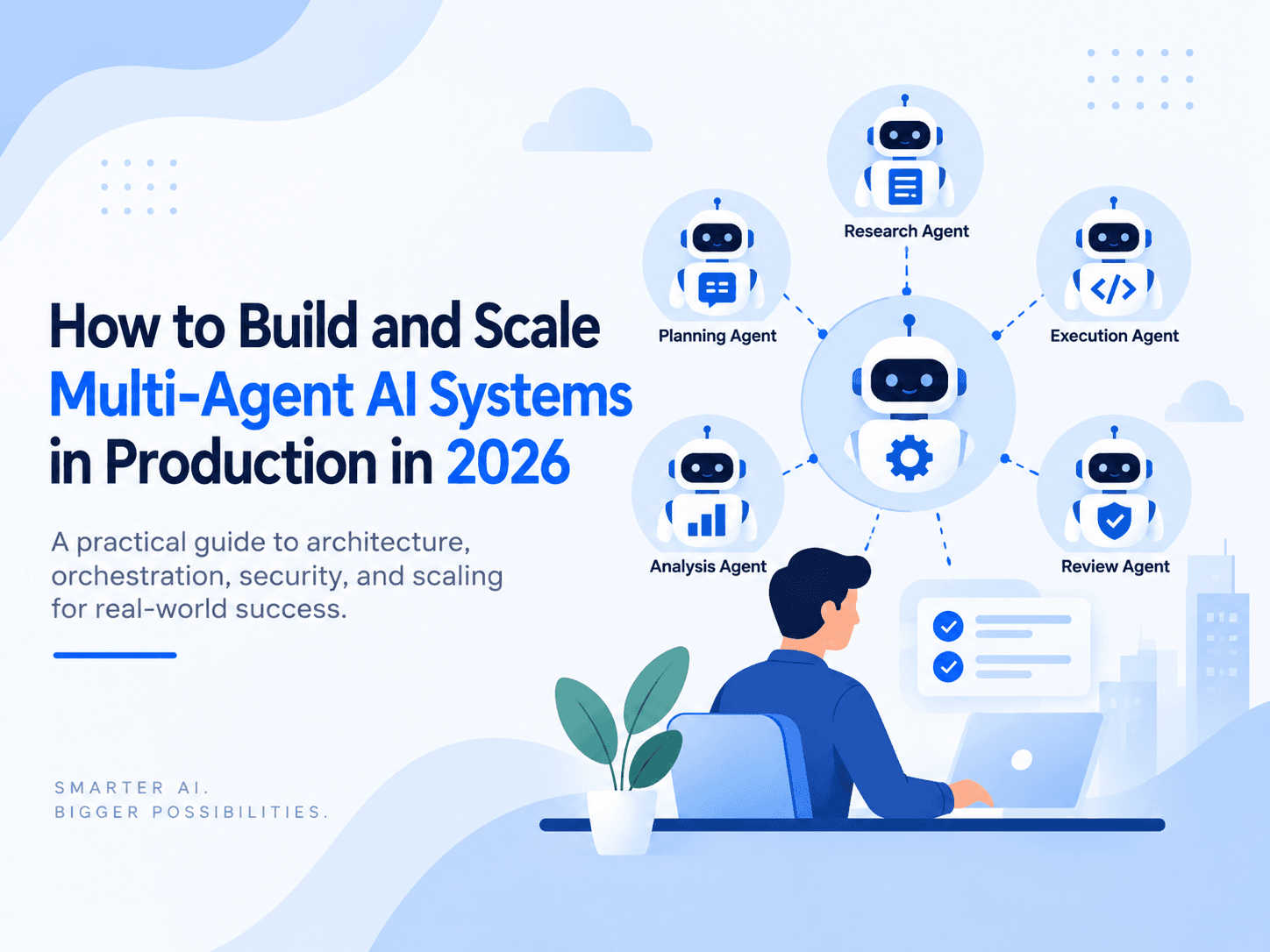
Quick Summary :- Multi-agent AI systems are transforming how businesses build and scale intelligent software in 2026. This guide explains how to design specialized AI agents, orchestrate workflows, manage costs, implement security, and monitor systems in production. Learn how businesses can build scalable, reliable, and production-ready multi-agent AI solutions that deliver real business value.
AI is moving beyond traditional chatbots and single-prompt applications. In 2026, businesses are increasingly exploring AI agents that can reason, use tools, complete tasks, and coordinate with other agents across complex workflows.
This shift is creating demand for multi-agent AI systems architectures where multiple specialized agents collaborate under defined workflows rather than relying on one general-purpose agent for everything.
The opportunity is significant, but moving from an impressive AI prototype to a reliable production system requires more than connecting multiple LLMs. Organizations need the right architecture, orchestration, security, observability, evaluation, and infrastructure.
This guide explains how businesses can build and scale multi-agent AI systems for real-world production environments.
What Is a Multi-Agent AI System?
A multi-agent AI system consists of multiple AI agents, each responsible for a specific task or capability, coordinated through software.
For example, an AI research platform might use:
- Planning Agent – Breaks a request into smaller tasks
- Research Agent – Searches and collects information
- Data Analysis Agent – Processes structured data
- Tool Agent – Interacts with external systems
- Review Agent – Checks the quality of results
- Orchestrator – Coordinates the entire workflow
Instead of asking one model to handle everything, the system distributes work among specialized agents.
Anthropic describes multi-agent systems as multiple agents using tools and working together on complex tasks, with separate agents helping divide work and explore different directions in parallel.
Why Multi-Agent AI Is Becoming Important in 2026
Enterprise AI is moving from experimentation toward deeper integration into repeatable workflows.
According to OpenAI's 2025 State of Enterprise AI report, weekly users of structured workflows such as Projects and Custom GPTs increased 19× year-to-date, while average reasoning-token consumption per organization increased approximately 320× over the previous 12 months.
This indicates that businesses are not simply experimenting with AI prompts they are increasingly incorporating AI into more complex and repeatable processes.
The shift toward multiple AI agents is also visible in enterprise research.
According to Salesforce's 2026 Connectivity Report, organizations currently use an average of 12 AI agents, with that number projected to increase by 67% within two years. The report also found that 50% of agents currently operate in isolated silos rather than as part of a multi-agent system.
These trends highlight an important engineering challenge: deploying individual AI agents is only one step. Businesses also need systems that can connect, coordinate, govern, and monitor those agents.
Single-Agent vs. Multi-Agent AI
Not every AI application needs multiple agents.
A single-agent architecture can be effective when a workflow is relatively simple, predictable, and can be completed by one model with a limited set of tools.
A multi-agent architecture becomes useful when a workflow requires:
- Multiple specialized capabilities
- Parallel task execution
- Different tools or data sources
- Complex decision-making
- Independent verification
- Long-running workflows
- Different security or permission boundaries
Simple Example
Consider an AI customer-support platform.
A single-agent architecture could look like:
Customer → AI Agent → Tools → Response
A multi-agent architecture could instead use:
Customer → Orchestrator
→ Customer Service Agent
→ Knowledge Agent
→ Order Management Agent
→ Refund Agent
→ Compliance Agent
→ Review Agent
→ Final Response
Each component has a defined responsibility, making the system easier to control and evolve.
How to Design a Production-Ready Multi-Agent Architecture
A scalable multi-agent system should be designed around clear responsibilities and measurable outcomes, rather than simply adding more agents.
1. Define the Business Workflow First
Start with the business problem, not the AI models.
Identify:
- What task needs to be automated?
- Which decisions require AI?
- Which steps should remain deterministic?
- Which tasks can run in parallel?
- Where is human approval required?
- What information does each agent need?
- What actions can each agent perform?
This prevents unnecessary complexity.
Anthropic recommends starting with simpler approaches and introducing agentic complexity only when it demonstrably improves the outcome.
2. Give Every Agent a Clear Responsibility
Each agent should have a specific role.
For example:
Agent | Responsibility |
Planner Agent | Breaks the request into tasks |
Research Agent | Collects relevant information |
Data Agent | Processes structured data |
Tool Agent | Executes approved actions |
Reviewer Agent | Validates results |
Orchestrator | Controls workflow and routing |
Clear boundaries reduce overlapping responsibilities and make individual agents easier to test.
3. Choose the Right Orchestration Pattern
The orchestrator determines how agents communicate and how work moves through the system.
Common patterns include:
Sequential Workflow
Agent A → Agent B → Agent C
Useful when each step depends on the previous step.
Parallel Workflow
Agent A
Agent B → Orchestrator
Agent C
Useful when multiple independent tasks can run simultaneously.
Hierarchical Workflow
A primary agent assigns tasks to specialized sub-agents and evaluates their results.
Conditional Workflow
The system dynamically selects the next agent based on the current state or result.
The important point is that orchestration should match the workflow. Adding agents without a clear coordination model can increase complexity rather than improve performance.
4. Build a Shared State and Memory Layer
Multi-agent systems need reliable state management.
Agents may need access to:
- Conversation history
- User preferences
- Task status
- Previous agent outputs
- Business data
- Tool results
- Long-term memory
However, sharing everything with every agent can increase context size, latency, and cost.
A better approach is to provide each agent with only the information it needs.
This creates context boundaries between agents and makes the system easier to debug and secure.
5. Design Tool Access Carefully
Agents become significantly more useful when they can interact with external systems.
Depending on the application, agents may access:
- Databases
- APIs
- CRM platforms
- Payment systems
- Search engines
- Internal knowledge bases
- Cloud infrastructure
- Business applications
However, every tool creates another security boundary.
Use:
- Role-based permissions
- Least-privilege access
- Authentication
- Input validation
- Action approval
- Rate limits
- Audit logs
An agent that can read customer information should not automatically have permission to modify or delete it.
6. Add Human-in-the-Loop Controls
Full autonomy is not appropriate for every workflow.
High-impact actions should have approval checkpoints.
For example:
AI Agent → Recommendation → Human Approval → Execution
Human approval can be required for:
- Financial transactions
- Account changes
- Sensitive data access
- Production deployments
- Legal or compliance decisions
- High-value customer actions
Human-in-the-loop controls allow businesses to benefit from AI automation while retaining appropriate human oversight.
7. Build Evaluation Into the Architecture
Traditional software testing is not enough for AI systems because model outputs can vary.
A production multi-agent system should evaluate:
Agent-Level Performance
- Accuracy
- Tool selection
- Instruction following
- Output quality
Workflow-Level Performance
- Task completion rate
- Failure rate
- Handoff accuracy
- End-to-end latency
Business-Level Performance
- Cost per task
- Customer satisfaction
- Conversion rate
- Resolution time
- Human intervention rate
Every production workflow should have measurable success criteria.
8. Monitor Agents in Production
Observability becomes increasingly important as the number of agents grows.
Track:
- Token consumption
- Model latency
- Tool calls
- Agent-to-agent communication
- Failed tasks
- Retry rates
- Escalations
- Cost per workflow
- Evaluation results
For example, if a workflow normally requires five tool calls but suddenly requires twenty, monitoring should identify the abnormal behavior before it becomes an operational or financial problem.
Anthropic's production experience highlights coordination, evaluation, and reliability as important challenges introduced by multi-agent systems.
9. Optimize AI Costs Before Scaling
Adding agents can increase AI consumption because every agent may make multiple model calls.
A workflow could look like:
1 user request → 5 agents → 15 model calls → multiple tool calls
Anthropic reports that, in its own research system, multi-agent systems used about 15× more tokens than standard chat interactions. This is an Anthropic-specific engineering observation, not a universal cost multiplier for every multi-agent system.
Therefore, cost optimization should be part of the architecture from the beginning.
Consider:
- Using smaller models for simple tasks
- Routing complex tasks to stronger models
- Limiting unnecessary agent loops
- Caching repeated results
- Compressing context
- Setting token budgets
- Running independent tasks in parallel
- Using deterministic code where AI is unnecessary
The goal is not to maximize the number of agents. It is to maximize useful work per AI call.
10. Design for Security and Governance
Multi-agent systems introduce additional identities, permissions, tools, and data flows.
A production architecture should include:
- Identity management
- Role-based access control
- Secrets management
- Data encryption
- Audit logging
- Prompt-injection defenses
- Tool authorization
- Data isolation
- Human approval workflows
- Continuous monitoring
For enterprise deployments, security should be designed into the architecture rather than added after deployment.
Salesforce's 2026 Connectivity Report found that 42% of organizations identified risk management, compliance/security, and/or legal implications as a major hurdle to agentic transformation, while 41% cited a lack of internal expertise in AI or agent design.
A Practical Multi-Agent Architecture
A production architecture can be structured into five major layers:
Layer 1: User Interface
Web, mobile, API, or enterprise application.
Layer 2: Orchestration
Responsible for:
- Task planning
- Agent selection
- Routing
- State management
- Error handling
Layer 3: Specialized Agents
Examples:
- Research Agent
- Data Agent
- Customer Support Agent
- Coding Agent
- Compliance Agent
Layer 4: Tools and Data
Connected systems such as:
- APIs
- Databases
- Vector stores
- Enterprise applications
- Cloud services
Layer 5: Governance and Observability
Includes:
- Authentication
- Authorization
- Monitoring
- Evaluation
- Logging
- Cost tracking
- Human approval
This layered approach makes the system easier to scale without turning the application into an uncontrolled collection of autonomous components.
When Should You Use Multi-Agent AI?
Multi-agent architecture is not automatically better than a single agent.
Use it when the problem genuinely benefits from specialization, parallel execution, or independent evaluation.
Good Use Cases
Enterprise Research
Multiple agents can investigate different sources simultaneously and consolidate findings.
Customer Support
Separate agents can handle knowledge retrieval, account information, order management, and escalation.
Software Development
Agents can specialize in planning, coding, testing, documentation, and code review.
Healthcare Operations
Agents can support administrative workflows while sensitive or high-impact decisions remain under appropriate human oversight.
Financial Services
Agents can assist with research, document analysis, reporting, and workflow automation while permissions and approval controls govern sensitive actions.
Common Challenges When Scaling Multi-Agent Systems
Agent Coordination
Agents may produce conflicting outputs or misunderstand handoffs.
Solution: Define structured communication formats and explicit responsibilities.
Increasing Costs
More agents can mean more model calls.
Solution: Use model routing, caching, token limits, and deterministic workflows where appropriate.
Unpredictable Behavior
Agents can take unexpected paths.
Solution: Add guardrails, bounded workflows, evaluation, monitoring, and human approval.
Security Risks
Agents may have access to sensitive tools and information.
Solution: Apply least-privilege permissions and separate access by agent role.
Debugging Complexity
Finding the source of a failure becomes harder when several agents participate.
Solution: Maintain complete execution traces and agent-level observability.
How to Scale Multi-Agent AI Systems
Once the initial system works, scaling should happen systematically.
Start With a Small Agent Team
Begin with two or three specialized agents instead of building a large swarm.
Standardize Agent Interfaces
Define consistent inputs, outputs, tool schemas, and error states.
Separate Deterministic and Agentic Logic
Not every decision needs an LLM.
Use traditional software for predictable operations and agents for tasks requiring reasoning or flexible interpretation.
Introduce Parallel Processing
Independent tasks should run simultaneously where possible.
This can reduce end-to-end workflow latency.
Add Production Observability
Track performance, costs, errors, and agent interactions before increasing traffic.
Scale Infrastructure Independently
Agent workloads can create unpredictable compute and API demand. Cloud-native infrastructure allows application components to scale according to workload.
Multi-Agent AI Tech Stack in 2026
A modern production stack can include:
Layer | Example Technologies |
LLMs | OpenAI, Anthropic, Google Gemini |
Orchestration | LangGraph, custom orchestration |
Memory | Vector databases, relational databases, state stores |
APIs | REST, GraphQL, internal service APIs |
Infrastructure | AWS, Azure, Google Cloud |
Observability | Tracing, logs, evaluation platforms |
Security | IAM, RBAC, secrets management |
Deployment | Containers, Kubernetes, CI/CD |
The specific stack should depend on the workflow, existing infrastructure, compliance requirements, and operational needs rather than choosing tools simply because they are popular.
The Future of Multi-Agent AI
The next phase of AI development is likely to focus less on individual models and more on AI systems that combine models, tools, data, workflows, and human oversight.
OpenAI's 2025 enterprise research describes a shift toward delegating increasingly complex, multi-step workflows to AI as enterprise adoption matures.
At the same time, Salesforce's 2026 research points to increasing agent adoption alongside growing challenges around integration and governance.
For businesses, this means the competitive advantage may increasingly come from how effectively AI capabilities are engineered into reliable operational systems.
Conclusion
Building a multi-agent AI system is not simply about connecting several LLMs.
Successful production systems require:
- Clear agent responsibilities
- Reliable orchestration
- Controlled tool access
- Secure state management
- Human oversight
- Continuous evaluation
- Production observability
- Cost optimization
- Security and governance
- Scalable cloud infrastructure
The most effective approach is to start with a focused business workflow, introduce specialized agents where they provide measurable value, and gradually expand the architecture as reliability and demand grow.
In 2026, successful multi-agent AI development will be less about deploying the largest number of agents and more about building well-orchestrated, secure, observable, and scalable AI systems that solve real business problems.
Frequently Asked Questions
A multi-agent AI system uses multiple specialized AI agents that work together to complete complex tasks.
A single agent handles the entire task, while multiple agents divide the work based on specialized roles.
Businesses can scale them through efficient orchestration, cloud infrastructure, monitoring, automation, and cost optimization.
Common challenges include agent coordination, security, higher AI costs, unpredictable behavior, and monitoring complexity.
Healthcare, finance, e-commerce, customer support, and software development can use multi-agent AI for complex workflow automation.
15 min read

Dhruv Patel
Dhruv Patel is the CEO of Zyora Global, bringing a strong technology background and a passion for building scalable digital solutions. With expertise in software development, product strategy, and business growth, he leads the company in delivering innovative web, mobile, AI, and enterprise solutions that help businesses accelerate their digital transformation.