


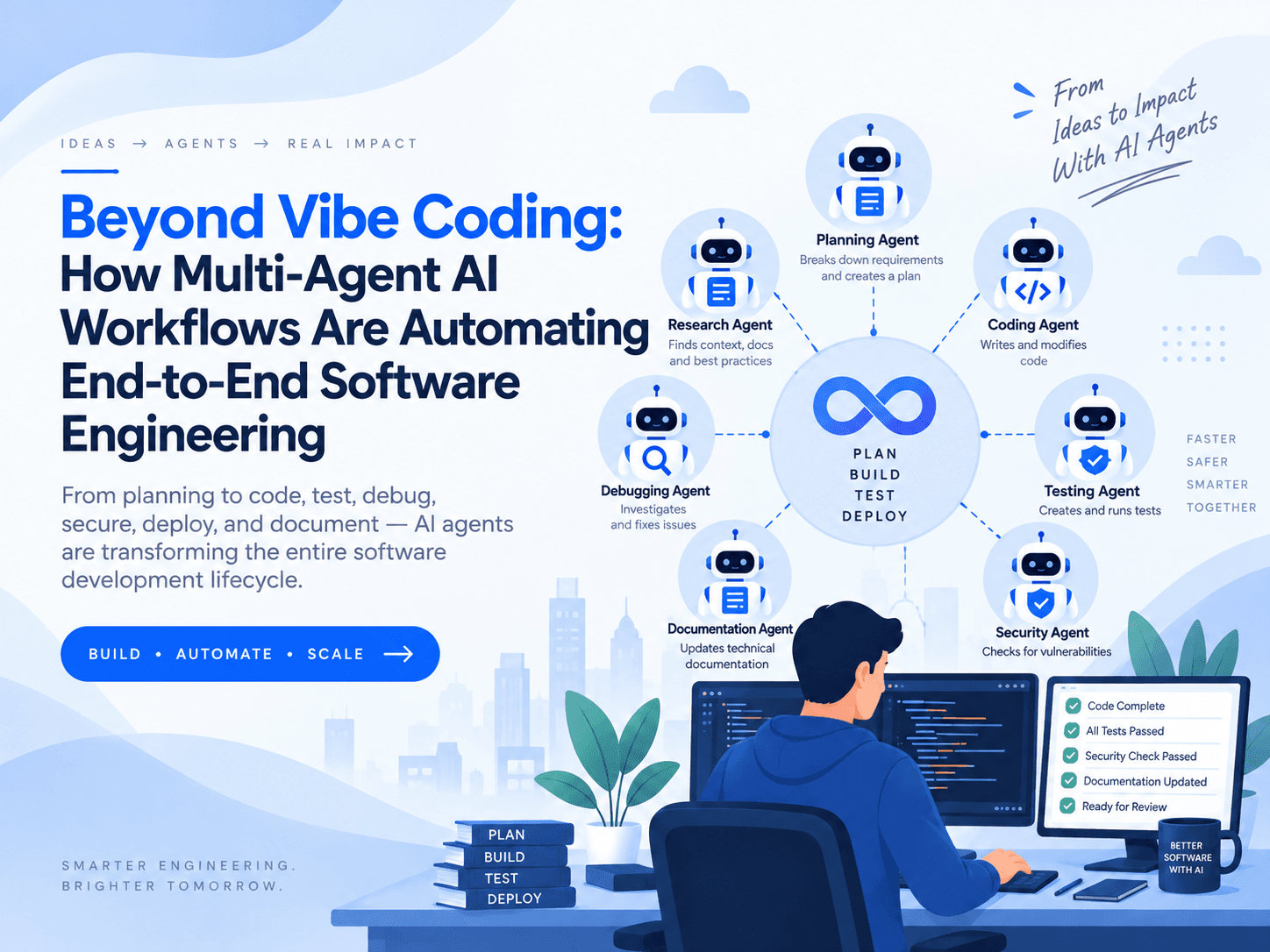
Quick Summary :- Multi-agent AI is taking software development beyond vibe coding by coordinating specialized AI agents across the entire engineering lifecycle. From planning and coding to testing, debugging, security, and deployment, these AI-driven workflows can automate repetitive engineering tasks while keeping humans involved in critical decisions, reviews, and approvals.
Software development is entering a new phase.
For the last few years, generative AI has primarily worked as an assistant. Developers describe what they want, an AI model generates code, and the developer reviews, modifies, tests, and integrates that code into the application.
That workflow is changing.
The emergence of AI coding agents and multi-agent AI systems is moving software development from simple code generation toward goal-driven automation. Instead of asking an AI to write one function or explain one error, developers can increasingly give an agent a broader objective and allow it to inspect a repository, create a plan, modify files, run tests, analyze failures, make corrections, and prepare the resulting changes for human review.
This does not mean developers disappear from the process. In fact, the more capable these systems become, the more important architecture, verification, security, governance, and human judgment become.
The difference is that humans can increasingly define what needs to be achieved, while AI agents handle more of the repetitive execution required to reach that goal.
According to JetBrains 2026 AI Coding Agent Adoption Research, based on more than 15,000 professional developers worldwide, 90% of professional developers surveyed were using AI coding agents at work at least weekly between May and July 2026, with 68% using them daily.
At the same time, adoption does not automatically mean full autonomy. Stack Overflow's 2026 pulse survey found that 63% of technologists still rarely or never let AI agents operate entirely on autopilot.
That tension defines the next stage of AI-powered software engineering: more automation, but with controlled autonomy.
What Is Multi-Agent AI in Software Development?
A multi-agent AI system uses multiple specialized AI agents that collaborate to complete a larger objective.
Instead of asking one AI system to perform every task, an engineering workflow can divide the work between specialized agents.
For example:
- A Planning Agent analyzes requirements and creates an implementation plan.
- A Coding Agent modifies the application code.
- A Testing Agent creates and executes tests.
- A Debugging Agent investigates failed tests.
- A Security Agent checks for vulnerabilities.
- A Documentation Agent updates technical documentation.
- A Review Agent examines the resulting changes.
- An Orchestrator Agent coordinates the overall workflow.
The important difference is not simply having several AI models.
The real value comes from coordinating specialized capabilities toward one software engineering goal.
A typical workflow could look like this:
Requirement → Planning → Coding → Testing → Debugging → Security Review → Documentation → Pull Request → Human Approval
Instead of a developer manually moving between every stage, agents can exchange context and results between stages.
This creates an engineering workflow that is closer to an automated production line than a traditional chatbot interaction.
From Vibe Coding to Agentic Software Engineering
The term vibe coding became popular as AI tools made it possible to create software through natural-language instructions without manually writing every line of code.
For prototypes, experiments, internal tools, and simple applications, this can be extremely useful.
However, production software requires more than generating code.
Real engineering involves:
- Understanding an existing architecture
- Managing dependencies
- Writing tests
- Debugging failures
- Reviewing changes
- Handling security
- Maintaining documentation
- Managing Git branches
- Running CI/CD pipelines
- Monitoring production systems
- Making architectural decisions
This is where multi-agent AI becomes particularly interesting.
Instead of asking:
"Write a login system."
A development team could give an agentic workflow a goal such as:
"Implement passwordless authentication in the existing application, add the required API and database changes, update the frontend, create regression tests, run the test suite, fix failures, perform a security check, and prepare a pull request."
The system can then break that objective into smaller tasks.
This is the difference between AI-assisted coding and AI-assisted engineering workflows.
Vibe coding is not the same as autonomous software engineering
Stack Overflow 2025 Developer Survey found that nearly 72% of developers said vibe coding was not part of their professional work, with another 5% saying they emphatically did not participate in it.
That is an important distinction.
The future of AI software development is not necessarily about developers blindly accepting whatever an AI generates.
It is increasingly about combining:
AI generation + planning + tools + testing + verification + human oversight.
How Multi-Agent AI Workflows Work
A production-oriented multi-agent software development workflow generally contains several layers.
1. Define the Software Engineering Goal
Everything starts with a clearly defined objective.
For example:
"Reduce API response time for the customer dashboard while maintaining existing functionality."
The system should not simply begin changing code.
First, it needs to understand the objective and determine what success means.
This could include measurable criteria such as:
- API response time below a defined threshold
- Existing tests continue to pass
- No breaking API changes
- No new security vulnerabilities
- No increase in infrastructure errors
The clearer the success criteria, the easier it becomes for agents to evaluate their own work.
2. Repository and Context Analysis
The first specialized agent can inspect the codebase.
It may examine:
- Repository structure
- Programming languages
- Frameworks
- APIs
- Database models
- Configuration files
- Dependencies
- Existing tests
- Documentation
- CI/CD configuration
- Recent Git changes
This contextual analysis is critical.
An AI agent that only sees a small code snippet may produce technically valid code that does not fit the rest of the application.
A repository-aware agent can reason about the broader system.
3. Task Decomposition
The planning agent breaks the main objective into smaller tasks.
For example:
Main goal: Improve dashboard API performance.
Possible subtasks:
- Identify slow API endpoints.
- Analyze database queries.
- Check existing indexes.
- Profile backend execution.
- Optimize inefficient queries.
- Add regression tests.
- Run performance tests.
- Compare results with the baseline.
- Review the changes.
- Prepare a pull request.
This decomposition is one of the defining characteristics of agentic development.
The developer does not necessarily need to specify every individual action.
Instead, the developer defines the objective and constraints.
The Multi-Agent Software Development Architecture
A practical architecture can contain five major layers.
Layer 1: Orchestrator
The orchestrator coordinates the entire workflow.
It determines:
- Which agent should work next
- What information should be passed between agents
- Whether a task succeeded
- Whether another iteration is required
- When human approval is necessary
The orchestrator acts like a project manager for the AI agents.
Layer 2: Specialized Agents
Different agents perform different responsibilities.
Planning Agent
Converts requirements into technical tasks.
Coding Agent
Implements the required changes.
Testing Agent
Creates and executes automated tests.
Debugging Agent
Investigates failed tests and proposes or implements fixes.
Security Agent
Checks code and dependencies for potential vulnerabilities.
Documentation Agent
Updates API documentation, technical guides, changelogs, and other engineering documents.
Review Agent
Analyzes the final changes before human review.
Specialization can make the workflow easier to control because each agent has a narrower responsibility.
Layer 3: Engineering Tools
Agents become significantly more useful when they can interact with real engineering tools.
Depending on the workflow, these may include:
- Git
- GitHub or GitLab
- IDEs
- Terminals
- Test runners
- Package managers
- Databases
- Issue trackers
- CI/CD systems
- Cloud platforms
- Monitoring systems
- Security scanners
Tool access transforms an AI model from a system that suggests actions into a system that can execute actions.
But tool access also increases risk.
An agent that can read source code has a different risk profile from an agent that can deploy directly to production.
Layer 4: Memory and Context
Long-running engineering tasks require context.
An agent may need to remember:
- Project requirements
- Previous decisions
- Files it modified
- Tests it executed
- Errors it encountered
- Previous failed approaches
- Architecture constraints
- Coding standards
Without appropriate context management, agents may repeat mistakes or make inconsistent changes.
This is why context management is becoming an important part of agentic software architecture.
Layer 5: Evaluation and Human Approval
The final layer is verification.
Agents should not simply decide that their own work is correct.
Instead, software development provides objective signals:
- Unit tests
- Integration tests
- Static analysis
- Security scans
- Build status
- Performance benchmarks
- Type checking
- Pull request checks
If the results do not satisfy predefined criteria, the workflow can return to an earlier stage.
For example:
Code → Test → Failure → Diagnose → Fix → Test Again
This creates an iterative agent loop.
7 High-Value Multi-Agent AI Use Cases in Software Engineering
1. Automated Feature Development
A planning agent can analyze a feature request and create a technical plan.
A coding agent can implement the changes.
A testing agent can create regression tests.
A review agent can inspect the resulting pull request.
This transforms feature development from a single coding interaction into an end-to-end workflow.
For example:
Product requirement → Technical plan → Code → Tests → Review → Pull Request
Human developers can remain responsible for requirements, architecture, and final approval.
2. Automated Debugging
Debugging is another strong use case.
A debugging workflow could:
- Receive an error report.
- Reproduce the issue.
- Inspect logs.
- Identify relevant source code.
- Analyze possible causes.
- Implement a fix.
- Run regression tests.
- Reproduce the original problem again.
- Create a pull request.
This creates a reproduce → diagnose → fix → validate loop.
Instead of merely telling a developer what might be wrong, the system can participate in the entire troubleshooting process.
3. AI-Powered Test Generation
Testing is particularly suitable for agentic automation because many results can be objectively evaluated.
A testing agent can:
- Read requirements
- Inspect existing code
- Identify untested paths
- Generate test cases
- Run the tests
- Analyze failures
- Improve test coverage
- Create regression tests
A second agent can review whether the generated tests actually test meaningful behavior rather than simply increasing the coverage percentage.
This distinction matters.
More tests do not automatically mean better software.
4. Legacy Software Modernization
Legacy systems are often difficult to modernize because developers may not fully understand undocumented dependencies and tightly coupled components.
A multi-agent workflow can divide modernization into stages.
One agent can analyze the legacy code.
Another can document dependencies.
Another can propose migration strategies.
A coding agent can implement incremental changes.
A testing agent can verify that existing behavior has not changed.
A documentation agent can update system documentation.
This allows modernization to happen incrementally rather than requiring an immediate complete rewrite.
5. Automated Code Review and Security
Code review is another area where multiple agents can cooperate.
For example:
Coding Agent → Security Agent → Quality Agent → Review Agent → Human Reviewer
The security agent might inspect:
- Authentication logic
- Authorization controls
- Dependency vulnerabilities
- Unsafe input handling
- Secrets exposure
- Common application security issues
The quality agent can look for:
- Code duplication
- Maintainability issues
- Style violations
- Potential bugs
- Poor error handling
The human reviewer remains responsible for high-impact decisions.
6. CI/CD and DevOps Automation
Multi-agent systems can also operate around CI/CD workflows.
Suppose a build fails.
A DevOps agent could:
- Inspect the failed pipeline.
- Identify the failing stage.
- Analyze logs.
- Compare recent commits.
- Determine the probable cause.
- Propose a fix.
- Run the pipeline again.
- Escalate the problem if the failure continues.
This can reduce the time engineers spend manually investigating repetitive pipeline failures.
However, production deployment requires stronger controls than development environments.
Agents should not automatically receive unrestricted production access.
7. Automated Documentation
Documentation is frequently disconnected from implementation.
When developers change an API, database model, or feature, documentation may not be updated immediately.
A documentation agent can monitor:
- Source code changes
- Pull requests
- API definitions
- Database changes
- Commit messages
It can then propose updates to:
- API documentation
- README files
- Architecture documentation
- Changelogs
- Developer guides
This creates a closer relationship between the actual software and its documentation.
Multi-Agent AI vs Single AI Coding Agent
A single coding agent can already perform many engineering tasks.
So why introduce multiple agents?
The answer is specialization and workflow complexity.
A single agent may be perfectly adequate for:
- Fixing a small bug
- Creating a simple component
- Writing a unit test
- Explaining an error
- Updating documentation
Multiple agents become more useful when the workflow contains several independent or specialized responsibilities.
For example:
Task | Single Agent | Multi-Agent Workflow |
Small bug fix | Suitable | Usually unnecessary |
Simple feature | Suitable | Optional |
Large migration | Possible | Useful |
Security + testing + coding | More complex | Strong fit |
Large repository analysis | Possible | Useful |
End-to-end delivery | Possible | Strong fit |
Long-running workflow | Difficult to coordinate | Strong fit |
However, more agents do not automatically mean better results.
Every additional agent can introduce:
- More communication
- More tool calls
- Higher infrastructure costs
- More latency
- More failure points
- More complex debugging
The architecture should therefore use multiple agents only when specialization provides measurable value.
What the Current Data Says About AI Agents
The transition toward agentic development is happening alongside broad AI adoption.
Google Cloud DORA 2025 Research surveyed nearly 5,000 technology professionals globally. It reported that 90% of software development professionals surveyed had adopted AI, while more than 80% reported that AI had improved their productivity. The same research found that 59% reported a positive influence on code quality.
However, AI adoption and AI autonomy are different things.
Stack Overflow's 2025 Developer Survey found that 52% of developers either did not use AI agents or used simpler AI tools, while 38% had no plans to adopt AI agents. Among developers who did use agents, 69% agreed that agents had increased their productivity.
This suggests that AI-assisted development is becoming widespread, while fully autonomous agentic development is still developing.
That distinction is important for organizations planning an AI engineering strategy.
The Biggest Challenge: Trust
The biggest obstacle to multi-agent software engineering may not be the ability to generate code.
It is knowing when the generated work can be trusted.
An agent can produce code that:
- Compiles successfully
- Passes some tests
- Looks reasonable
- Follows the requested specification
and still introduce an architectural or business-logic problem.
This is why organizations should avoid measuring agentic development only through:
"How much code did the AI generate?"
Better measurements include:
- Task completion rate
- Test pass rate
- Defect rate
- Rework rate
- Review time
- Human intervention rate
- Cycle time
- Cost per completed task
- Production reliability
The objective is not to maximize AI autonomy.
The objective is to improve the overall engineering system.
Security Risks of Multi-Agent AI
The more tools an AI agent can access, the greater its potential impact.
Consider the difference between:
Read-only repository access
and
Production deployment access
These are fundamentally different risk levels.
A multi-agent engineering environment should therefore implement several controls.
Least-Privilege Access
Each agent should receive only the permissions required for its task.
A documentation agent does not need production database access.
A test agent does not need permission to deploy infrastructure.
Sandboxed Execution
Agents should execute potentially risky commands in isolated environments.
This reduces the impact of accidental or malicious operations.
Branch Isolation
AI-generated changes should generally be isolated from protected branches until they have passed required checks.
Approval Gates
Human approval should be required for high-impact actions such as:
- Production deployments
- Security-sensitive changes
- Infrastructure modifications
- Access-control changes
- Sensitive data operations
- Irreversible actions
Audit Logs
Organizations should maintain records of:
- Agent instructions
- Tool calls
- Code changes
- Test results
- Approvals
- Deployment actions
- Failures
This makes the system easier to investigate and govern.
How Companies Can Start With Multi-Agent AI
Organizations do not need to automate their entire SDLC immediately.
A phased approach is safer.
Step 1: Identify Repetitive Work
Look for engineering tasks that are:
- Repetitive
- Well-defined
- Easy to verify
- Low-risk
- Reversible
Good starting points include:
- Test generation
- Documentation updates
- Dependency maintenance
- Repository analysis
- Small bug fixes
- CI failure investigation
Step 2: Define Success Criteria
Before introducing an agent, establish what successful execution means.
For example:
"The agent successfully resolves the issue if all existing tests pass, the new regression test passes, static analysis reports no new critical issues, and the pull request passes CI."
Clear criteria give the agent measurable feedback.
Step 3: Start With Limited Permissions
Do not begin by giving an AI agent unrestricted access to your infrastructure.
Start with:
Repository → Sandbox → Tests → Pull Request
rather than:
Repository → Production
Step 4: Measure the Baseline
Before automation, record:
- Average task completion time
- Developer hours
- Number of review cycles
- Defect rate
- Testing time
- Cost
Then compare those numbers after introducing the agent.
Step 5: Expand Gradually
Once a workflow consistently produces acceptable results, additional autonomy can be introduced.
For example:
Level 1: AI suggests changes.
Level 2: AI creates a branch and implements changes.
Level 3: AI runs tests and fixes failures.
Level 4: AI prepares pull requests automatically.
Level 5: AI handles selected low-risk deployments with approval gates.
The exact progression should depend on the organization's risk tolerance and the reversibility of the task.
The Role of Developers Is Changing
Multi-agent AI does not simply remove developers from software engineering.
It changes where developers spend their time.
Developers may spend less time on repetitive implementation and more time on:
- Architecture
- Product requirements
- System design
- Validation
- Security
- Performance
- Technical strategy
- Reviewing AI-generated changes
- Defining engineering standards
Architects may focus more heavily on system boundaries and design trade-offs.
QA engineers may spend more time designing risk-based validation strategies.
DevOps engineers may focus more on infrastructure governance, observability, permissions, and deployment safety.
Engineering managers may need new metrics for measuring AI-assisted productivity and quality.
The result is not necessarily AI replacing engineering teams.
It is a shift from manually executing every step toward designing, supervising, and validating increasingly automated engineering workflows.
What the Future of Software Engineering Could Look Like
Imagine a product team submitting a requirement:
"Add a subscription management system for enterprise customers."
A multi-agent workflow could automatically:
- Analyze the product requirement.
- Identify affected services.
- Review the existing architecture.
- Create an implementation plan.
- Identify database changes.
- Design required APIs.
- Implement backend changes.
- Implement frontend components.
- Generate unit and integration tests.
- Run the test suite.
- Investigate failures.
- Apply fixes.
- Run security checks.
- Update API documentation.
- Review the Git diff.
- Prepare a pull request.
- Ask a human engineer for approval.
The human does not disappear.
Instead, the human becomes the final decision-maker overseeing a system capable of executing a much larger portion of the engineering workflow.
This is the real promise of multi-agent AI.
Multi-Agent AI Is Not About Maximum Autonomy
The most important lesson is that organizations should not measure success by how much autonomy they can give an AI system.
More autonomy can also mean more risk.
A better principle is:
Give agents as much autonomy as the task can safely support.
For a low-risk documentation update, high autonomy may be appropriate.
For a production database migration, human approval may be essential.
For a security-sensitive authentication change, automated testing and human review should be mandatory.
For architecture decisions, human leadership should remain central.
The right question is therefore not:
"How can we make AI fully autonomous?"
It is:
"Which parts of our engineering workflow can be safely automated, verified, and continuously improved?"
Conclusion: From AI Coding Assistants to AI Engineering Systems
Vibe coding demonstrated that natural language can become a powerful interface for software creation.
AI coding agents take the next step by allowing AI systems to work across repositories, tools, tests, and development workflows.
Multi-agent AI goes further by coordinating specialized agents across the software development lifecycle.
The emerging model looks like this:
Human defines the goal → Agents plan → Agents execute → Agents test → Agents evaluate → Agents iterate → Humans approve
The strongest implementations will not be the systems that simply generate the most code.
They will be the systems that combine automation, verification, security, observability, and human judgment.
AI adoption in software development is already broad, while fully autonomous agentic workflows remain a work in progress. Current developer research shows both sides of this transition: AI coding agents are gaining substantial adoption, but developers still retain significant concerns around trust and autonomous execution.
The future of software engineering may therefore not be "developers VS AI."
It may be developers designing engineering systems in which humans and specialized AI agents work together.
And that is what makes multi-agent AI more significant than another generation of coding assistants: it has the potential to change not only how developers write code, but how software gets engineered from idea to production.
Frequently Asked Questions
Multi-agent AI uses multiple specialized AI agents to handle software engineering tasks such as planning, coding, testing, debugging, security, code review, and documentation.
Vibe coding mainly focuses on generating code from natural-language prompts, while multi-agent AI coordinates specialized agents across the software development lifecycle, including testing, debugging, security, and deployment.
AI agents can automate many repetitive software engineering tasks, from requirement analysis and coding to testing, debugging, documentation, and CI/CD. Human review remains important for critical decisions and approvals.
Multi-agent AI can help development teams automate repetitive work, improve development speed, coordinate complex tasks, increase testing coverage, and support more efficient software delivery.
Multi-agent AI can be used in production when workflows include proper testing, security controls, access restrictions, monitoring, evaluation, and human approval for high-impact actions.
14 min read

Dhruv Patel
Dhruv Patel is the CEO of Zyora Global, bringing a strong technology background and a passion for building scalable digital solutions. With expertise in software development, product strategy, and business growth, he leads the company in delivering innovative web, mobile, AI, and enterprise solutions that help businesses accelerate their digital transformation.