


Quick Summary :- AI development in 2026 requires choosing the right programming language for the project. This guide explores Python, C++, Java, R, Julia, JavaScript, and Rust, comparing their strengths, use cases, performance, and suitability for machine learning, deep learning, generative AI, enterprise applications, and AI infrastructure.
Artificial intelligence has moved from being a specialized research field to becoming a core part of modern software development. Developers are now building generative AI applications, machine learning systems, recommendation engines, computer vision tools, AI agents, chatbots, predictive analytics platforms, and intelligent automation systems across almost every industry.
As AI development continues to expand, one question becomes increasingly important: Which programming language should you learn for AI development in 2026?
There is no single programming language that is perfect for every AI project. Different languages offer different advantages in areas such as machine learning, data science, deep learning, performance, scalability, enterprise development, scientific computing, and AI infrastructure.
However, Python remains one of the most important languages for AI development. According to the 2025 Stack Overflow Developer Survey, Python adoption increased by 7 percentage points between 2024 and 2025, with Stack Overflow specifically connecting this growth to AI, data science, and backend development.
At the same time, other languages such as C++, Java, R, Julia, JavaScript, and Rust continue to have important roles in the broader AI ecosystem.
This guide explores the best programming languages for AI development in 2026, their strengths, use cases, limitations, and the types of AI projects where each language can be useful.
Why Programming Languages Matter for AI Development
AI development involves much more than training a machine learning model.
A complete AI application may require:
- Data collection
- Data preprocessing
- Statistical analysis
- Machine learning
- Deep learning
- Model training
- Model evaluation
- API development
- Database integration
- Cloud deployment
- Real-time inference
- Application development
- Performance optimization
- Monitoring and maintenance
The programming language you choose can influence how easily you perform these tasks.
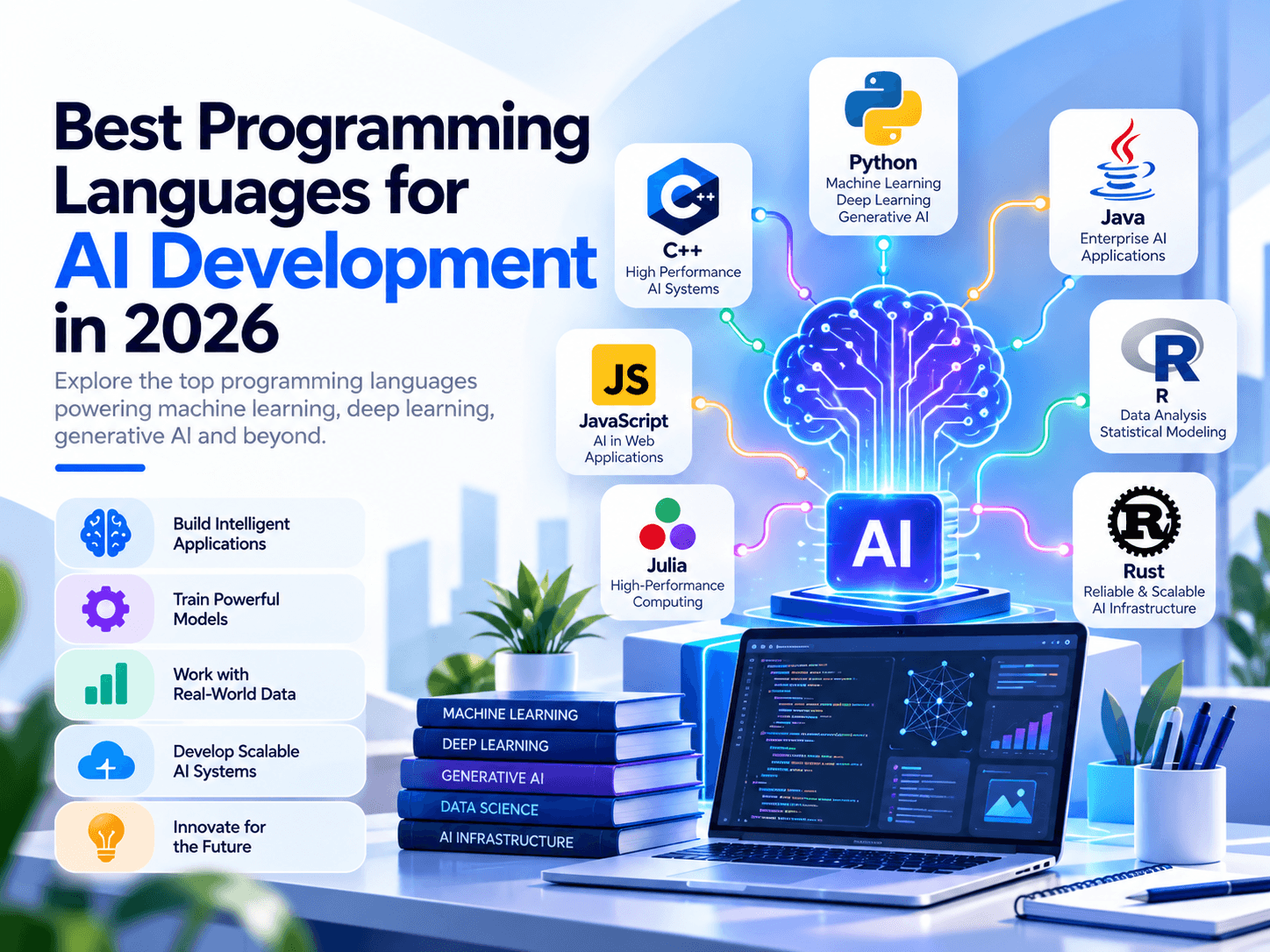
For example, Python provides an extensive ecosystem for machine learning and data science, while C++ can be valuable when high-performance computation and low-level control are important.
Java remains relevant for enterprise applications, while R is particularly useful for statistical computing. Julia focuses heavily on numerical and scientific computing, and JavaScript or TypeScript can be useful when AI functionality needs to be integrated directly into web applications.
The right choice therefore depends on what you are building rather than simply which language is currently popular.
AI Programming Languages in 2026: Quick Comparison
Programming Language | AI/ML Strength | Performance | Learning Difficulty | Best Use Cases |
Python | Excellent | High | Easy | ML, deep learning, GenAI, data science |
C++ | Excellent | Very high | High | Computer vision, robotics, AI infrastructure |
Java | Strong | High | Moderate | Enterprise AI, backend systems |
R | Strong | Moderate | Moderate | Statistics, analytics, research |
Julia | Strong | Very high | Moderate | Scientific computing, numerical AI |
JavaScript/TypeScript | Growing | High | Easy–Moderate | AI web apps, browser AI, AI interfaces |
Rust | Growing | Very high | High | AI infrastructure, performance-focused systems |
The table above should not be interpreted as a ranking. Each language has a different role within the AI development ecosystem.
1. Python: The Most Widely Used Choice for AI Development
Python is the first language most developers encounter when exploring artificial intelligence and machine learning.
Its popularity comes from a combination of simple syntax, a huge developer community, extensive libraries, strong documentation, and support across practically every stage of the AI development lifecycle.
The 2025 Stack Overflow Developer Survey reported that Python's adoption increased by 7 percentage points from 2024 to 2025, describing Python as a go-to language for AI, data science, and backend development.
GitHub's Octoverse 2024 report also reported that Python became the most-used programming language on GitHub in 2024, overtaking JavaScript after a decade at the top. GitHub linked Python's growth partly to the expansion of data science and generative AI activity.
Why Python is popular for AI
Python has an extensive collection of AI and machine learning libraries, including:
- TensorFlow
- PyTorch
- Scikit-learn
- Keras
- NumPy
- Pandas
- Matplotlib
- Transformers
- XGBoost
- OpenCV
Python is particularly useful because developers can move between different AI tasks without changing their primary programming language.
For example, a developer could use NumPy and Pandas for data preparation, Scikit-learn for traditional machine learning, PyTorch for deep learning, Transformers for language models, and FastAPI or Flask to expose the trained model through an API.
Python use cases
Python is commonly used for:
- Machine learning
- Deep learning
- Generative AI
- Natural language processing
- Computer vision
- Recommendation systems
- Predictive analytics
- Chatbots
- AI agents
- Data science
- Model APIs
Is Python good for beginners?
For someone starting AI programming in 2026, Python is often a practical starting point because its syntax is comparatively approachable and its AI ecosystem is extensive.
The 2025 Stack Overflow Developer Survey also found that more than 36% of respondents had learned to use AI-enabled tools during the previous year for work or career development, showing the increasing importance of AI-related technical skills.
2. C++: Important for High-Performance AI Systems
C++ occupies a different position in AI development.
While Python is often used to write high-level AI applications, C++ becomes particularly valuable when performance, memory management, latency, and hardware-level optimization matter.
C++ can be used in:
- Computer vision
- Robotics
- Autonomous systems
- Embedded AI
- Game AI
- Speech processing
- AI infrastructure
- High-performance inference
- Edge AI
One important reason C++ remains relevant is that many AI workloads eventually interact with optimized lower-level software and hardware.
For example, an AI system running on an edge device may need extremely efficient memory usage and fast inference. In such environments, a language with strong performance and low-level control can become important.
C++ vs Python for AI
Python and C++ are not necessarily competitors.
They are frequently used together.
A development team might build the high-level application in Python while performance-critical components are implemented in C++.
Feature | Python | C++ |
Ease of learning | High | Moderate–Low |
AI libraries | Excellent | Strong |
Development speed | Very high | Moderate |
Runtime performance | Good | Excellent |
Memory control | Limited | Excellent |
Prototyping | Excellent | Moderate |
Embedded AI | Good | Excellent |
Computer vision | Excellent | Excellent |
For beginners, Python is generally easier to approach. For developers working on performance-intensive AI infrastructure, C++ can provide capabilities that high-level languages cannot easily match.
3. Java: A Strong Option for Enterprise AI
Java has been used for large-scale enterprise software for decades, and it continues to have a role in AI development.
Java is particularly relevant when AI functionality needs to become part of an existing enterprise application.
Common use cases include:
- Enterprise AI
- Backend AI services
- Recommendation engines
- Fraud detection
- Search systems
- Business intelligence
- Large-scale data processing
- Chatbots
- Predictive analytics
Java's major advantage is not necessarily that it has the largest AI ecosystem. Instead, its value comes from its mature enterprise ecosystem.
Many large organizations already operate Java-based backend systems. Adding AI capabilities to these systems can therefore be easier when developers can integrate AI functionality within an existing Java architecture.
Java AI libraries and frameworks
The Java ecosystem includes technologies such as:
- Deep Java Library
- Tribuo
- Weka
- Apache OpenNLP
- TensorFlow Java
- Deeplearning4j
Java also offers strong tooling for application development, scalability, security, and enterprise infrastructure.
When should you choose Java?
Java can make sense if:
- Your organization already uses Java extensively.
- You are building enterprise backend systems.
- Your AI application needs integration with existing Java infrastructure.
- You require a mature ecosystem for large-scale applications.
4. R: Strong for Statistics and Data Analysis
R is different from Python because its origins are deeply connected to statistics and data analysis.
R is particularly useful for:
- Statistical modeling
- Data analysis
- Visualization
- Research
- Predictive modeling
- Statistical machine learning
- Academic applications
- Business analytics
R provides a large ecosystem of statistical packages and visualization tools.
For example, researchers can use R to analyze datasets, create statistical models, visualize trends, and evaluate relationships between variables.
R vs Python
Requirement | R | Python |
Statistics | Excellent | Excellent |
Data analysis | Excellent | Excellent |
Visualization | Excellent | Excellent |
Machine learning | Strong | Excellent |
Deep learning | Good | Excellent |
Generative AI | Limited compared with Python | Excellent |
Web application development | Moderate | Strong |
AI ecosystem | Strong | Excellent |
For a data scientist focused heavily on statistics and research, R can still be a valuable choice.
For someone focused on modern AI application development, Python generally provides a broader ecosystem.
5. Julia: High-Performance Numerical Computing
Julia was designed to combine the productivity of high-level programming with performance suitable for technical and numerical computing.
That makes Julia interesting for AI and machine learning applications that involve large mathematical computations.
Julia can be useful for:
- Scientific machine learning
- Numerical computing
- Mathematical modeling
- Simulation
- Optimization
- Research
- High-performance analytics
- Large-scale numerical workloads
The Julia ecosystem includes tools such as:
- Flux.jl
- MLJ.jl
- DataFrames.jl
- Knet.jl
- DifferentialEquations.jl
Julia can also interact with other programming languages, which makes it useful in environments where existing Python, C, or C++ components need to be integrated.
Who should learn Julia?
Julia can be especially interesting for:
- Researchers
- Scientists
- Engineers
- Computational mathematicians
- Developers working with numerical simulations
- AI researchers working on scientific computing
It may not be the first language a complete beginner needs to learn for AI, but it can become valuable when numerical performance is a major requirement.
6. JavaScript and TypeScript: AI Moves Into Web Applications
AI development is no longer restricted to notebooks and backend servers.
AI features are increasingly being integrated directly into websites and web applications.
This makes JavaScript and TypeScript relevant to AI developers.
Developers can use JavaScript and TypeScript to build:
- AI chat interfaces
- AI-powered websites
- Browser-based machine learning
- AI productivity tools
- AI SaaS platforms
- Real-time AI interfaces
- AI dashboards
- Voice interfaces
- Frontend applications connected to AI APIs
The biggest advantage of JavaScript and TypeScript is their position within the web ecosystem.
For example, a developer could build a complete AI-powered SaaS product using TypeScript across the frontend and backend while connecting it to an external AI model through an API.
This makes JavaScript and TypeScript particularly useful for developers who want to combine AI + web development.
7. Rust: A Growing Choice for AI Infrastructure
Rust is not traditionally considered one of the first languages people learn for AI.
However, its strengths in performance, memory safety, and systems programming make it increasingly relevant to AI infrastructure.
GitHub's Octoverse 2024 report identified Rust among the programming languages gaining popularity, particularly because of its combination of safety, performance, and productivity.
Rust can be useful for:
- AI infrastructure
- High-performance services
- Model-serving systems
- Data processing
- Edge AI
- Developer tools
- AI tooling
- Systems programming
Rust is especially interesting when an AI application requires reliable, efficient infrastructure rather than only model experimentation.
Programming Language Choice by AI Use Case
Different AI projects require different technical characteristics.
AI Use Case | Suitable Languages |
Machine Learning | Python, R |
Deep Learning | Python, C++ |
Generative AI | Python, TypeScript, JavaScript |
AI Agents | Python, TypeScript |
Computer Vision | Python, C++ |
Robotics | C++, Python |
Statistical AI | R, Python, Julia |
Scientific AI | Julia, Python, C++ |
Enterprise AI | Java, Python |
AI Web Applications | TypeScript, JavaScript, Python |
Edge AI | C++, Rust, Python |
AI Infrastructure | C++, Rust, Python |
Data Science | Python, R, Julia |
This illustrates why there is no universal answer to the question of which programming language is "best" for AI.
Python vs C++ vs Java vs R vs Julia
For developers comparing the major AI languages, the differences can be summarized as follows:
Factor | Python | C++ | Java | R | Julia |
AI ecosystem | Excellent | Strong | Strong | Strong | Growing |
Machine learning | Excellent | Strong | Strong | Strong | Strong |
Deep learning | Excellent | Excellent | Good | Good | Good |
Statistics | Excellent | Moderate | Moderate | Excellent | Excellent |
Performance | Good | Excellent | Excellent | Moderate | Excellent |
Ease of learning | Easy | Difficult | Moderate | Moderate | Moderate |
Generative AI | Excellent | Strong | Good | Limited | Growing |
Prototyping | Excellent | Moderate | Moderate | Excellent | Excellent |
Enterprise integration | Strong | Strong | Excellent | Moderate | Moderate |
Scientific computing | Strong | Excellent | Strong | Strong | Excellent |
The Growth of AI Development
The increasing adoption of AI tools is changing what developers expect from programming languages.
The 2025 Stack Overflow Developer Survey found that 84% of respondents were using or planning to use AI tools in their development process, compared with 76% the previous year. The same survey reported that 51% of professional developers used AI tools daily.
These numbers demonstrate why programming languages with strong AI ecosystems are becoming increasingly important.
GitHub also reported that developers created more than 70,000 new public and open-source generative AI projects during 2024, while the overall number of generative AI projects grew by 98% year over year.
That growth creates demand for developers who understand not only programming but also machine learning, APIs, model deployment, data engineering, and AI infrastructure.
What Programming Language Should Beginners Learn for AI?
If you are completely new to programming and want to enter AI development, Python is a practical starting point.
A beginner can gradually learn:
Step 1: Learn Python Fundamentals
Start with:
- Variables
- Data types
- Conditions
- Loops
- Functions
- Classes
- Modules
- File handling
- Error handling
Step 2: Learn Data Handling
Move into:
- NumPy
- Pandas
- Data visualization
- Data cleaning
- Exploratory data analysis
Step 3: Learn Machine Learning
Learn concepts such as:
- Regression
- Classification
- Clustering
- Decision trees
- Random forests
- Feature engineering
- Model evaluation
Scikit-learn is a common starting point for these concepts.
Step 4: Learn Deep Learning
After understanding traditional machine learning, explore:
- Neural networks
- CNNs
- RNNs
- Transformers
- Computer vision
- Natural language processing
Frameworks such as PyTorch and TensorFlow can then become part of your toolkit.
Step 5: Learn Generative AI
Modern AI development can then expand into:
- Large language models
- Embeddings
- Vector databases
- Retrieval-augmented generation
- AI agents
- Prompt engineering
- Model APIs
- AI application development
This learning path allows a beginner to progress from basic programming to practical AI development.
Do You Need to Know Multiple Programming Languages for AI?
Not necessarily.
You can build a large number of AI applications using primarily Python.
However, learning a second language can become useful as your projects become more specialized.
For example:
Python + C++
Useful for high-performance AI and computer vision.
Python + JavaScript/TypeScript
Useful for building AI-powered web applications.
Python + Java
Useful for integrating AI into enterprise systems.
Python + Rust
Useful for AI infrastructure and performance-oriented systems.
Python + R
Useful for statistics and data analysis.
The important point is that learning multiple languages should follow your project requirements rather than becoming a goal by itself.
AI Programming Languages and the Future of Development
AI is also changing the way developers interact with programming languages.
Developers increasingly use AI coding tools to generate code, explain APIs, debug problems, write tests, and understand unfamiliar technologies.
However, AI coding tools do not eliminate the importance of programming knowledge.
The 2025 Stack Overflow Developer Survey found that 66% of developers identified AI solutions that are "almost right" as their biggest frustration, while 45% said debugging AI-generated code can take more time.
This means understanding programming fundamentals remains important even when AI tools are used to accelerate development.
A developer who understands Python, algorithms, data structures, APIs, databases, testing, and system architecture can evaluate AI-generated code much more effectively than someone who relies on generated code without understanding it.
How to Choose the Right AI Programming Language
Instead of asking only "Which programming language is best?", ask the following questions:
1. What type of AI application are you building?
A machine learning model, robotics system, AI website, and enterprise platform can have very different requirements.
2. Do you need maximum performance?
If latency, memory usage, or hardware-level optimization is critical, C++, Rust, or Julia may be worth considering.
3. Are you working with statistics?
R and Python are strong options for statistical analysis.
4. Are you building an AI web application?
JavaScript or TypeScript can be particularly useful alongside Python or an AI API.
5. Are you working in an enterprise environment?
Java and Python can integrate well with large application architectures.
6. Are you a beginner?
Python provides a comparatively approachable entry point and has a large AI ecosystem.
Key Takeaways
The AI programming landscape in 2026 is broader than simply choosing one language.
Python remains central to AI, machine learning, data science, and generative AI development. Its adoption increased by 7 percentage points in Stack Overflow's 2025 survey, while GitHub reported Python becoming its most-used programming language in 2024.
C++ remains valuable for performance-intensive AI systems, robotics, computer vision, and embedded applications.
Java continues to provide an important option for enterprise AI and large-scale backend applications.
R remains useful for statistics, research, and data analysis.
Julia provides an interesting combination of high-level programming and high-performance numerical computing.
JavaScript and TypeScript are increasingly useful for integrating AI into modern web applications.
Rust provides a growing option for high-performance and memory-safe AI infrastructure.
Ultimately, the right language depends on the project, development environment, performance requirements, existing technology stack, and your career goals.
For someone beginning AI development in 2026, learning Python fundamentals followed by machine learning, deep learning, and generative AI concepts provides a practical foundation. As your projects become more specialized, adding languages such as C++, Java, TypeScript, R, Julia, or Rust can expand the types of AI systems you can build.
Conclusion
The best programming language for AI development in 2026 depends on what you want to build. Python provides a broad foundation for machine learning, deep learning, data science, and generative AI, while C++ offers performance and low-level control. Java supports enterprise-scale applications, R remains valuable for statistics and analytics, and Julia provides high-performance numerical computing. Meanwhile, JavaScript, TypeScript, and Rust expand the possibilities for web-based AI applications and AI infrastructure.
The most important skill is not simply memorizing a programming language, but understanding how programming, data, machine learning, AI models, APIs, and software engineering work together. As AI becomes increasingly integrated into software development, developers who understand these fundamentals will be better positioned to build, evaluate, deploy, and maintain intelligent applications. For beginners, starting with Python is a practical path, followed by specialization in areas such as generative AI, machine learning, computer vision, robotics, AI agents, enterprise AI, scientific computing, or AI-powered web applications.
Frequently Asked Questions
Python is a major choice for AI development because of its extensive machine learning, deep learning, data science, and generative AI ecosystem. Its adoption increased by 7 percentage points in the 2025 Stack Overflow Developer Survey.
Yes. Python continues to have strong adoption across AI, data science, machine learning, and backend development. GitHub reported that Python became its most-used programming language in 2024.
Yes. C++ can be useful for high-performance AI applications, computer vision, robotics, embedded systems, and performance-sensitive AI infrastructure.
The choice depends on your goals. Python has a particularly broad AI and machine learning ecosystem, while Java can be useful for enterprise applications and organizations with established Java infrastructure.
Yes. Python is widely used for generative AI applications and can connect developers with machine learning frameworks, model APIs, data-processing tools, and AI application frameworks.
12 min read

Dhruv Patel
Dhruv Patel is the CEO of Zyora Global, bringing a strong technology background and a passion for building scalable digital solutions. With expertise in software development, product strategy, and business growth, he leads the company in delivering innovative web, mobile, AI, and enterprise solutions that help businesses accelerate their digital transformation.