


Quick Summary :- Global AI spending is set to hit $2.59 trillion in 2026, yet Gartner predicts more than 40% of agentic AI projects will be canceled by 2027 usually from cost overruns and unclear ROI, not bad models. The enterprises avoiding that fate treat AI readiness as five layers working together: modernizing legacy systems incrementally, controlling AI cost the way they control cloud cost, scaling through partnerships instead of headcount, building security in from day one, and assigning a clear owner before anything moves past pilot. Skip any one layer, and the others compensate for a while until they don't.
Every Enterprise Has an AI Strategy. Few Have an AI-Ready Enterprise.
That gap is where most 2026 AI budgets are quietly disappearing.
Global spending on AI is forecast to reach $2.59 trillion this year a 47% jump year-over-year, according to Gartner's May 2026 worldwide AI spending forecast. AI infrastructure alone the servers, network fabric, and processing hardware behind the applications is adding roughly $401 billion in new spending in 2026. This is no longer an experimentation budget. It's core capital expenditure, on the scale of building a new business unit.
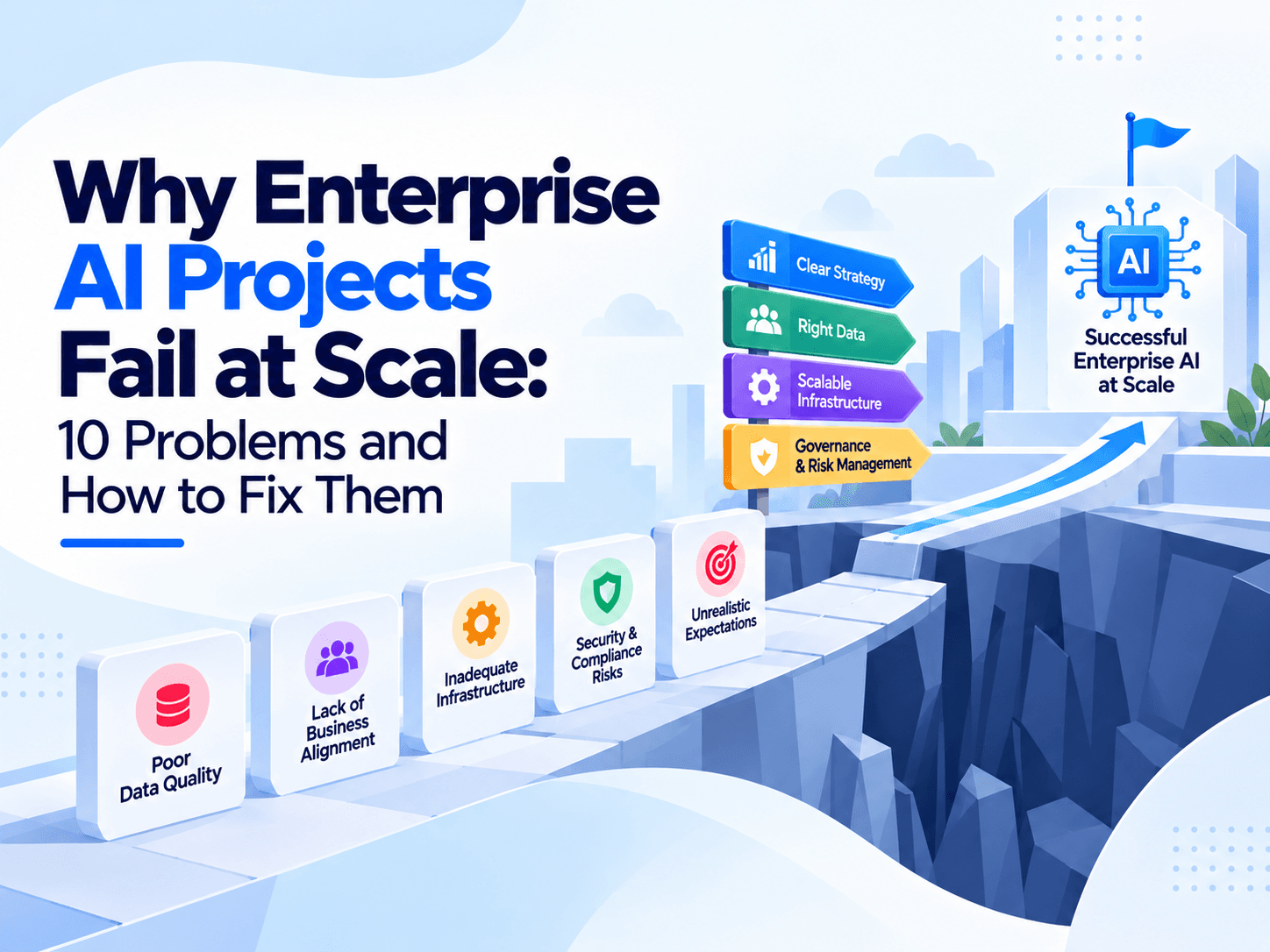
And yet, in that same window, Gartner is predicting that more than 40% of agentic AI projects will be canceled by the end of 2027 not because the underlying models don't work, but because of escalating costs, unclear business value, and inadequate risk controls. Gartner analyst Anushree Verma put it bluntly: most agentic AI projects today are early-stage experiments driven by hype, which blinds organizations to the real cost and complexity of running AI agents at scale.
That's not a verdict on AI as a technology. It's a readiness problem and it's showing up in the data everywhere you look. Budgets are running hot. Expensive infrastructure is sitting idle. And the projects that skip the fundamentals are the ones most likely to get pulled before they ever prove their worth.
Here's what actually separates the enterprises getting durable value from AI in 2026 from the ones quietly writing off pilots.
What "AI-Ready" Actually Means
Being AI-ready has very little to do with which model an organization has access to. GPT-5-class models, Gemini, and Claude are all available to essentially every enterprise on the planet today. What separates the winners isn't model access it's whether the organization around that model can use it reliably, affordably, and safely at scale.
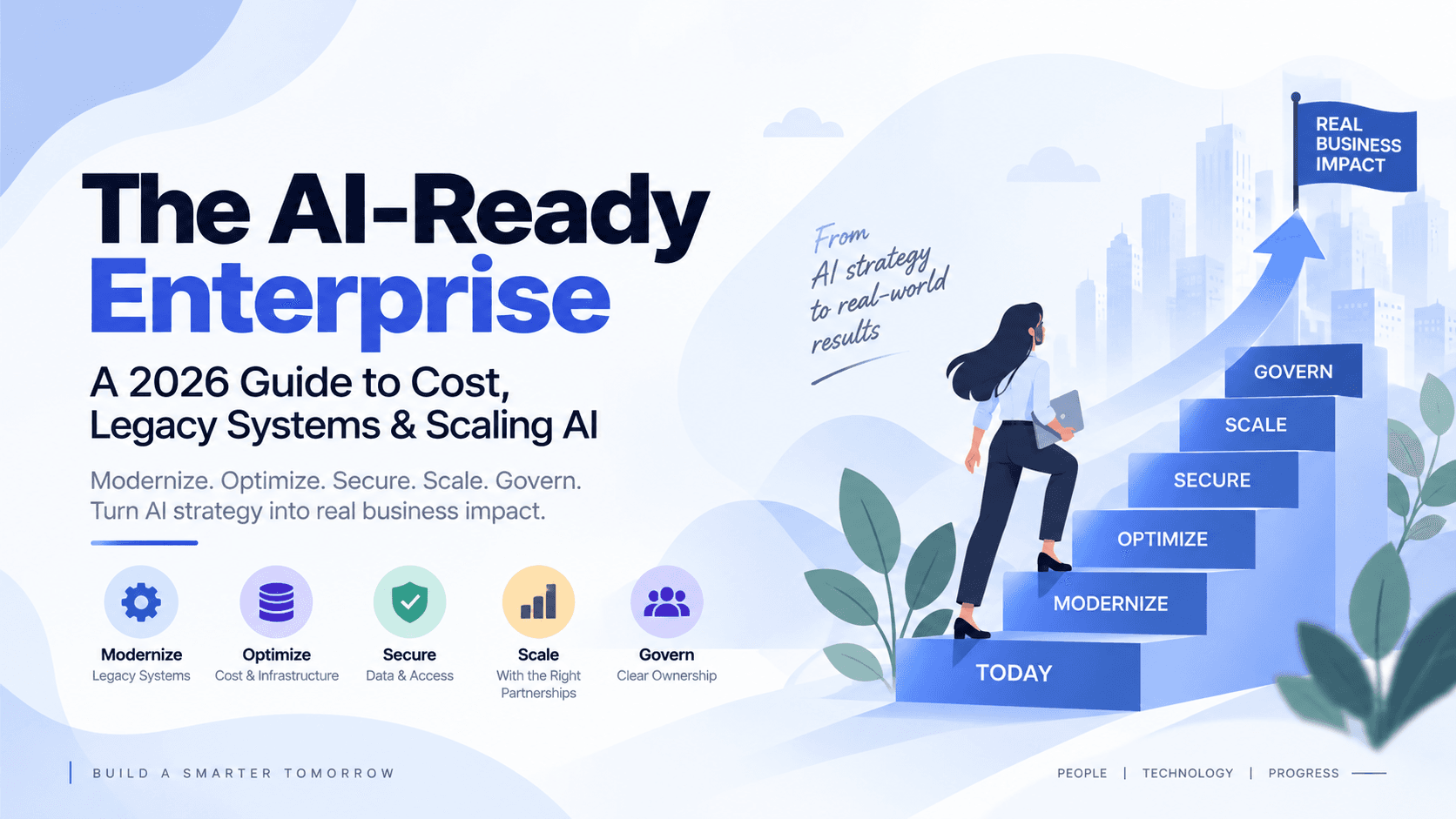
In practice, AI-readiness comes down to five things working together, and this framework runs through everything that follows:
- Modernize — legacy systems connected and gradually upgraded, not replaced wholesale
- Optimize — cloud, compute, and AI usage cost treated as an ongoing discipline, not a one-time cleanup
- Secure — data and access controls built into the architecture from day one
- Scale — capacity extended through the right mix of internal ownership and specialized partners, not headcount alone
- Govern — clear ownership, monitoring, and human oversight established before anything scales past pilot
Miss any one of these, and the other four don't save you. A technically brilliant model sitting on top of an ungoverned legacy data estate is still a liability. A well-governed pilot nobody can afford to run in production is still a write-off waiting to happen.
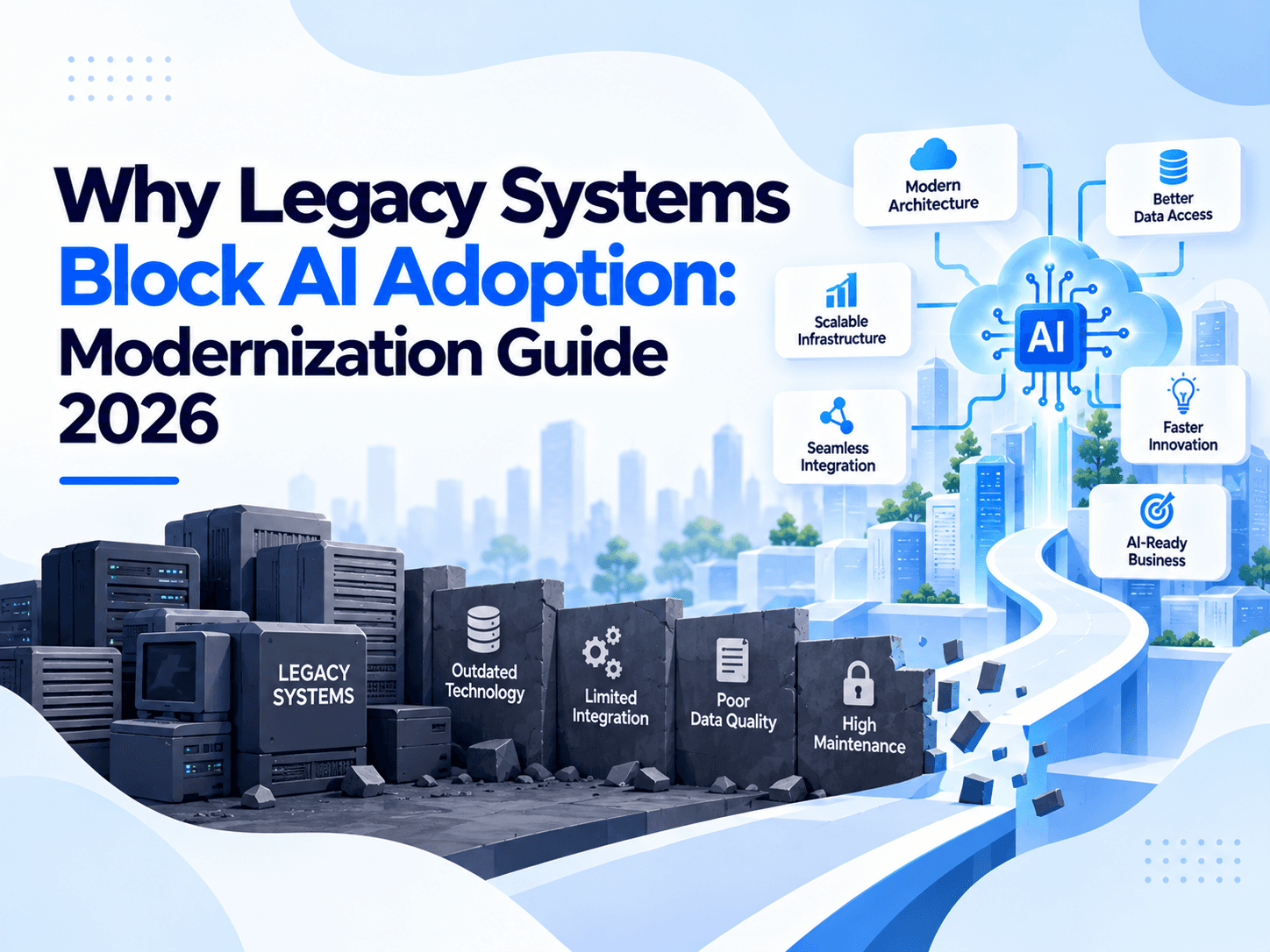
1. Modernize Legacy Systems Incrementally
The instinct when introducing AI into an old technology estate is to treat it as an excuse for a full rebuild. Resist that instinct.
Full legacy replacements are slow, expensive, and carry a failure rate that dwarfs the risk of the AI project itself. RAND Corporation's 2024 study, based on interviews with 65 experienced data scientists and engineers, found that by some estimates more than 80% of AI projects fail to reach meaningful production roughly twice the failure rate of comparable non-AI technology projects. Legacy integration is one of the most frequently cited reasons agentic projects specifically stall before ever reaching production.
The approach that actually works is incremental, not wholesale:
- Document and extract the business logic buried in legacy systems before touching the infrastructure underneath it. Decades of decision rules, pricing logic, and edge-case handling live in old code that nobody fully remembers writing losing it in a rushed migration is how "modernization" quietly breaks things that used to work.
- Wrap existing applications in APIs so AI tools can read and write data without a rip-and-replace project. This lets you connect a legacy claims system or an old ERP to a modern AI layer in weeks instead of years.
- Move specific, well-understood workloads to modern infrastructure rather than migrating everything simultaneously. Pick the workload with the clearest business case and the least organizational risk first.
- Use AI-assisted code analysis to accelerate the parts of modernization that used to require months of manual code archaeology understanding what a 15-year-old codebase actually does before anyone tries to change it.
- Run new AI-native capabilities alongside legacy systems, migrating in controlled stages as confidence builds, rather than betting the business on a single cutover date.
This matters because most legacy systems were never built to expose clean, structured data to anything let alone a model that needs reliable inputs to produce reliable outputs. Trying to bolt AI directly onto an unmodernized core system is usually where a promising two-week pilot quietly turns into a six-month integration project nobody budgeted for. The goal isn't "replace everything." It's making the existing technology estate capable of supporting the next generation of applications without risking the business that runs on it today.
2. Treat AI Cost Like Cloud Cost Because It Increasingly Is
Traditional cloud cost management focused on oversized instances, idle servers, and storage sprawl. That waste hasn't gone away Flexera's 2026 State of the Cloud Report, based on a survey of 753 global cloud decision-makers, found that estimated wasted cloud spend climbed to 29% of total IaaS and PaaS spend this year the first increase in five years after a steady decline. Flexera attributes the reversal largely to AI adoption outpacing the tagging, attribution, and governance practices that FinOps teams had spent years building for more predictable workloads like virtual machines and storage.
AI has added a second, harder layer on top of that baseline cloud waste: model inference, token consumption, GPU hours, vector database costs, and the least predictable of all agentic workflows, where a single business task can trigger multiple model calls, tool invocations, and retries before it ever produces a usable result.
The numbers on the ground show exactly how expensive that unpredictability gets. A review of 127 enterprise agentic AI implementations found that 73% went over budget, some by more than 2.4 times their original estimate burning through millions of dollars on costs nobody had modeled in advance. Meanwhile, the infrastructure sitting underneath all of this is running astonishingly underused: Cast AI's 2026 State of Kubernetes Optimization Report, drawn from direct telemetry across tens of thousands of production clusters (not a survey), found that average GPU utilization sat at just 5% meaning roughly 95% of provisioned, paid-for GPU capacity is doing nothing at any given moment.
Put those two numbers together and the picture is stark: enterprises are simultaneously overspending on unpredictable agentic workflows and underusing the expensive infrastructure they've already committed to. That combination is exactly the kind of invoice-driven surprise that gets AI projects pulled at renewal time.
Enterprises getting this under control are doing a consistent set of things:
- Tracking AI and cloud usage by business outcome, not just by infrastructure line item the question isn't "what does the GPU cost," it's "what does it cost to produce one successful claim resolution, one qualified lead, one resolved support ticket."
- Matching model size to task complexity using smaller, cheaper models for routine classification or extraction tasks, and reserving frontier models for the genuinely hard problems that need them.
- Implementing caching so repeated or similar queries don't trigger a full model call every time.
- Setting hard usage limits and cost alerts specifically on agentic workflows, since they're the least predictable cost center by a wide margin.
- Reviewing GPU and compute utilization on a recurring schedule, not just at initial provisioning utilization degrades over time as workloads shift, and static rightsizing done once at deployment stops reflecting reality within months.
AI cost management in 2026 isn't a finance function bolted onto engineering after the fact. It's becoming its own discipline, sitting between FinOps and application architecture and the organizations still treating it as a one-time cleanup project rather than an ongoing operating system are the ones most likely to show up in next year's "over budget" statistics.
3. Scale AI Without Building a Parallel Engineering Org
One of the most persistent myths in enterprise AI adoption is that an organization needs a large internal team of data scientists, ML engineers, and AI specialists in place before it can do anything meaningful with the technology. For most organizations, that isn't true and trying to build that team from scratch before shipping a single production use case is one of the slower, more expensive paths into an AI program.
A more effective model combines three things:
- Internal teams who understand the business problem, own the outcome, and make the final call on priorities and risk tolerance
- Specialized technology partners who bring deployment experience across data engineering, cloud architecture, legacy integration, and AI implementation the parts of the work that have already been solved dozens of times elsewhere
- Managed services that handle the ongoing operational load monitoring, tuning, security patching, incident response that doesn't need reinventing in-house every time a new use case comes online
This isn't an argument against investing in people. It's an argument against building large, permanent headcount to solve what is often a well-understood integration problem, especially while the specific use case and its ROI model are still being validated. Once a use case proves out and scales into a genuinely core, ongoing capability, that's the point to consider building deeper internal expertise around it not before.
4. Build Security Into the Architecture, Not After Launch
AI systems move sensitive business data through prompts, third-party model APIs, vector stores, and agent tool calls in ways that traditional enterprise software simply never did. A chain of agent actions can pull customer data, financial figures, or proprietary business logic through several systems in the course of completing a single task and if that chain isn't designed with security in mind from the start, it's very difficult to retrofit safely later.
Treating security as something added after a pilot succeeds is one of the fastest ways to turn a promising proof of concept into an incident report. The controls that matter most in an AI-specific context include:
- Data classification before information ever reaches a model or an autonomous agent
- Scoped access management giving each AI system exactly the permissions it needs for its task, not blanket access to whatever data happens to be convenient
- Prompt and input protection against injection attempts and other manipulation of model behavior
- Detection for sensitive data leakage in model inputs or outputs
- Audit logging detailed enough to reconstruct exactly what an agent did, when, and why, after the fact
- Human approval gates on any AI-driven decision with real business, financial, or customer impact
None of this is exotic or unfamiliar. It's the same security discipline enterprises already apply to every other category of system that touches sensitive data it just has to be deliberately extended to cover a new category of system that behaves less predictably, and often more autonomously, than the software it's replacing.
5. Design Around the Business Workflow Then Assign an Owner
The AI projects that deliver real, lasting value almost always start from a business problem, not a technology capability. "Let's build an AI chatbot" is a much weaker starting point than "which support processes are consuming the most staff time, and where could AI cut resolution time without hurting the quality of service." The second framing forces a team to define what success actually looks like before a single dollar is spent which is precisely the discipline Gartner points to when explaining why so many agentic AI projects stall: unclear business value, discovered only after the money is already gone.
This outcome-first framing becomes even more important as organizations move from isolated pilots into genuine production deployments, because production is exactly where vague success criteria quietly turn into unmanageable scope and runaway cost.
But defining the right problem is only half the equation. Before any AI initiative scales past pilot stage, someone in the organization needs to be able to answer a short, specific list of questions without hesitation: Who owns this application once it's live? Who approves the next new use case that wants to reuse this infrastructure? Who is actively watching cost and performance on an ongoing basis, not just at launch? Who handles a security incident if one occurs? And where, specifically, does a human still have to approve the outcome before it reaches a customer or a financial system?
These aren't compliance checkboxes to satisfy an audit. They're the actual difference between an AI program that scales in a controlled, defensible way and one that shows up eighteen months from now as another line in someone else's industry report on canceled agentic AI projects.
Where to Start
If you're mapping this out for the first time inside your own organization, resist the urge to tackle all five areas modernize, optimize, secure, scale, govern simultaneously. That's how AI programs turn into year-long transformation initiatives that never ship anything.
Instead: pick one high-value, well-understood business workflow. Assess the data and systems that actually support it today. Estimate the real infrastructure cost of automating it not just the model license fee, but the integration work, the ongoing compute, and the monitoring overhead. Build in security and clear ownership from day one, not as an afterthought once the pilot works. Prove real, measurable value there before expanding to the next workflow.
The enterprises consistently avoiding the cancellation statistics aren't the ones with the biggest AI budgets or the most advanced models. They're almost always the ones that started narrow, instrumented everything from the beginning, and only scaled what had already proven its value in production.
Conclusion
AI readiness in 2026 isn't a single purchase, a single vendor, or a single model choice. It's five layers working together and skipping any one of them lets the others compensate for a while, right up until they don't.
At Zyora Global, we help enterprises build exactly this kind of foundation from legacy modernization and cloud cost engineering to scoped, production-ready AI implementation so that AI investment turns into lasting business value instead of next year's canceled pilot. If you're mapping out where AI fits into your own technology roadmap, we're glad to walk through what a properly scoped first project would look like for your environment.
Frequently Asked Questions
An AI-ready enterprise has the technology, security, cost controls, and governance needed to scale AI effectively.
By using APIs, modernizing selected workloads, analyzing legacy code, and migrating systems gradually.
By optimizing models, tracking usage, using caching, setting cost limits, and monitoring infrastructure.
They can combine internal teams with specialized AI technology partners and managed services.
The five pillars are Modernize, Optimize, Secure, Scale, and Govern.
12 min read

Dhruv Patel
Dhruv Patel is the CEO of Zyora Global, bringing a strong technology background and a passion for building scalable digital solutions. With expertise in software development, product strategy, and business growth, he leads the company in delivering innovative web, mobile, AI, and enterprise solutions that help businesses accelerate their digital transformation.