


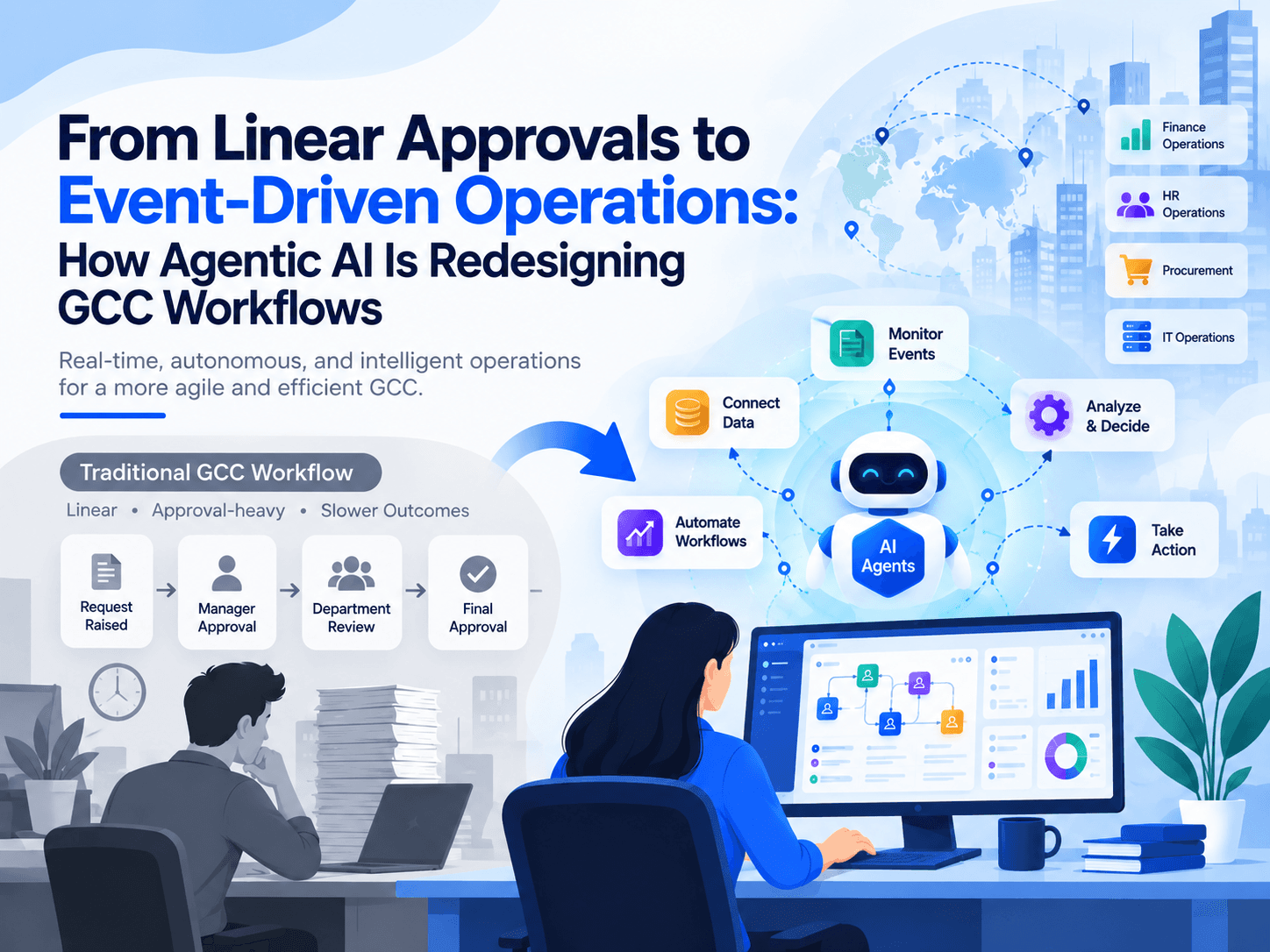
Quick Summary :- Agentic AI is transforming GCC workflows from traditional linear approvals to event-driven operations. Instead of relying on manual handoffs, AI agents can monitor business events, understand context, coordinate enterprise systems, automate routine actions, and escalate exceptions to human teams. This approach helps GCCs improve workflow efficiency, reduce manual effort, and enable employees to focus on higher-value decisions while maintaining appropriate governance and human oversight.
Global Capability Centers (GCCs) have traditionally been built around structured processes, predefined approvals, human handoffs, and standardized service delivery. A request enters a system, moves from one team to another, waits for an approval, and then proceeds to the next stage.
That model worked when most enterprise work was predictable.
But modern enterprises generate continuous streams of data, alerts, transactions, customer requests, compliance events, and operational changes. Waiting for a person to notice an event, open a system, perform a task, and forward it to another team can introduce unnecessary delays.
This is where Agentic AI is changing the GCC operating model.
Instead of simply automating an individual task, AI agents can observe business events, interpret context, plan multiple steps, interact with enterprise systems, execute permitted actions, and escalate exceptions to humans.
According to EY's 2025 GCC Pulse Survey, 58% of India-based GCCs were already investing in Agentic AI, while another 29% planned to invest within one year. The same survey reported that 83% were investing in GenAI.
The important question for GCC leaders is therefore no longer simply:
"Where can we add AI?"
It is:
"Which workflows should be redesigned around autonomous, event-driven execution?"
What Is Changing in GCC Workflows?
Traditional enterprise workflows are usually linear.
A request follows a predetermined path:
Request → Review → Approval → Execution → Verification → Closure
Every step may depend on a person completing the previous step.
Agentic workflows work differently.
They can respond to events as they happen:
Event → Agent detects context → Agent plans action → Systems are updated → Exception escalated → Workflow continues
This does not mean removing people from the process.
Instead, it changes where people participate.
Humans increasingly focus on:
- Exceptions
- Complex decisions
- Risk management
- Policy interpretation
- Strategic judgment
- Approvals above predefined thresholds
Agents can handle:
- Monitoring
- Classification
- Data retrieval
- Cross-system coordination
- Reconciliation
- Routine decisions within guardrails
- Status updates
- Workflow routing
EY's 2026 analysis describes this shift directly: agentic systems can perceive context, plan multi-step actions, invoke tools and APIs, coordinate across platforms, and operate in event-driven environments where agents execute work and escalate exceptions requiring human judgment.
Linear Workflows vs Event-Driven Operations
The difference becomes clearer when we compare the two operating models.
Area | Linear Workflow | Event-Driven Agentic Workflow |
Trigger | Human request or scheduled activity | Business event or real-time signal |
Execution | Predefined sequence | Dynamic planning |
System interaction | Human moves between systems | Agent interacts with approved systems |
Decision-making | Human at multiple stages | Agent within defined boundaries |
Exceptions | Often handled manually | Automatically identified and escalated |
Approvals | Required at predefined stages | Required based on risk/threshold |
Monitoring | Periodic | Continuous |
Human role | Execution + approval | Judgment + exception management |
Scalability | Limited by human capacity | Increased through agent-augmented capacity |
Operating model | Process-centric | Event- and outcome-centric |
This distinction is becoming particularly relevant for GCCs because they operate across multiple functions and enterprise systems.
Why GCCs Are Moving Toward Event-Driven Operations
GCCs have a structural advantage when it comes to implementing agentic workflows.
They often combine:
- Enterprise process knowledge
- Technology teams
- Data capabilities
- Cross-functional operations
- Shared services
- Governance functions
- Access to global systems
That combination gives GCCs visibility across multiple stages of an enterprise process.
EY describes GCCs as being well positioned for this transition because they combine enterprise data, process expertise, engineering scale, and governance maturity.
The adoption numbers also show that this is moving beyond experimentation.
What Is an Event-Driven GCC Workflow?
An event-driven workflow starts with a business event, rather than a person manually initiating the next step.
An event could be:
- An invoice exceeding a threshold
- A customer submitting a complaint
- An employee joining the company
- A security alert being generated
- A payment failing
- Inventory falling below a threshold
- A contract approaching expiration
- A production system generating an incident
- A regulatory requirement changing
Once an event occurs, an agent can determine what should happen next.
For example:
Invoice received
↓
Agent extracts invoice information
↓
Agent checks purchase order
↓
Agent compares invoice and goods receipt
↓
Agent identifies mismatch
↓
Agent checks company policy
↓
If within tolerance → route for automated processing
↓
If outside threshold → escalate to finance
This is fundamentally different from asking an employee to manually move the invoice through multiple systems.
How Agentic AI Redesigns the Workflow
Agentic AI does not necessarily replace the entire process.
Instead, it can redesign the process around five capabilities.
1. Sense
The agent continuously receives signals from enterprise systems.
These may come from:
- ERP systems
- CRM platforms
- HR systems
- IT monitoring tools
- Databases
- APIs
- Workflow platforms
- Business applications
The agent identifies whether an event requires action.
2. Understand
An event alone is not enough.
The agent needs context.
For example:
An invoice of ₹8 lakh may look unusual.
But the agent can check:
- Supplier history
- Purchase order
- Contract terms
- Previous invoices
- Approval thresholds
- Payment history
- Fraud indicators
This contextual understanding allows the workflow to become more intelligent than simple rule-based automation.
3. Plan
Once the agent understands the situation, it can determine the sequence of actions.
For example:
Detect mismatch → retrieve purchase order → compare records → contact system → calculate variance → classify exception → route to appropriate reviewer
This is where Agentic AI differs from traditional RPA.
RPA generally follows predefined instructions.
Agentic AI can determine the next permitted action based on context and objectives.
4. Act
Agents can interact with approved enterprise tools.
Depending on the governance model, they may:
- Create tickets
- Update records
- Generate documents
- Send notifications
- Request additional information
- Reconcile records
- Trigger workflows
- Update status
- Recommend decisions
The critical point is that action must remain within predefined permissions.
5. Escalate
Autonomy does not mean unlimited authority.
A mature agentic workflow should know when it cannot proceed.
For example:
"This transaction exceeds the approved threshold. Human approval required."
That creates a model where agents handle routine execution while humans handle exceptions and high-impact decisions.
EY's 2026 GCC analysis similarly describes the movement toward workflows where autonomous agents execute tasks and escalate exceptions requiring human judgment.
5 GCC Workflows That Can Become Event-Driven
1. Finance: Invoice Exception Management
Traditional finance operations often involve multiple manual checks.
An employee receives an invoice, checks the purchase order, verifies the goods receipt, identifies discrepancies, contacts the relevant team, and waits for approval.
An agentic workflow can continuously monitor invoices.
Event
Invoice received
Agent actions
- Extract invoice information
- Match purchase order
- Verify goods receipt
- Check supplier history
- Identify mismatch
- Apply approved business rules
- Route exceptions
Human intervention
Finance teams only need to review exceptions that exceed defined thresholds or involve unusual risk.
Potential KPI
- Exception resolution time
- Manual intervention rate
- Invoice processing time
- Exception accuracy
2. Human Resources: Employee Onboarding
Employee onboarding is another workflow that contains many handoffs.
A new employee may require:
- Document verification
- Identity validation
- HR record creation
- Policy acknowledgement
- Equipment requests
- Application access
- Training assignments
Instead of waiting for different teams to complete each stage manually, an agent can coordinate the workflow.
Event
Employee joins the organization
↓
Agent checks required documents
↓
Agent identifies missing information
↓
Agent triggers approved requests
↓
Agent coordinates IT access
↓
Agent monitors completion
↓
Agent escalates exceptions
The employee gets a more connected onboarding experience, while HR teams spend less time tracking individual tasks.
3. IT: Incident Management
IT operations are especially suitable for event-driven workflows because systems continuously generate signals.
An incident can begin with:
Monitoring alert → Agent investigates → Context gathered → Incident classified → Priority assigned → Recommended action → Human approval if required
For example, an agent can analyze:
- Error logs
- Recent deployments
- System health
- Historical incidents
- Monitoring alerts
- Service dependencies
It can then recommend the next action.
For high-risk production changes, the workflow can stop and request human approval.
This creates a balance between automation and operational control.
4. Customer Service: Intelligent Case Resolution
Customer service is another area where event-driven agents can reduce unnecessary handoffs.
Customer submits a request
↓
Agent identifies intent
↓
Agent retrieves account information
↓
Agent checks policy
↓
Agent determines whether the request falls within standard rules
↓
Agent resolves or drafts response
↓
Complex case → Human escalation
This can help service teams concentrate on unusual or sensitive cases rather than repeatedly handling predictable requests.
EY's 2025 GCC survey found GenAI adoption was particularly high in customer service, at 65%, followed by finance at 53%, operations at 49%, and IT/cybersecurity at 45%.
5. Supply Chain and Procurement
Supply chain operations generate continuous events.
For example:
- Inventory drops
- Supplier misses delivery
- Demand changes
- Purchase order changes
- Shipment gets delayed
- Product reaches a threshold
Instead of waiting for a person to review every event, an agent can monitor these signals.
Consider:
Supplier delay detected
→ Check shipment status
→ Review inventory
→ Identify affected orders
→ Check alternative suppliers
→ Calculate potential impact
→ Recommend action
→ Escalate if financial or contractual thresholds are exceeded
The workflow becomes responsive instead of reactive.
From Approval Chains to Exception Chains
One of the biggest changes in an agentic GCC is the role of approvals.
Traditional workflow design often looks like:
Everyone reviews → Everyone approves → Work proceeds
Agentic workflow design can instead become:
Agent executes within boundaries → Only exceptions require approval
This is a significant operating-model change.
The goal is not to eliminate governance.
The goal is to make governance risk-based.
Example
Action | Agent Can Execute? | Human Approval |
Update low-risk ticket | Yes | No |
Generate report | Yes | No |
Reconcile standard transaction | Yes | No |
Send routine customer response | Yes, within policy | No |
Approve large payment | No | Yes |
Modify production system | No | Yes |
Change employee compensation | No | Yes |
Override compliance policy | No | Yes |
This creates a human-on-the-loop operating model where people monitor and intervene rather than manually execute every routine step.
What Happens to GCC Employees?
Event-driven operations do not simply eliminate workflow steps.
They redistribute them.
People increasingly move from:
Execution → Monitoring → Exception handling → Judgment → Process improvement
This creates demand for new roles such as:
- AI Workflow Architect
- Agent Supervisor
- AI Product Owner
- AI Governance Lead
- Data Specialist
- Automation Strategist
- Agent Evaluation Specialist
EY's 2026 GCC research identifies emerging roles including AI workflow architects, agent supervisors, Responsible AI leads, and data-to-decision specialists as organizations move toward AI-first operating models.
At the same time, the transition requires reskilling. EY's 2025 GCC survey reported that 71% of GCCs had reskilling initiatives in 2025, reflecting the growing focus on future-ready capabilities.
The Architecture Behind an Event-Driven Agentic GCC
An event-driven agentic system typically requires multiple layers.
Layer | Purpose | Example |
Event Layer | Detect business events | Alerts, transactions, requests |
Data Layer | Provide context | Databases, data platforms |
Agent Layer | Reason and plan | AI agents |
Tool Layer | Execute actions | APIs, enterprise applications |
Orchestration Layer | Coordinate agents | Workflow/agent orchestration |
Governance Layer | Control actions | Permissions, policies |
Human Layer | Handle exceptions | Approvals and judgment |
Monitoring Layer | Track performance | Logs, evaluations, dashboards |
The architecture should not treat the AI agent as an isolated chatbot.
The agent needs access to context, enterprise tools, permissions, monitoring and governance.
EY's 2026 research specifically highlights hybrid stacks, API-first platforms, modular architecture, governance, and operating-model redesign as interconnected pillars of an AI-first GCC.
Why APIs and Enterprise Integration Matter
An intelligent agent is only useful if it can safely interact with the systems where work actually happens.
Those systems might include:
- SAP
- Salesforce
- ServiceNow
- Workday
- Oracle
- Microsoft platforms
- Internal applications
- Data warehouses
- Databases
This is why API-based integration becomes increasingly important.
An agent may decide:
"The customer request is eligible for a standard refund."
But the workflow is incomplete unless the agent can safely execute the permitted action in the appropriate enterprise system.
The architecture therefore becomes:
AI reasoning + enterprise context + tools + permissions + governance
rather than simply:
AI model → answer
Governance Becomes Part of the Workflow
As agents gain the ability to take actions, governance cannot remain a document sitting outside the workflow.
It needs to be embedded into the process.
A mature governance framework should define:
Decision Ownership
Who owns the agent?
Who owns the business process?
Who is accountable if the workflow fails?
Approval Thresholds
Which actions can happen automatically?
Which actions require approval?
Permissions
What systems can the agent access?
What data can it read?
What actions can it perform?
Auditability
Can the organization determine:
- What the agent saw?
- What it decided?
- Which tools it used?
- What action it took?
- Why it took that action?
- Where a human intervened?
Escalation
What happens when:
- Confidence is low?
- Data conflicts?
- Policies disagree?
- A threshold is exceeded?
- A new situation is detected?
These controls become especially important as enterprise adoption expands. A September 2026 EY survey of 202 senior AI executives found that 98% reported having formal AI governance policies, but 47% said their organizations had previously not followed their AI governance process for urgent deployments.
The same survey found that 26% of respondents whose organizations use Agentic AI said they could not detect unauthorized AI agents operating internally.
This highlights an important point:
Having an AI governance policy is not the same as enforcing governance inside autonomous workflows.
How GCCs Can Move From Linear to Event-Driven Operations
GCC leaders should not attempt to transform every process simultaneously.
A controlled approach is more practical.
Step 1: Identify High-Volume Workflows
Look for processes with:
- High transaction volumes
- Repetitive activities
- Clear inputs
- Structured data
- Measurable outcomes
- Frequent handoffs
Step 2: Map Every Event
Instead of documenting only the process steps, identify the events that trigger work.
For example:
Invoice received
Payment failed
Employee joined
Security alert generated
Customer complaint received
This helps identify where autonomous execution can begin.
Step 3: Separate Decisions From Actions
Not every action has the same risk.
Classify actions as:
Low Risk
Agent can execute automatically.
Medium Risk
Agent recommends; human confirms.
High Risk
Human must approve.
This becomes the foundation of the autonomy model.
Step 4: Connect the Required Systems
Identify:
- APIs
- Databases
- SaaS applications
- Internal applications
- Authentication systems
- Data sources
The objective is to give agents controlled access to the systems required to complete the workflow.
Step 5: Establish the Escalation Model
Every autonomous workflow should answer:
When does the agent stop?
For example:
If transaction value exceeds ₹10 lakh → human approval.
If confidence falls below defined threshold → human review.
If policy conflict is detected → compliance escalation.
If production impact is possible → IT approval.
Step 6: Measure Outcomes
Traditional GCC metrics such as:
- Cost per transaction
- Throughput
- SLA adherence
- Productivity
still matter.
But agentic operations introduce additional metrics.
KPI | What It Measures |
Automation Rate | Percentage of workflow handled without manual execution |
Exception Rate | Percentage requiring human intervention |
Decision Cycle Time | Time from event to decision |
Agent Success Rate | Percentage of workflows completed successfully |
Human Intervention Rate | Frequency of human involvement |
Escalation Accuracy | Whether the right cases reach humans |
MTTR | Time required to resolve incidents |
Cost per Workflow | Operating cost per completed workflow |
Rework Rate | Percentage requiring correction |
Policy Violation Rate | Actions outside defined boundaries |
The objective is not to maximize autonomy at any cost.
It is to optimize business outcomes while maintaining appropriate control.
A New GCC Operating Model
The transformation can ultimately be represented as a shift between two models.
Traditional GCC
People → Processes → Systems → Approvals → Outcome
Agentic GCC
Events → Agents → Systems → Decisions → Exceptions → Human Judgment → Outcome
The second model does not remove people.
It changes their position in the workflow.
People become increasingly responsible for:
- Setting objectives
- Designing workflows
- Defining guardrails
- Reviewing exceptions
- Managing risk
- Improving agents
- Making high-impact decisions
Agents become responsible for more of the routine execution.
This is consistent with EY's 2026 view that AI-first GCCs move human work toward judgment, oversight and accountability while agents operate as an execution layer.
The Future of GCC Workflows Is Not Fully Autonomous
The future is unlikely to be:
Humans disappear → Agents do everything.
A more practical model is:
Agents execute routine work → humans govern decisions → exceptions receive attention.
This distinction matters.
An autonomous workflow without appropriate controls can create new operational risks.
A workflow that requires humans to approve every action simply recreates the bottleneck it was supposed to remove.
The objective is therefore controlled autonomy.
Conclusion
Agentic AI is moving GCCs from linear, approval-heavy workflows toward event-driven operations. By connecting events, systems, and autonomous agents, GCCs can reduce manual handoffs while keeping humans involved in critical decisions and exceptions.
The real opportunity is not simply to automate existing tasks, but to redesign how work is triggered, executed, governed, and improved. As GCCs adopt this model, Agentic AI can become a foundation for faster, more scalable, and intelligent enterprise operations.
Frequently Asked Questions
Agentic AI enables GCCs to use autonomous AI agents to monitor events, coordinate workflows, execute approved tasks, and escalate complex decisions to humans.
It shifts GCC workflows from linear, approval-heavy processes to event-driven operations where agents can respond to business events and coordinate multiple steps automatically.
Event-driven operations can reduce manual handoffs, improve workflow speed, automate repetitive tasks, and allow employees to focus on exceptions and higher-value decisions.
Agentic AI can support finance, HR, IT, customer service, procurement, and supply chain workflows where processes involve repetitive tasks, multiple systems, and clearly defined business rules.
No. A well-designed agentic workflow keeps humans involved in high-risk decisions, exceptions, approvals, and situations that require business judgment.
16 min read

Dhruv Patel
Dhruv Patel is the CEO of Zyora Global, bringing a strong technology background and a passion for building scalable digital solutions. With expertise in software development, product strategy, and business growth, he leads the company in delivering innovative web, mobile, AI, and enterprise solutions that help businesses accelerate their digital transformation.