


Quick Summary :- Modern business web applications in 2026 are no longer just digital tools they are strategic assets that drive growth, efficiency, and customer satisfaction. To stay competitive, businesses need web apps that offer intuitive user experiences, mobile responsiveness, robust security, scalability, high performance, AI-powered automation, real-time communication, advanced analytics, and seamless third-party integrations. Features such as personalization, workflow automation, cloud accessibility, role based access control, and API-first architecture further enhance operational efficiency and support long-term business growth. By investing in a modern, scalable, and intelligent web application, organizations can streamline processes, improve decision making, and create exceptional user experiences while preparing for future digital transformation trends.
Introduction
In today's digital first business environment, a website alone is no longer enough to support growth, improve customer experiences, and streamline operations. Businesses across the United States are increasingly investing in web applications to automate processes, improve collaboration, and create seamless digital experiences for customers and employees alike.
According to industry research, organizations that invest in digital transformation initiatives are significantly more likely to improve operational efficiency, customer retention, and overall profitability. As customer expectations continue to evolve, businesses need solutions that are flexible, scalable, secure, and capable of supporting future growth.
This is where modern web applications come into play.
Whether you're a startup validating an idea, a growing business looking to automate workflows, or an enterprise seeking digital transformation, understanding the Top Features Every Modern Business Web App Should Have is essential for building a successful solution.
This guide explores the critical features that define high-performing web applications and explains how they can help businesses stay competitive in 2026 and beyond.
Why Businesses Need Modern Web Applications
The way businesses operate has changed dramatically over the last decade.
Customers expect instant access to services. Employees need tools that simplify workflows. Leadership teams require real-time visibility into business performance.
A well designed modern web application serves as a centralized platform that connects people, processes, and data.
Instead of relying on disconnected spreadsheets, outdated software, and manual workflows, businesses can leverage web applications to:
- Improve operational efficiency
- Enhance customer experiences
- Increase employee productivity
- Reduce manual tasks
- Generate actionable business insights
- Scale operations more effectively
Organizations that embrace digital transformation often outperform competitors because they can respond to market demands more quickly and efficiently.
Quick Comparison: Traditional Software vs Modern Business Web Applications
Feature | Traditional Software | Modern Business Web Application |
|---|---|---|
Accessibility | Device specific | Accessible from anywhere |
Updates | Manual installation | Automatic deployment |
Scalability | Limited | Highly scalable |
Collaboration | Restricted | Real-time collaboration |
Integration | Complex | API-driven integrations |
Cost Efficiency | Higher maintenance costs | Lower operational costs |
User Experience | Often outdated | Modern and intuitive |
Businesses looking for long-term growth increasingly prefer web based solutions because they provide greater flexibility and scalability.
1. User Friendly Interface: The Foundation of Business Web App Features
One of the most critical business web app features is a user friendly interface.
No matter how powerful your application may be, users will quickly abandon it if it is difficult to navigate.
Why User Experience Matters
Research consistently shows that users form opinions about digital products within seconds. A confusing interface creates frustration and reduces engagement.
A user friendly application should include:
- Clean visual design
- Logical navigation
- Easy onboarding
- Consistent layouts
- Clear calls-to-action
- Accessibility standards compliance
Business Impact
When users can easily complete tasks, businesses benefit through:
- Higher adoption rates
- Increased productivity
- Improved customer satisfaction
- Lower support costs
Real-World Example
Imagine an HR platform where employees can request leave, access documents, and manage benefits with just a few clicks. A simple interface dramatically improves the overall experience.
2. Mobile Responsiveness: A Must Have Modern Web Application Feature
More than half of web traffic now comes from mobile devices.
Business owners, executives, customers, and employees regularly access applications using smartphones and tablets.
A successful modern web application must deliver a seamless experience across every device.
Essential Mobile Features
- Responsive layouts
- Fast mobile performance
- Touch friendly navigation
- Device compatibility
- Optimized forms
Why It Matters
Mobile responsiveness directly impacts:
- User engagement
- Conversion rates
- Search engine visibility
- Customer satisfaction
Example
A field sales representative should be able to update CRM records directly from their smartphone while meeting clients.
Businesses that ignore mobile optimization risk losing valuable opportunities.
3. Security and Data Protection: Essential Business Web App Features
Security has become one of the most important considerations in modern software development.
Customers trust businesses with sensitive information, making security a critical component of every successful application.
Among the most important business web app features are robust security measures.
Core Security Features
- Multi-factor authentication
- SSL encryption
- Role-based permissions
- Secure API management
- Data encryption
- Automated backups
- Threat monitoring
Why Security Matters
A single data breach can damage customer trust, disrupt operations, and result in significant financial losses.
Statistics
Studies consistently show that cybersecurity incidents cost businesses millions of dollars annually, making proactive protection essential.
Business Benefit
Strong security builds trust while ensuring compliance with industry regulations and data privacy standards.
4. Scalability Through Custom Web Application Development
Businesses rarely remain the same size forever.
Growth brings more users, more transactions, and more operational complexity.
This is why custom web application development should prioritize scalability from day one.
What Is Scalability?
Scalability refers to an application's ability to handle increased demand without sacrificing performance.
Signs Your Application Needs Scalability
- Growing customer base
- Increased data storage needs
- More complex workflows
- Expansion into new markets
Benefits
- Reduced redevelopment costs
- Better user experiences
- Improved system reliability
- Long-term flexibility
Example
An eCommerce platform that handles 1,000 orders per month today may need to process 50,000 orders within a few years.
Scalable architecture makes this possible.
5. High Performance and Speed Optimization
Speed is no longer a luxury.
Users expect applications to load instantly and perform efficiently.
Slow applications create frustration and increase abandonment rates.
Key Performance Features
- Optimized code
- Database optimization
- Caching systems
- Content Delivery Networks (CDNs)
- Efficient API communication
Why Performance Matters
Research shows that even a one second delay can significantly impact conversion rates and customer satisfaction.
Business Benefits
- Increased engagement
- Higher conversions
- Better retention
- Improved productivity
For organizations managing large-scale enterprise web applications, performance optimization is particularly important.
6. Real-Time Notifications and Communication
Modern users expect instant updates.
Whether tracking orders, managing projects, or monitoring business operations, real-time information improves experiences.
Examples of Real-Time Features
- Push notifications
- Status updates
- Live chat
- Team alerts
- Activity feeds
Why Businesses Need Real-Time Functionality
Real-time communication reduces uncertainty and keeps users informed.
Example
A logistics company can notify customers about shipment updates in real time, improving transparency and customer satisfaction.
7. Seamless Third-Party Integrations
Today's businesses use multiple software platforms.
CRM systems, payment gateways, marketing tools, and analytics platforms all need to work together.
Professional web app development services ensure seamless integration between systems.
Common Integrations
- Salesforce
- HubSpot
- Stripe
- PayPal
- QuickBooks
- Google Analytics
- Microsoft Dynamics
Benefits
- Improved workflows
- Reduced manual work
- Better data accuracy
- Enhanced productivity
Businesses that connect their tools effectively gain significant operational advantages.
8. Advanced Search and Filtering Capabilities
As applications grow, users need efficient ways to locate information quickly.
Advanced search functionality has become a necessity rather than a convenience.
Essential Search Features
- Predictive search
- Smart filters
- Category sorting
- Auto-suggestions
- Saved searches
Business Impact
Improved search functionality helps users find information faster, reducing frustration and improving productivity.
Example
An eCommerce platform with thousands of products relies heavily on advanced filtering to improve customer experiences.
9. Analytics and Reporting Dashboards
Businesses cannot improve what they do not measure.
Analytics dashboards provide visibility into operations, customer behavior, and performance metrics.
Modern business application development focuses heavily on data driven decision making.
Dashboard Features
- KPI tracking
- Revenue monitoring
- User analytics
- Operational insights
- Real-time reporting
Why Analytics Matter
Businesses that leverage analytics are better equipped to identify opportunities and make informed decisions.
10. Personalization and User Customization
Consumers increasingly expect personalized experiences.
Applications that adapt to individual preferences tend to achieve higher engagement and retention rates.
Personalization Features
- Customized dashboards
- Saved preferences
- Personalized recommendations
- User-specific content
- Adaptive workflows
Business Benefits
- Improved engagement
- Increased loyalty
- Better customer satisfaction
Personalization helps businesses create stronger relationships with users.
11. Artificial Intelligence and Machine Learning
Artificial intelligence is transforming how businesses operate.
Organizations are increasingly integrating AI capabilities into enterprise web applications to improve efficiency and customer experiences.
AI-Powered Features
- Intelligent chatbots
- Predictive analytics
- Recommendation engines
- Automated workflows
- Natural language processing
Business Impact
AI reduces manual work while enabling smarter decision making.
Example
An AI-powered customer support chatbot can handle thousands of inquiries without increasing staffing costs.
12. Workflow Automation
One of the biggest goals of digital transformation is eliminating repetitive manual tasks.
Modern business application development increasingly focuses on workflow automation.
Common Automation Features
- Approval workflows
- Task assignments
- Automated notifications
- Report generation
- Customer onboarding
Benefits
- Increased productivity
- Reduced human error
- Faster operations
- Lower costs
Automation allows employees to focus on strategic work rather than routine administrative tasks.
13. Cloud Based Accessibility
Remote work has become a permanent part of business operations.
Cloud native applications allow users to access information securely from anywhere.
Advantages
- Remote access
- Better collaboration
- Reduced infrastructure costs
- Improved scalability
- Easier maintenance
Cloud accessibility provides flexibility while supporting modern work environments.
14. Role Based Access Control
Not every user should have access to every feature or piece of information.
Role based permissions improve security while simplifying user experiences.
Examples
- Administrator access
- Manager level permissions
- Employee restrictions
- Customer access controls
Benefits
- Enhanced security
- Better compliance
- Reduced risk
This feature is especially important for organizations handling sensitive business data.
15. API-First Architecture
API-first development enables applications to communicate seamlessly with other platforms and services.
Benefits
- Easier integrations
- Greater flexibility
- Improved scalability
- Faster development cycles
Businesses investing in custom web application development often prioritize API-first architectures because they support future growth and innovation.
Key Takeaway
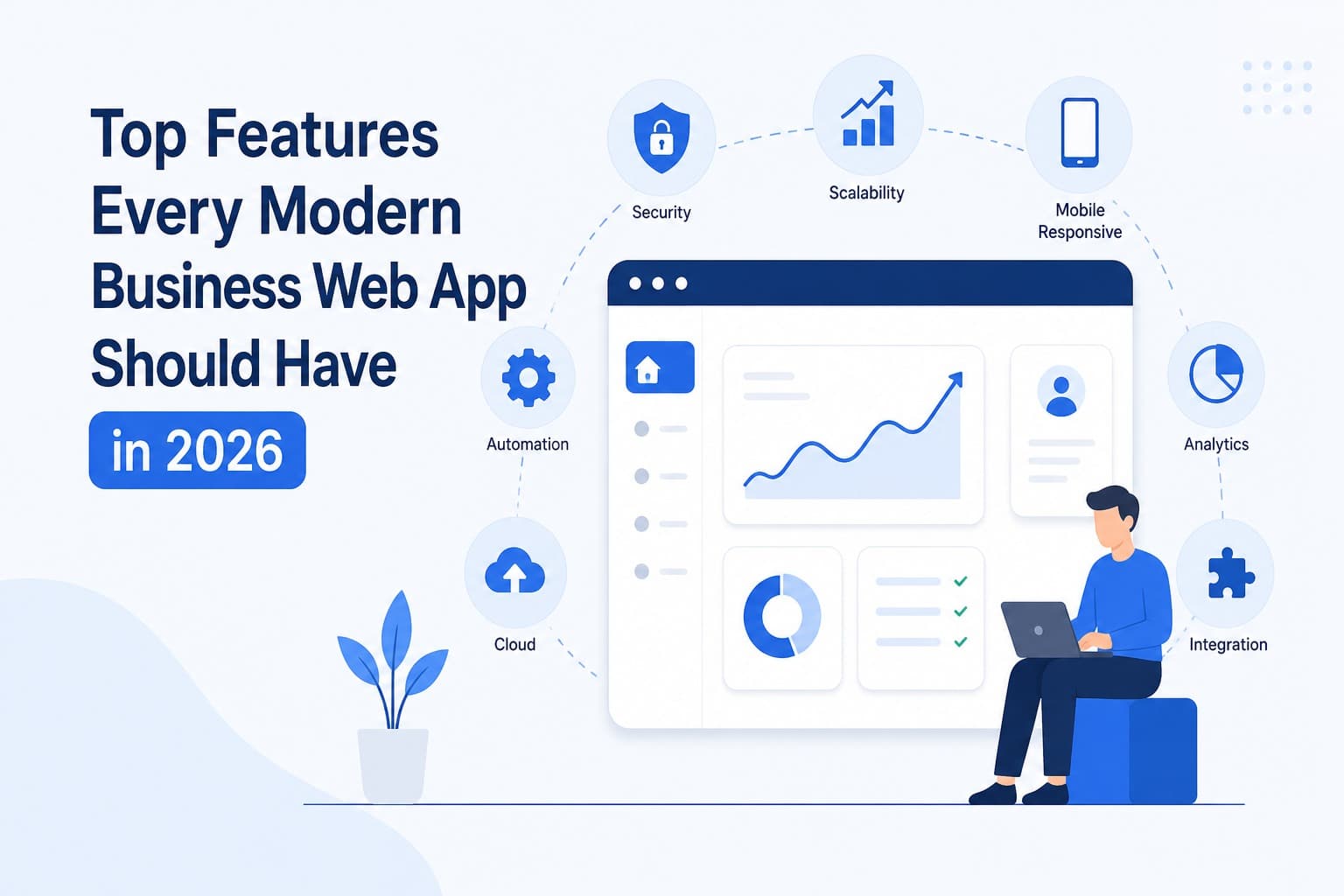
The Top Features Every Modern Business Web App Should Have go beyond design and functionality. Businesses need solutions that are secure, scalable, intelligent, and capable of supporting future growth.
The most successful applications combine:
- User-friendly design
- Mobile responsiveness
- Security
- Scalability
- Performance
- Automation
- AI capabilities
- Analytics
- Integrations
- Personalization
These features help organizations improve customer experiences, increase efficiency, and remain competitive in an increasingly digital marketplace.
Why Choosing the Right Development Partner Matters
Even the best features will fail if they are not implemented correctly. The success of a web application depends heavily on the expertise, architecture decisions, and long-term scalability planning of the development team behind it.
This is why choosing the right technology partner is critical for businesses investing in web app development services.
A strong development partner helps businesses with:
- Strategic planning before development
- Choosing the right tech stack
- Building scalable architecture
- Ensuring security compliance
- Delivering high-performance applications
- Providing long-term maintenance and support
Businesses that rush into development without proper planning often end up rebuilding their systems later, which increases cost and delays growth.
When Does Your Business Need a Modern Web Application?
Many businesses delay investing in digital solutions because their existing systems “still work.” However, inefficiencies grow silently over time.
You likely need a web application if:
- Your team relies on spreadsheets to manage operations
- Manual processes are slowing down productivity
- Customers are demanding self-service options
- You struggle to integrate multiple tools
- Reporting and analytics are time consuming
- Scaling operations has become difficult
If these challenges sound familiar, investing in custom web application development can significantly improve efficiency and unlock new growth opportunities.
Cost of Building a Modern Business Web Application (USA Market)
Understanding cost is one of the biggest concerns for businesses evaluating digital transformation.
The cost of a web application depends on complexity, features, integrations, and scalability requirements.
Type of Application | Estimated Cost (USA) |
|---|---|
MVP Development | $10,000 – $30,000 |
Mid-Level Business App | $30,000 – $80,000 |
Enterprise Web Application | $80,000 – $250,000+ |
Factors that influence cost:
- Number of features
- UI/UX complexity
- Third party integrations
- Security requirements
- Scalability architecture
- AI or automation capabilities
Businesses often start with MVP development to validate their idea before investing in full-scale systems.
Future Trends in Modern Web Applications (2026 and Beyond)
Technology is evolving rapidly, and modern businesses must prepare for future trends to stay competitive.
1. AI-First Web Applications
AI is no longer optional. Future applications will rely heavily on automation, predictive insights, and intelligent workflows.
2. Progressive Web Apps (PWA)
PWAs combine mobile app experiences with web accessibility, improving speed and engagement.
3. Hyper-Personalization
Applications will increasingly adapt in real time based on user behavior.
4. Voice and Conversational Interfaces
Voice search and AI assistants will become standard user interaction methods.
5. Zero Trust Security Models
Security will shift toward continuous authentication and strict access control policies.
Businesses adopting these innovations early will gain a significant competitive advantage.
Final Conclusion
The Top Features Every Modern Business Web App Should Have are not just technical enhancements — they are strategic business enablers.
A well designed web application helps businesses:
- Improve operational efficiency
- Deliver better customer experiences
- Increase revenue opportunities
- Reduce manual workload
- Scale without friction
- Compete in a digital first economy
In today’s competitive landscape, businesses that invest in modern, scalable, and intelligent web applications are the ones that will lead their industries in the coming years.
Whether you're a startup building your first product or an enterprise modernizing legacy systems, choosing the right features and the right development partner — is critical for success.
Frequently Asked Questions
The most important features include scalability, security, performance optimization, mobile responsiveness, analytics dashboards, AI integration, automation, and seamless third-party integrations.
Scalability ensures that your application can handle increased users, data, and transactions without performance issues or expensive redevelopment.
Development timelines vary based on complexity. A basic MVP may take 6–10 weeks, while enterprise-level applications can take 4–9 months or more.
MVP development focuses on building a basic version of the product with essential features to validate an idea, while full development includes complete functionality, scalability, and advanced features.
Look for experience, technical expertise, industry knowledge, strong portfolio, scalability capabilities, and the ability to provide long-term support and strategy guidance.
10 min read

Dhruv Patel
Dhruv Patel is the CEO of Zyora Global, bringing a strong technology background and a passion for building scalable digital solutions. With expertise in software development, product strategy, and business growth, he leads the company in delivering innovative web, mobile, AI, and enterprise solutions that help businesses accelerate their digital transformation.